Results by title
805 books match the query '18th Century' and 30 start with w
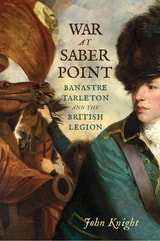
War at Saber Point
Banastre Tarleton and the British LegionJohn Knight
Westholme Publishing, 2023
The British Legion was one of the most remarkable regiments, not only of the American Revolution, but of any war. A corps made up of American Loyalists, it saw its first action in New York and then engaged in almost every battle in the Southern colonies. Led by a twenty-four-year-old libertine who purchased his commission to escape enormous gambling debts, the Legion gained notoriety for its ruthless tactics. Excelling in “special operations,” they frequently overwhelmed the Continental forces they fought, becoming the most feared British regiment of the war.
Banastre Tarleton and the Americans he led have always been characterized as brutal, immoral villains—most recently in the movie, The Patriot. But this study subverts our pre-conceived notions of patriotism. The men who filled the Legions ranks were not weak-willed collaborators or treacherous renegades, but free men as motivated by conscience as the Patriots they battled. Few were wealthy. None had a vested stake in the British Government. Each believed that in defending the Crown; they were upholding the rule of law and preserving individual liberty.
These men followed Banastre Tarleton clear across America for years, sacrificing not only their families and homes but, in many instances, their lives. Self-interest could not have persuaded them to do this. Patriotism and fidelity did. Relying on first-hand accounts—letters, diaries, and journals—War at Saber Point: Banastre Tarleton and the British Legion is the enthralling story of those forgotten Americans and the young Englishman who led them.
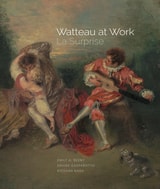
Watteau at Work
La SurpriseEmily A. Beeny
J. Paul Getty Trust, The, 2022
The painting La Surprise by Jean Antoine Watteau (1684–1721) belongs to a new genre of painting invented by the artist himself—the fête galante. These works, which show graceful open-air gatherings filled with scenes of courtship, music and dance, strolling lovers, and actors, do not so much tell a story as set a mood: one of playful, wistful, nostalgic reverie. Esteemed by collectors in Watteau’s day as a work that showed the artist at the height of his skill and success, La Surprise vanished from public view in 1848, not to reemerge for more than a century and a half. Acquired by the Getty Museum in 2017, it has never before been the subject of a dedicated publication. Marking the three hundredth anniversary of Watteau’s death, this book considers La Surprise within the context of the artist’s oeuvre and discusses the surprising history of collecting Watteau in Los Angeles.
This volume is published to accompany an exhibition on view at the J. Paul Getty Museum at the Getty Center from November 23, 2021, to February 20, 2022.
We Alone Will Rule
Native Andean Politics in the Age of InsurgencySinclair Thomson
University of Wisconsin Press, 2003
We Have Not a Government
The Articles of Confederation and the Road to the ConstitutionGeorge William Van Cleve
University of Chicago Press, 2017
In George William Van Cleve’s book, we encounter a sharply divided America. The Confederation faced massive war debts with virtually no authority to compel its members to pay them. It experienced punishing trade restrictions and strong resistance to American territorial expansion from powerful European governments. Bitter sectional divisions that deadlocked the Continental Congress arose from exploding western settlement. And a deep, long-lasting recession led to sharp controversies and social unrest across the country amid roiling debates over greatly increased taxes, debt relief, and paper money. Van Cleve shows how these remarkable stresses transformed the Confederation into a stalemate government and eventually led previously conflicting states, sections, and interest groups to advocate for a union powerful enough to govern a continental empire.
Touching on the stories of a wide-ranging cast of characters—including John Adams, Patrick Henry, Daniel Shays, George Washington, and Thayendanegea—Van Cleve makes clear that it was the Confederation’s failures that created a political crisis and led to the 1787 Constitution. Clearly argued and superbly written, We Have Not a Government is a must-read history of this crucial period in our nation’s early life.
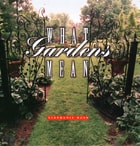
What Gardens Mean
Stephanie Ross
University of Chicago Press, 1998
In What Gardens Mean, Stephanie Ross draws on philosophy as well as the histories of art, gardens, culture, and ideas to explore the magical lure of gardens. Paying special attention to the amazing landscape gardens of eighteenth-century England, she situates gardening among the other fine arts, documenting the complex messages gardens can convey and tracing various connections between gardens and the art of painting.
What Gardens Mean offers a distinctive blend of historical and contemporary material, ranging from extensive accounts of famous eighteenth-century gardens to incisive connections with present-day philosophical debates. And while Ross examines aesthetic writings from the seventeenth and eighteenth centuries, including Joseph Addison's Spectator essays on the pleasures of imagination, the book's opening chapter surveys more recent theories about the nature and boundaries of art. She also considers gardens on their own terms, following changes in garden style, analyzing the phenomenal experience of viewing or strolling through a garden, and challenging the claim that the art of gardening is now a dead one.
Showing that an artistic lineage can be traced from gardens in the Age of Satire to current environmental installations, this book is a sophisticated account of the myriad pleasures that gardens offer and a testimony to their enduring sensory and cognitive appeal. Beautifully illustrated and elegantly written, What Gardens Mean will delight all those interested in the history of gardens and the aesthetic and philosophical issues that they invite.
"Replete with provocative musings, Ross delineates links that should prove interesting to readers engaged in pondering our capacity to relate to the natural world through the gardens we create."—Booklist
"[A]n innovative and absorbing study of the garden as an object of aesthetic interest."—Allen Carlson, Journal of Aesthetics and Art Criticism
"[P]leasantly readable. . . . A thought-provoking book for all who reflect as they dig."—Noel Kingsbury, Country Life
"[A] refreshing view of the subject. . . . Ross's book is continually illuminating in unexpected ways."—Gillian Darley, Architects' Journal
"What Gardens Mean is a wonderful intellectual combination of discussions on the interdisciplinary histories of art, gardening, and philosophy."—Choice
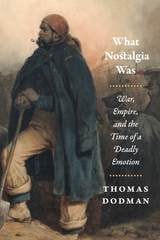
What Nostalgia Was
War, Empire, and the Time of a Deadly EmotionThomas Dodman
University of Chicago Press, 2017
What Nostalgia Was unearths that history. Thomas Dodman begins his story in Basel, where a nineteen-year-old medical student invented the new diagnosis, modeled on prevailing notions of melancholy. From there, Dodman traces its spread through the European republic of letters and into Napoleon's armies, as French soldiers far from home were diagnosed and treated for the disease. Nostalgia then gradually transformed from a medical term to a more expansive cultural concept, one that encompassed Romantic notions of the aesthetic pleasure of suffering. But the decisive shift toward its contemporary meaning occurred in the colonies, where Frenchmen worried about racial and cultural mixing came to view moderate homesickness as salutary. An afterword reflects on how the history of nostalgia can help us understand the transformations of the modern world, rounding out a surprising, fascinating tour through the history of a durable idea.
Who is Buried in Chaucer's Tomb?
Studies in the Reception of Chaucer's BookJoseph A. Dane
Michigan State University Press, 1998
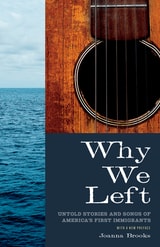
Why We Left
Untold Stories and Songs of America's First ImmigrantsJoanna Brooks
University of Minnesota Press, 2024
A grounded, tender, and mournful reckoning with the catastrophes that launched poor, white Anglos into their role as itinerant foot soldiers for modern imperialism—now in paperback with a new preface
Joanna Brooks’s ancestors were among the early waves of emigrants to leave England for North America. For generations, they lived hardscrabble lives, eking out subsistence in one place after another as they continually moved west in search of a better life. Why, Brooks wondered, did her people and countless other poor English subjects abandon their homeland for such unremitting hardship? The question leads her on a journey through an obscure dimension of American history.
Why We Left reveals the violence and dislocation that propelled seventeenth- and eighteenth-century working-class English emigration, presenting a powerful restorying of how we arrived at our present moment of precarity and rootlessness. Following American folk ballads back across the Atlantic to find histories of economic displacement, environmental destruction, and social betrayal at the heart of the early Anglo-American migrant experience, Brooks offers a scholarly and personal account of the intergenerational traumas that shape the history of white Anglos on Turtle Island.
She shares folk ballads such as “Edward,” which reveals the influence of deforestation on the dislocation of early Anglo-American peasant immigrants, and “The House Carpenter’s Wife,” which emphasizes the impact of economic instability and the colonial enterprise on women. From these ballads, tragic and heartrending, Brooks uncovers an archaeology of the worldviews of America’s earliest immigrants. This tenth-anniversary edition includes a new preface and develops a haunting historical perspective on the ancestors we thought we knew.
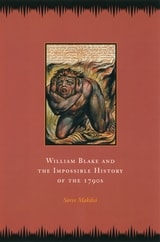
William Blake and the Impossible History of the 1790s
Saree Makdisi
University of Chicago Press, 2003

William Knox
The Life and Thought of an Eighteenth-Century ImperialistBy Leland J. Bellot
University of Texas Press, 1977
Colonial expert and pamphleteer William Knox has received attention in virtually every major study of the American Revolution, yet this is the first biography of Knox ever written.
Knox is best known as undersecretary of state in the American Department of the British government from 1770 to 1782. A prolific and candid commentator, he also made a reputation as a pamphleteer, defending the imperial cause during the decade preceding the Revolution. It had been his experience as provost marshal in Georgia from 1757 to 1762 that convinced Knox of the danger to the empire of the growing "democratic" forces in the American colonies.
While numerous historical works have focused on this or that aspect of Knox's career and thought, such treatment has produced at best a jigsaw portrait. Bellot's comprehensive narrative reveals Knox as a person—one whose Calvinist heritage and Scots-Irish upbringing profoundly influenced his view of empire—and as a historical actor and witness. Here is a look at the events of the revolutionary period through the eyes of a British bureaucrat who had a significant role in both the formation and the execution of British policy. This perspective also provides an excellent case study of the operation of the eighteenth-century British bureaucracy.
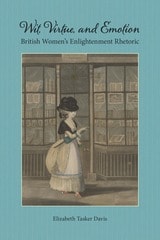
Wit, Virtue, and Emotion
British Women's Enlightenment RhetoricElizabeth Tasker Davis
Southern Illinois University Press, 2022
Women’s persuasion and performance in the Age of Enlightenment
Over a century before first-wave feminism, British women’s Enlightenment rhetoric prefigured nineteenth-century feminist arguments for gender equality, women’s civil rights, professional opportunities, and standardized education. Author Elizabeth Tasker Davis rereads accepted histories of seventeenth- and eighteenth-century British rhetoric, claiming a greater variety and power of women’s rhetoric. This recovery of British women’s performative and written roles as speakers, spectators, authors, and readers in diverse venues counters the traditional masculine model of European Enlightenment rhetoric. Davis broadens women’s Enlightenment rhetorics to include highly public venues such as theaters, clubs, salons, and debating societies, as well as the mediated sites of the periodical essay, the treatise on rhetorical theory, and women’s written proposals, plans, defenses and arguments for education. Through these sites, women’s rhetorical postures diverged from patriarchal prescriptions rather to deliver protofeminist persuasive performances of wit, virtue, and emotion.
Davis examines context, the effects of memory and gendering, and the cultural sites and media of women’s rhetoric to reveal a fuller ecology of British Enlightenment rhetoric. Each chapter covers a cultural site of women’s rhetorical practice—the court, the stage, the salon, and the printed page. Applying feminist rhetorical theory, Davis documents how women grasped their rhetorical ability in this historical moment and staged a large-scale transformation of British women from subalterns to a vocal counterpublic in British society.
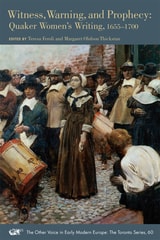
Witness, Warning, and Prophecy
Quaker Women's Writing, 1655-1700Edited by Teresa Feroli and Margaret Olofson Thickstun
Iter Press, 2018
The Other Voice in Early Modern Europe - The Toronto Series: Volume 60
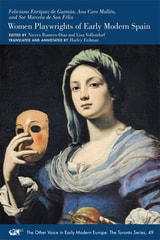
Women Playwrights of Early Modern Spain
Feliciana Enríquez de Guzmán, Ana Caro Mallén, and Sor Marcela de San Félix
Iter Press, 2016
This volume presents ten plays by three leading women playwrights of Spain’s Golden Age. Included are four bawdy and outrageous comic interludes; a full-length comedy involving sorcery, chivalry, and dramatic stage effects; and five short religious plays satirizing daily life in the convent. A critical introduction to the volume positions these women and their works in the world of seventeenth-century Spain.
Women Warriors in Romantic Drama
Wendy C. Nielsen
University of Delaware Press, 2013
Women Warriors in Romantic Drama examines a recurring figure that appears in French, British, and German drama between 1789 and 1830: the woman warrior. The term itself, “woman warrior,” refers to quasi-historical female soldiers or assassins. Women have long contributed to military campaigns as canteen women. Camp followers ranged from local citizenry to spouses and prostitutes, and on occasion, women assisted men in combat. However, the woman warrior is a romantic figure, meaning a fanciful ideal, despite the reality of women’s participation in select scenes of the French Revolution and the Napoleonic Wars. The central claim of this book is the woman warrior is a way for some women writers (Olympe de Gouges, Christine Westphalen, Karoline von Günderrode, and Mary Robinson) to explore the case for extending citizenship to women. This project focuses primarily on theater for the reason that the stage simulates the public world that female dramatists and their warriors seek to inhabit. Novels and poetry clearly belong to the realm of fiction, but when audiences see women fighting onstage, they confront concrete visions of impossible women. I examine dramas in the context of their performance and production histories in order to answer why so many serious dramas featuring women warriors fail to find applause, or fail to be staged at all. Dramas about women warriors seem to sometimes contribute to the argument for female citizenship when they take the form of tragedy, because the deaths of female protagonists in such plays often provoke consideration about women’s place in society.
Consequently, where we find women playing soldiers in various entertainment venues, farce and satire often seem to dominate, although this book points to some exceptions. Censorship and audience demand for comedies made producing tragedies difficult for female playwrights, who battled additional obstacles to fashioning their careers. I compare male (Edmund Eyre, Heinrich von Kleist) and female writers’ dramatizations of the woman warrior. This analysis shows that the difficult project of getting audiences to take women warriors seriously resembles women writers’ struggles to enter the ostensibly male domains of tragedy and the public sphere.
Published by University of Delaware Press. Distributed worldwide by Rutgers University Press.
Women Who Live Evil Lives
Gender, Religion, and the Politics of Power in Colonial GuatemalaBy Martha Few
University of Texas Press, 2002
Women Who Live Evil Lives documents the lives and practices of mixed-race, Black, Spanish, and Maya women sorcerers, spell-casters, magical healers, and midwives in the social relations of power in Santiago de Guatemala, the capital of colonial Central America. Men and women from all sectors of society consulted them to intervene in sexual and familial relations and disputes between neighbors and rival shop owners; to counter abusive colonial officials, employers, or husbands; and in cases of inexplicable illness.
Applying historical, anthropological, and gender studies analysis, Martha Few argues that women's local practices of magic, curing, and religion revealed opportunities for women's cultural authority and power in colonial Guatemala. Few draws on archival research conducted in Guatemala, Mexico, and Spain to shed new light on women's critical public roles in Santiago, the cultural and social connections between the capital city and the countryside, and the gender dynamics of power in the ethnic and cultural contestation of Spanish colonial rule in daily life.
Women and Men in Late Eighteenth-Century Egypt
By Afaf Lutfi al-Sayyid Marsot
University of Texas Press, 1995
In the late eighteenth century, decentralized and chaotic government in Egypt allowed women a freedom of action that has not been equaled until recent times. Delving extensively into archival sources, Afaf Marsot presents the first comprehensive picture of women's status and opportunities in this period.
Marsot makes important connections between forms of government, economic possibilities, and gender relations, showing how political instability allowed women to acquire property, independent of males, as a hedge against political uncertainty. She traces the linkages that women formed among themselves and with the ulama (non-Ottoman native elites) who aided and supported them. The book concludes with a comparison of women's status in the nineteenth century, when the introduction of European institutions that did not recognize their legal existence marginalized women, causing them to have to rely on men as major breadwinners. These important findings about the relationship between forms of government and the status of women will be of interest to a wide audience.
Women and Music in the Age of Austen
Linda Zionkowski
Bucknell University Press, 2024
Published by Bucknell University Press. Distributed worldwide by Rutgers University Press.
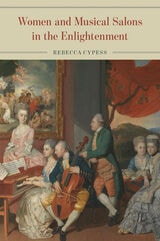
Women and Musical Salons in the Enlightenment
Rebecca Cypess
University of Chicago Press, 2022
In eighteenth-century Europe and America, musical salons—and the women who hosted and made music in them—played a crucial role in shaping their cultural environments. Musical salons served as a testing ground for new styles, genres, and aesthetic ideals, and they acted as a mediating force, bringing together professional musicians and their audiences of patrons, listeners, and performers. For the salonnière, the musical salon offered a space between the public and private spheres that allowed her to exercise cultural agency.
In this book, musicologist and historical keyboardist Rebecca Cypess offers a broad overview of musical salons between 1760 and 1800, placing the figure of the salonnière at its center. Cypess then presents a series of in-depth case studies that meet the salonnière on her own terms. Women such as Anne-Louise Brillon de Jouy in Paris, Marianna Martines in Vienna, Sara Levy in Berlin, Angelica Kauffman in Rome, and Elizabeth Graeme in Philadelphia come to life in multidimensional ways. Crucially, Cypess uses performance as a tool for research, and her interpretations draw on her experience with the instruments and performance practices used in eighteenth-century salons. In this accessible, interdisciplinary book, Cypess explores women’s agency and authorship, reason and sentiment, and the roles of performing, collecting, listening, and conversing in the formation of eighteenth-century musical life.
Women and Politics in the Age of the Democratic Revolution
Harriet B. Applewhite and Darline G. Levy, Editors
University of Michigan Press, 1993
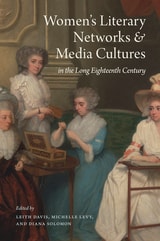
Women's Literary Networks and Media Cultures in the Long Eighteenth Century
Leith Davis
Bucknell University Press, 2027
This pathbreaking collection features original essays by leading scholars working at the intersections of women’s literary history, book history, and media cultures. Drawing on underexplored archives and innovative methodologies—from feminist bibliography to digital humanities—the contributors generate new narratives about the long eighteenth century and the centrality of gender to its literary production. Moving beyond a narrow focus on authorship, the chapters recover women as writers and readers, editors and curators, printers and book owners, scholars, preachers, and political actors. Across print, manuscript, and oral cultures, they illuminate the collaborative networks and material conditions shaping cultural production and circulation. Organized into sections on print histories, manuscript cultures, and new methodological approaches, this collection reshapes eighteenth-century studies while modeling ethically engaged archival research. Accessible and wide-ranging, it will appeal to scholars and students in literary studies, women’s and gender studies, and book history alike.
Published by Bucknell University Press. Distributed worldwide by Rutgers University Press.
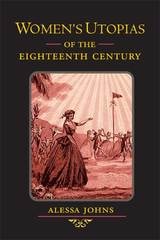
Women's Utopias of the Eighteenth Century
Alessa Johns
University of Illinois Press, 2003
The most studied utopias have been proposed by men, but during the eighteenth century a group of reform-oriented female novelists put forth a series of work that expressed their views of, and their reservations about, ideal societies. In Women's Utopias of the Eighteenth Century, Alessa Johns examines the utopian communities envisaged by Mary Astell, Sarah Fielding, Mary Hamilton, Sarah Scott, and other writers from Britain and continental Europe, uncovering the ways in which they resembled--and departed from--traditional utopias.
Johns demonstrates that while traditional visions tended to look back to absolutist models, women's utopias quickly incorporated emerging liberal ideas that allowed far more room for personal initiative and gave agency to groups that were not culturally dominant, such as the female writers themselves. Women's utopias, Johns argues, were reproductive in nature. They had the potential to reimagine and perpetuate themselves.

Women's Voices, Women's Lives
Documents in Early American HistoryUniversity Press of New England, 1998
Women's Wit on the Early Modern Stage
Beth Cortese
University of Delaware Press, 2027
Women's Wit on the Early Modern Stage explores the overlooked, gendered challenge posed by heroines and villainesses in comedies, tragedies, and tragicomedies through who displayed their wit through repartee, plotting, and disguise, combining verbal skill with physical action to produce a feminized perspective. The chapters showcase the portrayal of women’s wit in the works of Frances Boothby, Aphra Behn, Elizabeth Polwhele, Mary Pix, Catharine Trotter, Delarivier Manley, and Susanna Centlivre, in which female characters criticize authority and address female spectators in the theater, including them as part of an emerging critical discourse on the public stage. As the first-ever scholarly monograph about women’s wit in drama before the twentieth century, this book draws attention to the cultural and social role that wit played in the public sphere as a mode of critique, empowerment, and play for women both on and offstage.
Word Of God & The Languages Of Man
Interpreting Nature In Early Modern Science And Medicine Volume I, Ficino To DescartesJames J. Bono
University of Wisconsin Press, 1995
James J. Bono shows how the new interpretive principles and scientific practices of the sixteenth and seventeenth centuries evolved in response to new views of the relationship between the “Word of God” and the “Languages of Man” fostered by Renaissance Humanism, Neoplatonism, magic, and both the reformed and radical branches of Protestantism. He traces the cultural consequences of these ideas in the thought and work of major and minor actors in the scientific revolution—from Ficino and Paracelsus to Francis Bacon and Descartes. By considering these natural philosophers in light of their own intellectual, religious, philosophical, cultural, linguistic, and especially narrative frameworks, Bono suggests a new way of viewing the sociocultural dynamics of scientific change in the pre–modern period—and ultimately, a new way of understanding the nature and history of scientific thought. The narrative configuration he proposes provides a powerful alternative to the longstanding “revolutionary” metaphor of the history of the scientific revolution.
Workshop of Revolution
Plebeian Buenos Aires and the Atlantic World, 1776–1810Lyman L. Johnson
Duke University Press, 2011
Worm Work
Recasting RomanticismJanelle A. Schwartz
University of Minnesota Press, 2012
Worms. Natural history is riddled with them. Literature is crawling with them. From antiquity to today, the ubiquitous and multiform worm provokes an immediate discomfort and unconscious distancing: it remains us against them in anthropocentric anxiety. So there is always something muddled, or dirty, or even offensive when talking about worms. Rehabilitating the lowly worm into a powerful aesthetic trope, Janelle A. Schwartz proposes a new framework for understanding such a strangely animate nature. Worms, she declares, are the very matter with which the Romantics rethought the relationship between a material world in constant flux and the human mind working to understand it.
Worm Work studies the lesser-known natural historical records of Abraham Trembley and his contemporaries and the familiar works of Erasmus Darwin, Charles Darwin, William Blake, Mary Shelley, and John Keats, to expose the worm as an organism that is not only reviled as a taxonomic terror but revered as a sign of great order in nature as well as narrative. This book traces a pattern of cultural production, a vermiculture that is as transformative of matter as it is of mind. It distinguishes decay or division as positive processes in Romantic era writings, compounded by generation or renewal and used to represent the biocentric, complex structuring of organicism.
Offering the worm as an archetypal figure through which to recast the evolution of a literary order alongside questions of taxonomy from 1740 to 1820 and on, Schwartz unearths Romanticism as a rich humus of natural historical investigation and literary creation.
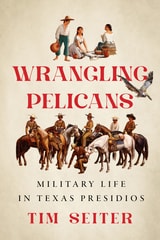
Wrangling Pelicans
Military Life in Texas PresidiosTim Seiter
University of Texas Press, 2025
2026 Excellence in Historic Preservation Award, Daughters of the American Revolution
2026 Summerlee Book Prize, Center for History and Culture of Southeast Texas and the Upper Gulf Coast
2026 Tejano Book Prize, Tejano Genealogy Society of Austin (TGSA)
A richly detailed history of daily life for colonial Spanish soldiers surviving on the eighteenth-century Texas Gulf Coast.
In 1775, Spanish King Carlos III ordered the capture of American pelicans for his wildlife park in Madrid. The command went to the only Spanish fort on the Texas coast—Presidio Nuestra Señora de Loreto de la Bahía in present-day Goliad. But the overworked soldiers stationed at the fort had little interest indulging a king an ocean away. Their days were consumed with guarding their community against powerful Indigenous peoples and managing the demands of frontier life. The royal order went ignored.
Wrangling Pelicans brings to life the world of Presidio La Bahía’s Hispano soldiers, whose duties ranged from heated warfare to high-stakes diplomacy, while their leisure pursuits included courtship, card playing, and cockfighting. It highlights the lives of presidio women and reveals the ways the Spanish legal system was used by and against the soldiers as they continually negotiated their roles within the empire and their community. Although they were agents of the Spanish crown, soldiers at times defied their king and even their captain as they found ways to assert their autonomy. Offering a fresh perspective on colonial Texas, Wrangling Pelicans recreates the complexities of life at the empire’s edge, where survival mattered more than royal decrees.
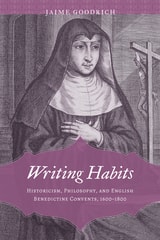
Writing Habits
Historicism, Philosophy, and English Benedictine Convents, 1600–1800Jaime Goodrich
University of Alabama Press, 2021
The first in-depth examination of the texts produced in English Benedictine convents between 1600 and 1800.
After Catholicism became illegal in England during the sixteenth century, Englishwomen established more than twenty convents on the Continent that attracted thousands of nuns and served as vital centers of Catholic piety until the French Revolution. Today more than 1,000 manuscripts and books produced by, and for, the Benedictine convents are extant in European archives. Writing Habits: Historicism, Philosophy, and English Benedictine Convents, 1600–1800 provides the first substantive analysis of these works in order to examine how members of one religious order used textual production to address a major dilemma experienced by every English convent on the Continent: How could English nuns cultivate a cloistered identity when the Protestant Reformation had swept away nearly all vestiges of English monasticism?
Drawing on an innovative blend of methodologies, Jaime Goodrich contends that the Benedictines instilled a collective sense of spirituality through writings that created multiple overlapping communities, ranging from the earthly society of the convent to the transhistorical network of the Catholic Church. Because God resides at the heart of these communities, Goodrich draws on the works of Martin Buber, a twentieth-century Jewish philosopher who theorized that human community forms a circle, with each member acting as a radius leading toward the common center of God. Buber’s thought, especially his conception of the I-You framework for personal and spiritual relationships, illuminates a fourfold set of affiliations central to Benedictine textual production: between the nuns themselves, between the individual nun and God, between the convent and God, and between the convent and the Catholic public sphere. By evoking these relationships, the major genres of convent writing—administrative texts, spiritual works, history and life writing, and controversial tracts—functioned as tools for creating community and approaching God.
Through this Buberian reading of the cloister, Writing Habits recovers the works of Benedictine nuns and establishes their broader relevance to literary history and critical theory.
Writing Lives in the Eighteenth Century
Tanya M. Caldwell
Bucknell University Press, 2020
Published by Bucknell University Press. Distributed worldwide by Rutgers University Press.
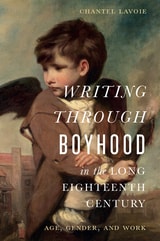
Writing through Boyhood in the Long Eighteenth Century
Age, Gender, and WorkChantel Lavoie
University of Delaware Press, 2024