Results by title
193 books match the query '1945-' and 6 start with w
When America Turned
Reckoning with 1968David Wyatt
University of Massachusetts Press, 2013
Wyatt explores these questions as he retraces the decisive moments of 1968—the Tet Offensive, the McCarthy campaign, the assassinations of Martin Luther King Jr. and Robert Kennedy, the student revolt at Columbia, the "police riot" at the Democratic Convention in Chicago, Lyndon Johnson's capitulation, and Richard Nixon's ascendency to power. Seeking to recover the emotions surrounding these events as well as analyze their significance, Wyatt draws on the insights of what Michael Herr has called "straight" and "secret" histories. The first category consists of work by professional historians, traditional journalists, public figures, and political operatives, while the second includes the writings of novelists, poets, New Journalists, and memoirists.
The aim of this parallel approach is to uncover two kinds of truth: a "scholarly truth" grounded in the documented past and an "imaginative truth" that occupies the more ambiguous realm of meaning. Only by reckoning with both, Wyatt believes, can Americans come to understand the true legacy of the 1960s.
Women March for Peace
Black Radical Women’s Anti-Korean War ActivismDenise Lynn
University of Massachusetts Press, 2025
The Korean War is commonly known as the “forgotten war” because it supposedly had little impact on American culture in comparison to World War II or the American War in Vietnam. Yet from 1950–1953, the conflict produced vigorous anti-war activism, particularly among Black radical women. Informed by their experiences with racism and misogyny within the US, these women were convinced that peace was not just the absence of military aggression, but that it required the liberation of the most oppressed, including the end of capitalist exploitation of women and People of Color and the return of self-determination to colonized peoples—themes that later anti-war activists would echo and develop. Whether or not the Korean War has ever truly been forgotten, the visionary activism of these women has been largely overlooked.
In Women March for Peace, Denise Lynn examines the lives of seven Black women—Louise Thompson Patterson, Claudia Jones, Charlotta Bass, Shirley Graham Du Bois, Eslanda Robeson, Lorraine Hansberry, and Beulah Richardson—and their resistance to domestic and foreign US policies during the height of anticommunist hysteria. While much peace scholarship focuses on the threat of nuclear conflict, Lynn instead explores how these women connected issues of civil rights at home with international military campaigns, highlights the hypocrisy of containment policies that sought to secure the freedom and rights for Koreans when US citizens were still oppressed. Lynn traces their peace advocacy through their personal papers, local and national articles, Progressive Party documents, and global conventions. Women March for Peace recovers the radical activism of these Black women to understand a crucial chapter in the fight against American imperialism and white supremacy.
Women Of Japan & Korea
Continuity and Changeedited by Joyce Gelb and Marian Lief Palley
Temple University Press, 1994

Words to Our Now
Imagination and DissentThomas Glave
University of Minnesota Press, 2007
In these lyrical and powerful essays, Thomas Glave draws on his experiences as a politically committed, gay Jamaican American to deliver a condemnation of the prejudices, hatreds, and inhumanities that persist in the United States and elsewhere. Exposing the hypocrisies of liberal multiculturalism, Glave offers instead a politics of heterogeneity in which difference informs the theory and practice of democracy. At the same time, he experiments with language to provide a model of creative writing as a tool for social change. From the death of black gay poet Essex Hemphill to the revelations of abuse at Abu Ghraib, Glave puts forth an ethical understanding of human rights to make vital connections across nations, races, genders, and sexualities.
Thomas Glave is assistant professor of English at SUNY Binghamton. He is author of Whose Song? and Other Stories.
Work in Black and White
Striving for the American DreamEnobong Hannah Branch
Russell Sage Foundation, 2022
The ability to achieve economic security through hard work is a central tenet of the American Dream, but significant shifts in today’s economy have fractured this connection. While economic insecurity has always been a reality for some Americans, Black Americans have historically long experienced worse economic outcomes than Whites. In Work in Black and White, sociologists Enobong Hannah Branch and Caroline Hanley draw on interviews with 80 middle-aged Black and White Americans to explore how their attitudes and perceptions of success are influenced by the stories American culture has told about the American Dream – and about who should have access to it and who should not.
Branch and Hanley find that Black and White workers draw on racially distinct histories to make sense of today’s rising economic insecurity. White Americans have grown increasingly pessimistic and feel that the American Dream is now out of reach, mourning the loss of a sense of economic security which they took for granted. But Black Americans tend to negotiate their present insecurity with more optimism, since they cannot mourn something they never had. All educated workers bemoaned the fact that their credentials no longer guarantee job security, but Black workers lamented the reality that even with an education, racial inequality continues to block access to good jobs for many.
The authors interject a provocative observation into the ongoing debate over opportunity, security, and the American Dream: Among policymakers and the public alike, Americans talk too much about education. The ways people navigate insecurity, inequality, and uncertainty rests on more than educational attainment. The authors call for a public policy that ensures dignity in working conditions and pay while accounting for the legacies of historical inequality.
Americans want the game of life to be fair. While the survey respondents expressed common ground on the ideal of meritocracy, opinions about to achieve economic security for all diverge along racial lines, with the recognition – or not – of differences in current and past access to opportunity in America.
Work in Black and White is a call to action for meaningful policies to make the premise of the American Dream a reality.
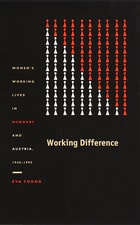
Working Difference
Women's Working Lives in Hungary and Austria, 1945-1995Éva Fodor
Duke University Press, 2003
Fodor brings qualitative and quantitative analyses to bear, combining statistical analyses of survey data, interviews with women managers in both countries, and archival materials including those from the previously classified archives of the Hungarian communist party and transcripts from sessions of the Austrian Parliament. She shows how women's access to power varied in degree and operated through different principles and mechanisms in accordance with the stratification systems of the respective countries. In Hungary women's mobility was curtailed by political means (often involving limited access to communist party membership), while in Austria women's professional advancement was affected by limited access to educational institutions and the labor market. Fodor discusses the legacies of Austria's and Hungary's "gender regimes" following the demise of state socialism and during the process of integration into the European Union.