Results by title
53 books match the query '1948-' and 7 start with w
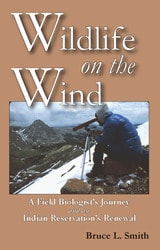
Wildlife on the Wind
A Field Biologist's Journey and an Indian Reservation's RenewalBruce L Smith
Utah State University Press, 2010
In the heart of Wyoming sprawls the ancient homeland of the Eastern Shoshone Indians, who were forced by the U.S. government to share a reservation in the Wind River basin and flanking mountain ranges with their historical enemy, the Northern Arapahos. Both tribes lost their sovereign, wide-ranging ways of life and economic dependence on decimated buffalo. Tribal members subsisted on increasingly depleted numbers of other big game—deer, elk, moose, pronghorn, and bighorn sheep. In 1978, the tribal councils petitioned the U.S. Fish and Wildlife Service to help them recover their wildlife heritage. Bruce Smith became the first wildlife biologist to work on the reservation. Wildlife on the Wind recounts how he helped Native Americans change the course of conservation for some of America's most charismatic wildlife.
William Gibson
Gary Westfahl
University of Illinois Press, 2013
William Gibson and the Future of Contemporary Culture
Mitch R. Murray and Mathias Nilges
University of Iowa Press, 2021
In the 1970s and 80s, Gibson, the “Godfather of Cyberpunk,” rejuvenated science fiction. In groundbreaking works such as Neuromancer, which changed science fiction as we knew it, Gibson provided us with a language and imaginary through which it became possible to make sense of the newly emerging world of globalization and the digital and media age. Ever since, Gibson’s reformulation of science fiction has provided us not just with radically innovative visions of the future but indeed with trenchant analyses of our historical present and of the emergence and exhaustion of possible futures.
Contributors: Maria Alberto, Andrew M. Butler, Amy J. Elias, Christian Haines, Kylie Korsnack, Mathias Nilges, Malka Older, Aron Pease, Lisa Swanstrom, Takayuki Tatsumi, Sherryl Vint, Phillip E. Wegner, Roger Whitson, Charles Yu
Words Are Something Else
David Albahari
Northwestern University Press, 1996
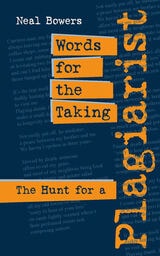
Words for the Taking
The Hunt for a PlagiaristNeal Bowers
Southern Illinois University Press, 2007
In January 1992, poet Neal Bowers received a phone call that changed his life. He learned his poems had been stolen and published under another name. Bowers hired a copyright lawyer and a private detective, and they began the agonizing hunt to track down the person who stole his creative work.
Bowers was dealing with more than the theft of words. He uncovered the plagiarist’s unsavory past when he found convicted child molester David Jones, who published the poems using the name David Sumner.
Determined to hold the plagiarist accountable, Bowers is drawn into a bizarre game of catch-me-if-you-can. His odyssey introduces him to the legal system and a sympathetic female detective, reveals the reactions of fellow poets, and provokes a flood of nationwide publicity and a deluge of letters from strangers interested in the case. Letters from Bowers’s attorney to Jones and phone conversations between the two produce unsatisfactory results. In the end, the plagiarist is not punished, and Bowers deals with the loss of friends, derision from his colleagues, and trouble in his marriage.
Words for the Taking: The Hunt for a Plagiarist, first published in 1997, is as much a commentary on our cultural view of plagiarism as it is a real-life detective story. Bowers’s wry and disturbing account of being the victim of a serial plagiarist offers unexpected twists and startling revelations. This updated edition presents a final consideration of the bizarre case and remains the only book to offer a personal account of the effects of plagiarism.
Ten years after the original publication, Neal Bowers finds his life as a writer altered in ways he could never have foreseen. His responses to the series of events show his vulnerability as an artist and his adjustment to being a victim. In a new chapter, Bowers describes his renewed quest in 2006 for a resolution and explains why he chose to give up writing poetry.
This beautifully written case study about the discovery and attempted resolution of an intellectual crime will appeal to academicians and general readers alike who care about language, the state of poetry, and intellectual property in contemporary America.

Writing Women in Central America
Gender and the Fictionalization of HistoryLaura Barbas-Rhoden
Ohio University Press, 2003
What is the relationship between history and fiction in a place with a contentious past? And of what concern is gender in the telling of stories about that past?
Writing Women in Central America explores these questions as it considers key Central American texts. This study analyzes how authors appropriate history to confront the rhetoric of the state, global economic powers, and even dissident groups within their own cultures. Laura Barbas-Rhoden winds a common thread in the literary imaginations of Claribel Alegría, Rosario Aguilar, Gioconda Belli, and Tatiana Lobo and shows how these writers offer provocative supplements to the historical record.
Writing Women in Central America considers more than a dozen narratives in which the authors craft their own interpretations of history to make room for women, indigenous peoples, and Afro-Latin Americans. Some of the texts reveal silences in the narratives of empire- and nation-building. Others reinterpret events to highlight the struggle of marginalized peoples for dignity and humanity in the face of oppression. All confront the ways in which stories have been told about the past.
Yet ultimately, Professor Barbas-Rhoden asserts, all concern the present and the future. As seen in Writing Women in Central America, though their fictions are historical, the writers direct their readers beyond the present toward a more just future for all who live in Central America.
Written in the Sky
Lessons of a Southern DaughterPatricia Foster
University of Alabama Press, 2023
In Written in the Sky: Lessons of a Southern Daughter, Patricia Foster presents a double portrait of place and family, a book of deeply personal essays that interrogate the legacy of racial tensions in the South, the constriction of caste and gender, and the ways race, class, and white privilege are entwined in her family story. After interviewing girls at Booker T. Washington High School in Tuskegee, Alabama, visiting the National Memorial for Peace and Justice in Montgomery, Alabama, and exploring Africatown in Plateau, Alabama, Patricia Foster was moved to reflect on the racial scars and crossroads in her southern past as well as to reckon with the intimate places of her own wounding and grief.
The story of place, she discovers, emerges not only from family histories and cultural traditions but also from wrestling with a culture’s irreconcilable ideas: the hard push to determine what matters. What matters to her are the shadow stories beneath our mythologies, the complicated and radiant narratives that must be excavated and reckoned with, stories that have no neat or binary resolution, stories full of luminous moments and riveting facts, and stories where the secrets hide. Written in the Sky presents the best of nonfiction storytelling: searingly honest portraits, dramatic encounters, and lyrical narratives that will interest teachers and students as well as social justice advocates, policymakers, and readers compelled by stories of awakening and the white-hot beauty of language.