Results by title
87 books match the query 'AIDS (Disease)' and 2 start with w
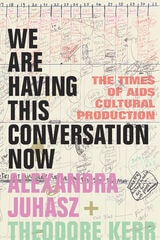
We Are Having This Conversation Now
The Times of AIDS Cultural ProductionAlexandra Juhasz and Theodore Kerr
Duke University Press, 2022
We Are Having This Conversation Now offers a history, present, and future of AIDS through thirteen short conversations between Alexandra Juhasz and Theodore Kerr, scholars deeply embedded in HIV responses. They establish multiple timelines of the epidemic, offering six foundational periodizations of AIDS culture, tracing how attention to the crisis has waxed and waned from the 1980s to the present. They begin the book with a 1990 educational video produced by a Black health collective, using it to consider organizing intersectionally, theories of videotape, empowerment movements, and memorialization. This video is one of many powerful yet overlooked objects that the pair focus on through conversation to understand HIV across time. Along the way, they share their own artwork, activism, and stories of the epidemic. Their conversations illuminate the vital role personal experience, community, cultural production, and connection play in the creation of AIDS-related knowledge, archives, and social change. Throughout, Juhasz and Kerr invite readers to reflect and find ways to engage in their own AIDS-related culture and conversation.
[more]
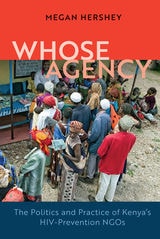
Whose Agency
The Politics and Practice of Kenya's HIV-Prevention NGOsMegan Hershey
University of Wisconsin Press, 2019
Nongovernmental organizations (NGOs) are ubiquitous in the Global South. Often international in origin, many attempt to assist local efforts to improve the lives of people often living in or near poverty. Yet their external origins often cloud their ability to impact health or quality of life, regardless of whether volunteers are local or foreign.
By focusing on one particular type of NGO—those organized to help prevent the spread and transmission of HIV in Kenya—Megan Hershey interrogates the ways these organizations achieve (or fail to achieve) their planned outcomes. Along the way, she examines the slippery slope that is often used to define “success” based on meeting donor-set goals versus locally identified needs. She also explores the complex network of bureaucratic requirements at both the national and local levels that affect the delicate relationships NGOs have with the state. Drawing on extensive, original quantitative and qualitative research, Whose Agency serves as a much-needed case study for understanding the strengths and shortcomings of participatory development and community engagement.
By focusing on one particular type of NGO—those organized to help prevent the spread and transmission of HIV in Kenya—Megan Hershey interrogates the ways these organizations achieve (or fail to achieve) their planned outcomes. Along the way, she examines the slippery slope that is often used to define “success” based on meeting donor-set goals versus locally identified needs. She also explores the complex network of bureaucratic requirements at both the national and local levels that affect the delicate relationships NGOs have with the state. Drawing on extensive, original quantitative and qualitative research, Whose Agency serves as a much-needed case study for understanding the strengths and shortcomings of participatory development and community engagement.
[more]