Results by title
56 books match the query 'Academic & Scholarly' and 14 start with w
Where Research Begins
Choosing a Research Project That Matters to You (and the World)Thomas S. Mullaney and Christopher Rea
University of Chicago Press, 2022
Plenty of books tell you how to do research. This book helps you figure out WHAT to research in the first place, and why it matters.
The hardest part of research isn't answering a question. It's knowing what to do before you know what your question is. Where Research Begins tackles the two challenges every researcher faces with every new project: How do I find a compelling problem to investigate—one that truly matters to me, deeply and personally? How do I then design my research project so that the results will matter to anyone else?
This book will help you start your new research project the right way for you with a series of simple yet ingenious exercises. Written in a conversational style and packed with real-world examples, this easy-to-follow workbook offers an engaging guide to finding research inspiration within yourself, and in the broader world of ideas.
Read this book if you (or your students):
- have difficulty choosing a research topic
- know your topic, but are unsure how to turn it into a research project
- feel intimidated by or unqualified to do research
- worry that you’re asking the wrong questions about your research topic
- have plenty of good ideas, but aren’t sure which one to commit to
- feel like your research topic was imposed by someone else
- want to learn new ways to think about how to do research.
Under the expert guidance of award-winning researchers Thomas S. Mullaney and Christopher Rea, you will find yourself on the path to a compelling and meaningful research project, one that matters to you—and the world.
Wiki Writing
Collaborative Learning in the College ClassroomRobert E. Cummings and Matt Barton, Editors
University of Michigan Press, 2008
When most people think of wikis, the first---and usually the only---thing that comes to mind is Wikipedia. The editors of Wiki Writing: Collaborative Learning in the College Classroom, Robert E. Cummings and Matt Barton, have assembled a collection of essays that challenges this common misconception, providing an engaging and helpful array of perspectives on the many pressing theoretical and practical issues that wikis raise. Written in an engaging and accessible manner that will appeal to specialists and novices alike, Wiki Writing draws on a wealth of practical classroom experiences with wikis to offer a series of richly detailed and concrete suggestions to help educators realize the potential of these new writing environments.
Robert E. Cummings began work at Columbus State University in August 2006 as Assistant Professor of English and Director of First-Year Composition. Currently he also serves as the Writing Specialist for CSU's Quality Enhancement Plan, assisting teachers across campus in their efforts to maximize student writing in their curriculum. He recently concluded a three-year research study with the Inter/National Coalition for Electronic Portfolio Research and continues to research in the fields of computers and writing, writing across the curriculum, writing in the disciplines, and curricular reform in higher education.
Matt Barton is Assistant Professor, St. Cloud State University, Department of English-Rhetoric and Applied Writing Program. His research interests are rhetoric, new media, and computers and writing. He is the author of Dungeons and Desktops: A History of Computer Role-Playing Games and has published in the journals Text and Technology, Computers and Composition, Game Studies, and Kairos. He is currently serving as Associate Editor of Kairosnews and Managing Editor of Armchair Arcade.
"Wiki Writing will quickly become the standard resource for using wikis in the classroom."
---Jim Kalmbach, Illinois State University
digitalculturebooks is an imprint of the University of Michigan Press and the Scholarly Publishing Office of the University of Michigan Library dedicated to publishing innovative and accessible work exploring new media and their impact on society, culture, and scholarly communication. Visit the website at www.digitalculture.org.
Work of Teaching Writing
Learning from Fiction, Film, and DramaJoseph Harris
Utah State University Press, 2020
Each chapter examines a fictional representation of writing classes—as portrayed in Dead Poets Society, Up the Down Staircase, Educating Rita, Push, and more—and shifts the conversation from how these works portray teachers to how they dramatize the actual work of teaching. Harris considers scenes of instruction from different stages of the writing process and depictions of students and teachers at work together to highlight the everyday aspects of teaching writing.
In the writing classroom the ideas of teachers come to life in the work of their students. The Work of Teaching Writing shows what fiction, film, and drama can convey about the moment of exchange between teacher and student as they work together to create new insights into writing. It will interest both high school and undergraduate English teachers, as well as graduate students and scholars in composition and rhetoric, literary studies, and film studies.
Write No Matter What
Advice for AcademicsJoli Jensen
University of Chicago Press, 2017
Jensen begins by busting the myth that universities are supportive writing environments. She points out that academia, an arena dedicated to scholarship, offers pressures that actually prevent scholarly writing. She shows how to acknowledge these less-than-ideal conditions, and how to keep these circumstances from draining writing time and energy. Jensen introduces tools and techniques that encourage frequent, low-stress writing. She points out common ways writers stall and offers workarounds that maintain productivity. Her focus is not on content, but on how to overcome whatever stands in the way of academic writing.
Write No Matter What draws on popular and scholarly insights into the writing process and stems from Jensen’s experience designing and directing a faculty writing program. With more than three decades as an academic writer, Jensen knows what really helps and hinders the scholarly writing process for scholars in the humanities, social sciences,and sciences.
Cut down the academic sword of Damocles, Jensen advises. Learn how to write often and effectively, without pressure or shame. With her encouragement, writers of all levels will find ways to create the writing support they need and deserve.
Write Your Way In
Crafting an Unforgettable College Admissions EssayRachel Toor
University of Chicago Press, 2017
The good news? You already have the “secret sauce” for crafting a compelling personal essay: your own experiences and your unique voice.
More than twenty million students apply to college every year; many of them look similar in terms of test scores, grades, courses taken, extracurricular activities. Admissions officers wade through piles of files. As an applicant, you need to think about what will interest an exhausted reader. What can you write that will make her argue to admit you instead of the thousands of other applicants?
A good essay will be conversational and rich in vivid details, and it could only be written by one person—you. This book will help you figure out how to find and present the best in yourself. You’ll acquire some useful tools for writing well—and may even have fun—in the process.
Writing Emergencies
Composing (Ourselves) in Times of CrisisHolly Hassel
Utah State University Press, 2026
Despite the adage “there are no writing emergencies,” at times situations invite or require immediate written response. In a modern era of social media and with the constancy of “crisis,” knowing when, how, and why to respond quickly is increasingly important. In Writing Emergencies, a diverse group of authors contribute scholarly, narrative-based discussions of writing emergencies, descriptions of more and less successful strategies, and a reflective conclusion that offers implications for writing studies praxis and theory.
In this collection, contributors demonstrate the reality of writing emergencies—in their own writing lives, classrooms, and programs—and they offer both self- and community-focused approaches for response. Chapters focus on discernment and prioritization, recognizing that all stressors are not necessarily emergencies. Instead, expanding our vocabulary for (and subsequent understanding) of the kinds of difficulties we come across can build our professional capacity and support greater career sustainability. The volume also illustrates the role of coalitions in navigating writing emergencies and how purposefully building and activating these coalitions subverts some challenges before they become emergencies, particularly those that are recurrent or manufactured.
Writing Emergencies both names and grapples with writing emergencies and offers insights for capacity-building in the acts of filtering and prioritizing competing urgent demands. The findings are meaningful for all leaders, students, and teachers who center care in their relationships with others.
Writing Science in Plain English
Anne E. Greene
University of Chicago Press, 2013
Writing Science in Plain English, Second Edition
Anne E. Greene
University of Chicago Press, 2025
Scientific writing is often dry, wordy, and difficult to understand. But, as biologist and experienced teacher of scientific writing Anne E. Greene shows in Writing Science in Plain English, writers from all scientific disciplines can learn to produce clear, concise prose by mastering just a few simple principles. This short, focused guide presents roughly a dozen such principles based on what readers need to understand complex information, including concrete subjects, strong verbs, consistent terms, organized paragraphs, and correct sentence structure. Greene illustrates each principle with real-life examples of both good and bad writing and shows how bad writing might be improved. She ends each chapter with revision exercises (and provides suggested answers in a separate key) so that readers can come away with new writing skills after just one sitting. To help readers understand the grammatical terms used in the book, an appendix offers a refresher course on basic grammar.
For this second edition, Greene has incorporated the latest research on what makes writing effective and engaging and has revised or replaced exercises and exercise keys where needed. She has also added new features that make it easier to navigate the book. A new resource for instructors who use Writing Science in Plain English in their classes is a free, online teacher’s guide. Drawn from Greene’s long experience teaching students how to write science clearly, the teacher’s guide provides additional lectures, assignments, and activities that will inform and enliven any class.
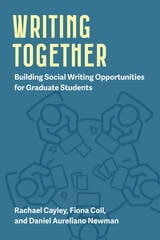
Writing Together
Building Social Writing Opportunities for Graduate StudentsRachael Cayley, Fiona Coll, and Daniel Aureliano Newman
University of Michigan Press, 2025
Writing Together gathers accounts from graduate writing professionals about how social writing programs are imagined and delivered. It surveys the motivations, rationales, evaluation strategies, and structures that underpin these initiatives in order to create a practical resource for writing professionals who wish to establish or refine their own offerings. Rather than presenting “how to” approaches, the book presents “how we” accounts that enable readers to learn from the creative practices and experiences of others. By capturing a range of experiences, institutional models, and forms of social writing support, Writing Together explains the thinking behind social writing initiatives and the processes through which those initiatives have been assessed. It demonstrates that social writing practices are not just a means to an end, but an end in themselves—that writing together is a great way to write and a promising basis for graduate writing pedagogy and professional development.
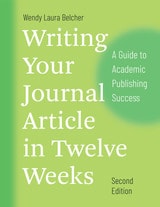
Writing Your Journal Article in Twelve Weeks, Second Edition
A Guide to Academic Publishing SuccessWendy Laura Belcher
University of Chicago Press, 2019
With this new edition, Belcher expands her advice to reach beginning scholars in even more disciplines. She builds on feedback from professors and graduate students who have successfully used the workbook to complete their articles. A new chapter addresses scholars who are writing from scratch. This edition also includes more targeted exercises and checklists, as well as the latest research on productivity and scholarly writing.
Writing Your Journal Article in Twelve Weeks is the only reference to combine expert guidance with a step-by-step workbook. Each week, readers learn a feature of strong articles and work on revising theirs accordingly. Every day is mapped out, taking the guesswork and worry out of writing. There are tasks, templates, and reminders. At the end of twelve weeks, graduate students, recent PhDs, postdoctoral fellows, adjunct instructors, junior faculty, and international faculty will feel confident they know that the rules of academic publishing and have the tools they need to succeed.
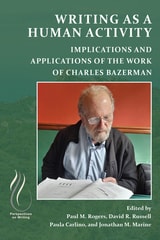
Writing as a Human Activity
Implications and Applications of the Work of Charles BazermanPaul M. Rogers
University Press of Colorado, 2023
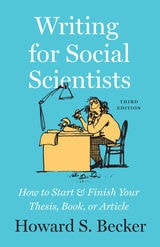
Writing for Social Scientists, Third Edition
How to Start and Finish Your Thesis, Book, or ArticleHoward S. Becker
University of Chicago Press, 2020
This is not a book about sociological writing. Instead, Becker applies his sociologist’s eye to some of the common problems all academic writers face, including trying to get it right the first time, failing, and therefore not writing at all; getting caught up in the trappings of “proper” academic writing; writing to impress rather than communicate with readers; and struggling with the when and how of citations. He then offers concrete advice, based on his own experiences and those of his students and colleagues, for overcoming these obstacles and gaining confidence as a writer.
While the underlying challenges of writing have remained the same since the book first appeared, the context in which academic writers work has changed dramatically, thanks to rapid changes in technology and ever greater institutional pressures. This new edition has been updated throughout to reflect these changes, offering a new generation of scholars and students encouragement to write about society or any other scholarly topic clearly and persuasively.
As Becker writes in the new preface, “Nothing prepared me for the steady stream of mail from readers who found the book helpful. Not just helpful. Several told me the book had saved their lives; less a testimony to the book as therapy than a reflection of the seriousness of the trouble writing failure could get people into.” As academics are being called on to write more often, in more formats, the experienced, rational advice in Writing for Social Scientists will be an important resource for any writer’s shelf.
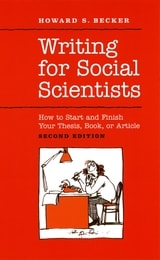
Writing for Social Scientists
How to Start and Finish Your Thesis, Book, or Article: Second EditionHoward S. Becker
University of Chicago Press, 2007
Sociologist Howard S. Becker has written the classic book on how to conquer these pressures and simply write. First published nearly twenty years ago, Writing for Social Scientists has become a lifesaver for writers in all fields, from beginning students to published authors. Becker’s message is clear: in order to learn how to write, take a deep breath and then begin writing. Revise. Repeat.
It is not always an easy process, as Becker wryly relates. Decades of teaching, researching, and writing have given him plenty of material, and Becker neatly exposes the foibles of academia and its “publish or perish” atmosphere. Wordiness, the passive voice, inserting a “the way in which” when a simple “how” will do—all these mechanisms are a part of the social structure of academic writing. By shrugging off such impediments—or at the very least, putting them aside for a few hours—we can reform our work habits and start writing lucidly without worrying about grades, peer approval, or the “literature.”
In this new edition, Becker takes account of major changes in the computer tools available to writers today, and also substantially expands his analysis of how academic institutions create problems for them. As competition in academia grows increasingly heated, Writing for Social Scientists will provide solace to a new generation of frazzled, would-be writers.
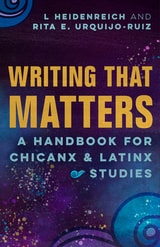
Writing that Matters
A Handbook for Chicanx and Latinx StudiesL Heidenreich and Rita E. Urquijo-Ruiz
University of Arizona Press, 2024
While it includes a brief history of the roots of the fields of Chicanx literature and history, Writing that Matters emphasizes practice: how to research and write a Chicanx or Latinx history paper; how to research and write a Chicanx or Latinx literature or cultural studies essay; and how to conduct interviews, frame pláticas, and conduct oral histories. It also includes a brief chapter on nomenclature and a grammar guide. Each chapter includes questions for discussion, and all examples from across the subfields are from noted Chicanx and Latinx scholars. Women’s and queer scholarship and methods are not addressed in a separate chapter but are instead integral to the work.
For years Professors Heidenreich and Urquijo-Ruiz waited for a writing and research manual that was rooted in critical Chicanx and Latinx studies. Now, they have crafted one.