Results by title
159 books match the query 'Academic writing' and 23 start with w
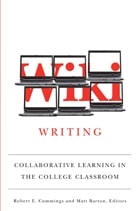
Wiki Writing
Collaborative Learning in the College ClassroomRobert E. Cummings and Matt Barton, Editors
University of Michigan Press, 2008
When most people think of wikis, the first---and usually the only---thing that comes to mind is Wikipedia. The editors of Wiki Writing: Collaborative Learning in the College Classroom, Robert E. Cummings and Matt Barton, have assembled a collection of essays that challenges this common misconception, providing an engaging and helpful array of perspectives on the many pressing theoretical and practical issues that wikis raise. Written in an engaging and accessible manner that will appeal to specialists and novices alike, Wiki Writing draws on a wealth of practical classroom experiences with wikis to offer a series of richly detailed and concrete suggestions to help educators realize the potential of these new writing environments.
Robert E. Cummings began work at Columbus State University in August 2006 as Assistant Professor of English and Director of First-Year Composition. Currently he also serves as the Writing Specialist for CSU's Quality Enhancement Plan, assisting teachers across campus in their efforts to maximize student writing in their curriculum. He recently concluded a three-year research study with the Inter/National Coalition for Electronic Portfolio Research and continues to research in the fields of computers and writing, writing across the curriculum, writing in the disciplines, and curricular reform in higher education.
Matt Barton is Assistant Professor, St. Cloud State University, Department of English-Rhetoric and Applied Writing Program. His research interests are rhetoric, new media, and computers and writing. He is the author of Dungeons and Desktops: A History of Computer Role-Playing Games and has published in the journals Text and Technology, Computers and Composition, Game Studies, and Kairos. He is currently serving as Associate Editor of Kairosnews and Managing Editor of Armchair Arcade.
"Wiki Writing will quickly become the standard resource for using wikis in the classroom."
---Jim Kalmbach, Illinois State University
digitalculturebooks is an imprint of the University of Michigan Press and the Scholarly Publishing Office of the University of Michigan Library dedicated to publishing innovative and accessible work exploring new media and their impact on society, culture, and scholarly communication. Visit the website at www.digitalculture.org.
Women Writing the Academy
Audience, Authority, and TransformationGesa E. Kirsch. Foreword by John Trimbur
Southern Illinois University Press, 1993
Women Writing the Academy is based on an extensive interview study by Gesa E. Kirsch that investigates how women in different academic disciplines perceive and describe their experiences as writers in the university.
Kirsch’s study focuses on the writing strategies of successful women writers, their ways of establishing authority, and the kinds of audiences they address in different disciplinary settings. Based on multiple interviews with thirty-five women from five different disciplines (anthropology, education, history, nursing, and psychology) and four academic ranks (seniors, graduate students, and faculty before and after tenure), this is the first book to systematically explore the academic context in which women write and publish.
While there are many studies in literary criticism on women as writers of fiction, there has not been parallel scholarship on women as writers of professional discourse, be it inside or outside the academy. Through her research, for example, Kirsch found that women were less likely than their male counterparts to think of their work as sufficiently significant to write up and submit for publication, tended to hold on to their work longer than men before sending it out, and were less likely than men to revise and resubmit manuscripts that had been initially rejected.
This book is significant in that it investigates a new area of research— gender and writing—and in doing so brings together findings on audience, authority, and gender.
Women's Professional Lives in Rhetoric and Composition
Choice, Chance, and SerendipityEdited by Elizabeth A. Flynn and Tiffany Bourelle
The Ohio State University Press, 2018
This collection, edited by Elizabeth A. Flynn and Tiffany Bourelle, contributes to the valuable work of chronicling the professional and personal lives of women in academia. Through its line-up of contributors from diverse backgrounds, locations, and career paths, Women’s Professional Lives in Rhetoric and Composition showcases the voices of multiple scholars occupying a multitude of different roles in the profession: from prestigious professors emeritae and endowed chairs to assistant professors starting their careers to an independent scholar to part-time faculty.
The collection sets itself apart from other volumes not just in its diversity of perspectives but also by speaking against linear stories of success in the profession—sharing moments of shame and failure, showing how the personal and professional often intertwine and influence one another, and ultimately revealing how choice, chance, serendipity, and kairos have all played a role in the lives of its contributors. In focusing on this convergence, Women’s Professional Lives in Rhetoric and Composition offers a more nuanced picture of the professional and intellectual trajectories of women in rhetoric and composition.
Working with Faculty Writers
Anne Ellen Geller and Michele Eodice
Utah State University Press, 2013
Contributors from a variety of institution types and perspectives consider who faculty writers are and who they may be in the future, reveal the range of locations and models of support for faculty writers, explore the ways these might be delivered and assessed, and consider the theoretical, philosophical, political, and pedagogical approaches to faculty writing support, as well as its relationship to student writing support.
With the pressure on faculty to be productive researchers and writers greater than ever, this is a must-read volume for administrators, faculty, and others involved in developing and assessing models of faculty writing support.
Write No Matter What
Advice for AcademicsJoli Jensen
University of Chicago Press, 2017
Jensen begins by busting the myth that universities are supportive writing environments. She points out that academia, an arena dedicated to scholarship, offers pressures that actually prevent scholarly writing. She shows how to acknowledge these less-than-ideal conditions, and how to keep these circumstances from draining writing time and energy. Jensen introduces tools and techniques that encourage frequent, low-stress writing. She points out common ways writers stall and offers workarounds that maintain productivity. Her focus is not on content, but on how to overcome whatever stands in the way of academic writing.
Write No Matter What draws on popular and scholarly insights into the writing process and stems from Jensen’s experience designing and directing a faculty writing program. With more than three decades as an academic writer, Jensen knows what really helps and hinders the scholarly writing process for scholars in the humanities, social sciences,and sciences.
Cut down the academic sword of Damocles, Jensen advises. Learn how to write often and effectively, without pressure or shame. With her encouragement, writers of all levels will find ways to create the writing support they need and deserve.
Writing Assessment, Social Justice, and the Advancement of Opportunity
Mya Poe
University Press of Colorado, 2018
Writing Ethnographic Fieldnotes
Robert M. Emerson, Rachel I. Fretz, and Linda L. Shaw
University of Chicago Press, 1995
Drawing on years of teaching and field research experience, the authors develop a series of guidelines, suggestions, and practical advice about how to write useful fieldnotes in a variety of settings, both cultural and institutional. Using actual unfinished, "working" notes as examples, they illustrate options for composing, reviewing, and working fieldnotes into finished texts. They discuss different organizational and descriptive strategies, including evocation of sensory detail, synthesis of complete scenes, the value of partial versus omniscient perspectives, and of first person versus third person accounts. Of particular interest is the author's discussion of notetaking as a mindset. They show how transforming direct observations into vivid descriptions results not simply from good memory but more crucially from learning to envision scenes as written. A good ethnographer, they demonstrate, must learn to remember dialogue and movement like an actor, to see colors and shapes like a painter, and to sense moods and rhythms like a poet.
The authors also emphasize the ethnographer's core interest in presenting the perceptions and meanings which the people studied attach to their own actions. They demonstrate the subtle ways that writers can make the voices of people heard in the texts they produce. Finally, they analyze the "processing" of fieldnotes—the practice of coding notes to identify themes and methods for selecting and weaving together fieldnote excerpts to write a polished ethnography.
This book, however, is more than a "how-to" manual. The authors examine writing fieldnotes as an interactive and interpretive process in which the researcher's own commitments and relationships with those in the field inevitably shape the character and content of those fieldnotes. They explore the conscious and unconscious writing choices that produce fieldnote accounts. And they show how the character and content of these fieldnotes inevitably influence the arguments and analyses the ethnographer can make in the final ethnographic tale.
This book shows that note-taking is a craft that can be taught. Along with Tales of the Field and George Marcus and Michael Fisher's Anthropology as Cultural Criticism, Writing Ethnographic Fieldnotes is an essential tool for students and social scientists alike.
Writing Ethnographic Fieldnotes, Second Edition
Robert M. Emerson, Rachel I. Fretz, and Linda L. Shaw
University of Chicago Press, 2011
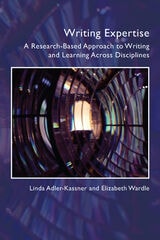
Writing Expertise
A Research-Based Approach to Writing and Learning Across DisciplinesLinda Adler-Kassner
University Press of Colorado, 2023
In Writing Expertise, Linda Adler-Kassner and Elizabeth Wardle address the question, “How can instructors across disciplines best help students write well?” Drawing on research about how disciplines use writing to engage in shared ways of thinking, practicing, and demonstrating knowledge, the authors offer an approach that helps faculty across the disciplines invite students to bring new ideas and identities to their work. Throughout the book, Adler-Kassner and Wardle help instructors explore what it means to write well in their courses, fields, or disciplines and offer strategies and activities that can help them improve their assignments by infusing research-based writing activities into their courses.
Writing Expertise provides an innovative, equity- and research-based approach to writing in the disciplines that will enrich instructor and student thinking. Thoughtful discussions and well-designed activities provide the support needed to help instructors put disciplinary thinking into written form, develop systematic aways of learning about the students who write in their courses, and ultimately develop more effective, inclusive courses.
Writing Groups in the Writing Center
Negotiating Authority and Expertise in Collaborative LearningSara Wilder
Utah State University Press, 2025
As many higher education institutions strive to create spaces and systems that increase equity, accessibility, and diversity, they recognize the need for improved mentorship across academic levels. This book analyzes the significant benefits as well as the challenges faced by writing groups in providing such support. Wilder presents a nuanced account of how facilitators scaffold group practice, how members use and build genre knowledge across disciplines, and how institutional contexts shape emotional labor requirements.
For educators and tutors, the book provides an in-depth examination of the facilitator role, describing essential logistical, emotional, and intellectual practices, and addresses common conflicts and challenges. Administrators can find valuable material for training tutor-facilitators and frameworks for conceptualizing writing group functions on campus. For researchers, the book extends scholarship on writing groups, writing transfer, and collaborative learning, bridging writing center and broader writing studies research.
In an era of concern about generative AI’s role in writing education, Writing Groups in the Writing Center extends research on group facilitation, collaborative learning, and authority negotiation in writing center communities of practice and emphasizes the human connections that make collaborative writing meaningful and valuable for student writers.
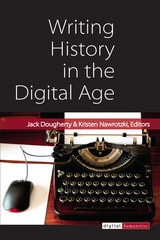
Writing History in the Digital Age
Jack Dougherty and Kristen Nawrotzki, editors
University of Michigan Press, 2013
Writing History in the Digital Age began as a “what-if” experiment by posing a question: How have Internet technologies influenced how historians think, teach, author, and publish? To illustrate their answer, the contributors agreed to share the stages of their book-in-progress as it was constructed on the public web.
To facilitate this innovative volume, editors Jack Dougherty and Kristen Nawrotzki designed a born-digital, open-access, and open peer review process to capture commentary from appointed experts and general readers. A customized WordPress plug-in allowed audiences to add page- and paragraph-level comments to the manuscript, transforming it into a socially networked text. The initial six-week proposal phase generated over 250 comments, and the subsequent eight-week public review of full drafts drew 942 additional comments from readers across different parts of the globe.
The finished product now presents 20 essays from a wide array of notable scholars, each examining (and then breaking apart and reexamining) if and how digital and emergent technologies have changed the historical profession.
Writing Instruction in Nineteenth-Century American Colleges
James A. Berlin. Foreword by Donald C. Stuart
Southern Illinois University Press, 1984
Defining a rhetoric as a social invention arising out of a particular time, place, and set of circumstances, Berlin notes that “no rhetoric—not Plato’s or Aristotle’s or Quintilian’s or Perelman’s—is permanent.” At any given time several rhetorics vie for supremacy, with each attracting adherents representing various views of reality expressed through a rhetoric.
Traditionally rhetoric has been seen as based on four interacting elements: “reality, writer or speaker, audience, and language.” As emphasis shifts from one element to another, or as the interaction between elements changes, or as the definitions of the elements change, rhetoric changes. This alters prevailing views on such important questions as what is appearance, what is reality.
In this interpretive study Berlin classifies the three 19th-century rhetorics as classical, psychological-epistemological, and romantic, a uniquely American development growing out of the transcendental movement. In each case studying the rhetoric provides insight into society and the beliefs of the people.
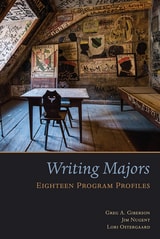
Writing Majors
Eighteen Program ProfilesGreg Giberson
Utah State University Press, 2015
The writing major is among the most exciting scenes in the evolving American university. Writing Majors is a collection of firsthand descriptions of the origins, growth, and transformations of eighteen different programs. The chapters provide useful administrative insight, benchmark information, and even inspiration for new curricular configurations from a range of institutions.
A practical sourcebook for those who are building, revising, or administering their own writing majors , this volume also serves as a historical archive of a particular instance of growth and transformation in American higher education. Revealing bureaucratic, practical, and institutional matters as well as academic ideals and ideologies, each profile includes sections providing a detailed program review and rationale, an implementation narrative, and reflection and prospection about the program.
Documenting eighteen stories of writing major programs in various stages of formation, preservation, and reform and exposing the contingencies of their local and material constitution, Writing Majors speaks as much to the “how to” of building writing major programs as to the larger “what,” “why,” and “how” of institutional growth and change.
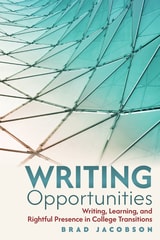
Writing Opportunities
Writing, Learning, and Rightful Presence in College TransitionsBrad Jacobson
Utah State University Press, 2026
Writing Opportunities presents in-depth text histories illustrating the interrelationship of writing, identities, and belonging in college writing transitions. Drawing on more than two years of research with three Latinx/a/o students transitioning from the same high school class to the local university, Brad Jacobson brings together analyses of interview transcripts, student writing, classroom genres, and institutional policies to foreground a sense of belonging as central to writing development and learning.
Including interviews with students and their instructors, Jacobson traces writing opportunities that Hercules, Jain, and Lucy were afforded as they transitioned from high school to college writing, particularly in general education courses. Chapters attend to multiple levels of interaction to show how policies, practices, and social histories can impact opportunities for learning. With attention to dominant discourses of writing that narrow what counts as good writing as well as positive opportunity structures that extend possibilities for identification, engagement, and deep learning, Jacobson also posits writing as an opportunity for writers to explore possibilities for who we are and who we may become.
Jacobson’s humanizing research invites readers to consider opportunity from multiple perspectives and shows how subtle shifts in relationships among students, instructors, and institutions can increase meaningful learning and provide a sense of belonging in educational contexts.
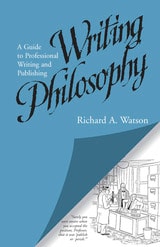
Writing Philosophy
A Guide to Professional Writing and PublishingRichard A. Watson
Southern Illinois University Press, 1992
Richard A. ("Red") Watson has published fiction, general nonfiction, and scholarly books. His essay "On the Zeedijk," about Descartes in Holland and first published in The Georgia Review, was the lead essay in The Pushcart Prize XV, 1990–1991: Best of the Small Presses. Red knows writing.
He also knows academe and has written Writing Philosophy as a kind of survival manual for undergraduates, graduate students, and junior faculty members in philosophy. Also helpful to those in the humanities and the social sciences, the book is a guide to the professional writing and publishing that are essential to an active participation in the conversation and discussion that constitute these professional fields. To the extent that publication is the crucial factor in tenure decisions, it will help the beginning scholar meet tenure criteria.
Despite the importance of the oral tradition in philosophy and the influence of the dialogue, many philosophical points are so intricate and complex that they can be advanced, followed, and criticized only if they are written as stepwise arguments for study and contemplation at length and at leisure. Watson provides a set of basic principles and a plan for writing argumentative papers of 1,500 to 15,000 words (3 to 30 printed pages) and books containing a sequence of sustained arguments of 70,000 to 150,000 words (200 to 300 printed pages).
Because the first book of most professional philosophers is a revised dissertation, Watson presents a plan for writing that dissertation in such a way that its chapters will serve as publishable articles and the dissertation itself will need very little rewriting as a book. His discussion of the principles of reason, clarity, and argument ranges from such topics as dangling participles and the proper usage of ellipses to matters of categorization and univocity.
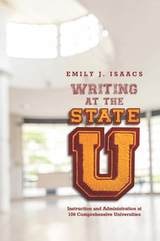
Writing at the State U
Instruction and Administration at 106 Comprehensive UniversitiesEmily Isaacs
Utah State University Press, 2017
Writing at the State U presents a comprehensive, empirical examination of writing programs at 106 universities. Rather than using open survey calls and self-reporting, Emily Isaacs uses statistical analysis to show the extent to which established principles of writing instruction and administration have been implemented at state comprehensive universities, the ways in which writing at those institutions has differed from writing at other institutions over time, and how state institutions have responded to major scholarly debates concerning first-year composition and writing program administration.
Isaacs’s findings are surprising: state university writing programs give lip service to important principles of writing research, but many still emphasize grammar instruction and a skills-based approach, classes continue to be outsized, faculty development is optional, and orientation toward basic writing is generally remedial. As such, she considers where a closer match between writing research and writing instruction might help to expose and remedy these difficulties and identifies strategies and areas where faculty or writing program administrators are empowered to enact change.
Unique in its wide scope and methodology, Writing at the State U sheds much-needed light on the true state of the writing discipline at state universities and demonstrates the advantages of more frequent and rigorous quantitative studies of the field.
Writing for Social Scientists, Third Edition
How to Start and Finish Your Thesis, Book, or ArticleHoward S. Becker
University of Chicago Press, 2020
This is not a book about sociological writing. Instead, Becker applies his sociologist’s eye to some of the common problems all academic writers face, including trying to get it right the first time, failing, and therefore not writing at all; getting caught up in the trappings of “proper” academic writing; writing to impress rather than communicate with readers; and struggling with the when and how of citations. He then offers concrete advice, based on his own experiences and those of his students and colleagues, for overcoming these obstacles and gaining confidence as a writer.
While the underlying challenges of writing have remained the same since the book first appeared, the context in which academic writers work has changed dramatically, thanks to rapid changes in technology and ever greater institutional pressures. This new edition has been updated throughout to reflect these changes, offering a new generation of scholars and students encouragement to write about society or any other scholarly topic clearly and persuasively.
As Becker writes in the new preface, “Nothing prepared me for the steady stream of mail from readers who found the book helpful. Not just helpful. Several told me the book had saved their lives; less a testimony to the book as therapy than a reflection of the seriousness of the trouble writing failure could get people into.” As academics are being called on to write more often, in more formats, the experienced, rational advice in Writing for Social Scientists will be an important resource for any writer’s shelf.
Writing for Social Scientists
How to Start and Finish Your Thesis, Book, or ArticleHoward S. Becker
University of Chicago Press, 1986
Both the means and the reasons for writing a thesis or article or book are socially structured by the organization of graduate study, the requirements for publication, and the conditions for promotion, and the pressures arising from these situations create the writing style so often lampooned and lamented. Drawing on his thirty-five years' experience as a researcher, writer, and teacher, Becker exposes the foibles of the academic profession to the light of sociological analysis and gentle humor. He also offers eminently useful suggestions for ways to make social scientists better and more productive writers. Among the topics discussed are how to overcome the paralyzing fears of chaos and ridicule that lead to writer's block; how to rewrite and revise, again and again; how to adopt a persona compatible with lucid prose; how to deal with that academic bugaboo, "the literature." There is also a chapter by Pamela Richards on the personal and professional risks involved in scholarly writing.
In recounting his own trials and errors Becker offers his readers not a model to be slavishly imitated but an example to inspire. Throughout, his focus is on the elusive work habits that contribute to good writing, not the more easily learned rules of grammar and punctuation. Although his examples are drawn from sociological literature, his conclusions apply to all fields of social science, and indeed to all areas of scholarly endeavor. The message is clear: you don't have to write like a social scientist to be one.
Writing for Social Scientists
How to Start and Finish Your Thesis, Book, or Article: Second EditionHoward S. Becker
University of Chicago Press, 2007
Sociologist Howard S. Becker has written the classic book on how to conquer these pressures and simply write. First published nearly twenty years ago, Writing for Social Scientists has become a lifesaver for writers in all fields, from beginning students to published authors. Becker’s message is clear: in order to learn how to write, take a deep breath and then begin writing. Revise. Repeat.
It is not always an easy process, as Becker wryly relates. Decades of teaching, researching, and writing have given him plenty of material, and Becker neatly exposes the foibles of academia and its “publish or perish” atmosphere. Wordiness, the passive voice, inserting a “the way in which” when a simple “how” will do—all these mechanisms are a part of the social structure of academic writing. By shrugging off such impediments—or at the very least, putting them aside for a few hours—we can reform our work habits and start writing lucidly without worrying about grades, peer approval, or the “literature.”
In this new edition, Becker takes account of major changes in the computer tools available to writers today, and also substantially expands his analysis of how academic institutions create problems for them. As competition in academia grows increasingly heated, Writing for Social Scientists will provide solace to a new generation of frazzled, would-be writers.

Writing in Disguise
Academic Life in SubordinationTerry Caesar
Ohio University Press, 1998
All of these texts have in common the imperative of disguise, represented as the most crucial consequence of dominant discourse, within which subordination might speak only by knowing its place, and write only by producing hidden transcripts.
Caustic, pointed, satiric, Writing in Disguise is an engaging critique of aspects of academia involving the misuse, misappropriation, and misappreciation of verbal communication in its many guises.
Writing in the Academic Disciplines, Second Edition
A Curricular HistoryDavid R. Russell. Foreword by Elaine P. Maimon
Southern Illinois University Press, 2002
“To understand the ways students learn to write, we must go beyond the small and all too often marginalized component of the curriculum that treats writing explicitly and look at the broader, though largely tacit traditions students encounter in the whole curriculum,” explains David R. Russell, in the introduction to this singular study. The updated edition provides a comprehensive history of writing instruction outside general composition courses in American secondary and higher education, from the founding public secondary schools and research universities in the 1870s, through the spread of the writing-across-the-curriculum movement in the 1980s, through the WAC efforts in contemporary curriculums.
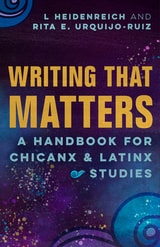
Writing that Matters
A Handbook for Chicanx and Latinx StudiesL Heidenreich and Rita E. Urquijo-Ruiz
University of Arizona Press, 2024
While it includes a brief history of the roots of the fields of Chicanx literature and history, Writing that Matters emphasizes practice: how to research and write a Chicanx or Latinx history paper; how to research and write a Chicanx or Latinx literature or cultural studies essay; and how to conduct interviews, frame pláticas, and conduct oral histories. It also includes a brief chapter on nomenclature and a grammar guide. Each chapter includes questions for discussion, and all examples from across the subfields are from noted Chicanx and Latinx scholars. Women’s and queer scholarship and methods are not addressed in a separate chapter but are instead integral to the work.
For years Professors Heidenreich and Urquijo-Ruiz waited for a writing and research manual that was rooted in critical Chicanx and Latinx studies. Now, they have crafted one.
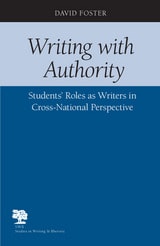
Writing with Authority
Students' Roles as Writers In Cross-National PerspectiveDavid Foster
Southern Illinois University Press, 2006
Writing with Authority: Students’ Roles as Writers in Cross-National Perspective offers a comparison of student writers in two university cultures—one German and one American—as the students learn to connect their writing to academic content. David Foster demonstrates the effectiveness of using cross-cultural comparisons to assess differences in literacy activities and suggests teaching approaches that will help American students better develop their roles as writers in knowledge-based communities. He proposes that American universities make stronger efforts to nurture the autonomy of American undergraduates as learner-writers and to create apprenticeship experiences that more closely reflect the realities of working in the academic community.
This comparative analysis identifies crucial differences in the ways German and American students learn to become academic writers, emphasizing two significant issues: the importance of self-directed, long-term planning and goal setting in developing knowledge-based projects and the impact of time structures on students’ writing practices. Foster suggests that students learn to write as knowledge makers, using cumulative, recursive task development as reflexive writing practices. He argues for the full integration of extended, self-managed, knowledge-based writing tasks into the American undergraduate curriculum from the onset of college study.
A cross-national perspective offers important insights into the conditions that influence novice writers, Foster says, including secondary preparations and transitions to postsecondary study. Foster proposes that students be challenged to write transformatively—to master new forms of authorship and authority based on self-directed planning, researching, and writing in specific academic communities. The text also addresses contested issues of power relations in students’ roles as academic writers and their perception of personal authority and freedom as writers.
A course model incorporates significant, self-directed writing projects to help students build sustainable roles as transformative writers, outlines “change goals” to help teachers develop curricular structures that support cumulative writing projects across the undergraduate curriculum, and shows how teachers can develop self-directed writing projects in a variety of program environments.