Results by title
56 books match the query 'Actors' and 2 start with w
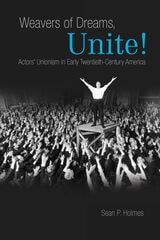
Weavers of Dreams, Unite!
Actors' Unionism in Early Twentieth-Century AmericaSean P. Holmes
University of Illinois Press, 2013
Published to coincide with the centenary of the founding of the Actors' Equity Association in 1913, Weavers of Dreams, Unite! explores the history of actors' unionism in the United States from the late nineteenth century to the onset of the Great Depression. Drawing upon hitherto untapped archival resources in New York and Los Angeles, Sean P. Holmes documents how American stage actors used trade unionism to construct for themselves an occupational identity that foregrounded both their artistry and their respectability. In the process, he paints a vivid picture of life on the theatrical shop floor in an era in which economic, cultural, and technological changes were transforming the nature of acting as work. The engaging study offers important insights into the nature of cultural production in the early twentieth century, the role of class in the construction of cultural hierarchy, and the special problems that unionization posed for workers in the commercial entertainment industry.
[more]
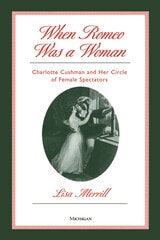
When Romeo Was a Woman
Charlotte Cushman and Her Circle of Female SpectatorsLisa Merrill
University of Michigan Press, 2000
At the height of her career, actress Charlotte Cushman (1816-76) was one of the most famous women in the English-speaking world. Cushman challenged Victorian notions of gender in her stage portrayals of male characters and of strong, androgynous female characters. Offstage, she was a powerful businesswoman who supported her family, women lovers, and friends.
Lisa Merrill examines Cushman's personal correspondence to shed new light on the actress's relationships and in turn on our understandings of the nature of women's "romantic friendships." She demonstrates how Cushman's androgynous presence served as a symbol to many of her contemporaries, and revealed their multiple and often contradictory attitudes toward female performers, women, and the unspeakable possibilities of same-sex desire.
The biography draws upon unpublished archival material as well as on current critical work to view Cushman's career, relationships, and posthumous reception. When Romeo Was a Woman examines as autobiographical performance Cushman's own narratives, the stories she authorized others to write, and the letters she wrote to intimates. The book is richly illustrated with many previously unpublished portraits of Cushman in her various stage roles, including Romeo and Lady Macbeth, and other revealing photographs of her family, lovers and friends.
When Romeo Was a Woman will find an appreciative audience among general readers as well as specialists in gay/lesbian history, women's history, theater and performance, popular culture, Victorian studies, and American studies.
"A fascinating story, and a major contribution to our understanding of lesbian history. . . . The work done on archival resources is both impressive in its extent and wholly convincing in its effect." --Jacky Bratton, University of London
Lisa Merrill is Associate Professor of Communication and Performance Studies, Hofstra University. She is the coauthor of The Power to Communicate: Gender Differences as Barriers, and the author of Untying the Tongue: Power, Gender, and the Word, forthcoming.
[more]