336 books match the query 'Age' and 17 start with w
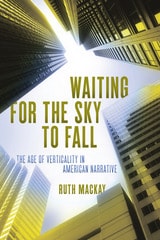
cover of Waiting for the Sky to Fall: The Age of Verticality in American Narrative

Waiting for the Sky to Fall

The Age of Verticality in American Narrative

Ruth Mackay

The Ohio State University Press, 2016

Waiting for the Sky to Fall: The Age of Verticality in American Narrative by Ruth Mackay traces the figures of flight, grievous falls, and collapsing towers, all of which haunt American narratives before and after 9/11. Mackay examines how these events prefigure 9/11, exploring the narrative residue left by the “end” of horizontal space—when settlers reached America’s Pacific Coast, leaving nowhere westward on the continent to go. She then continues into the aftermath of the fall of the Twin Towers. This period of time marks an era of verticality: an age that offers a transformed concept of the limits of space, entwined with a sense of anxiety and trepidation.

With this study, Mackay asks: In what oblique ways has verticality leaked into American narrative? Why do metaphors of up and down recur across the twentieth century? With close readings of Jonathan Safran Foer’s Extremely Loud and Incredibly Close, Winsor McCay’s comic strip Little Nemo in Slumberland, Upton Sinclair’s Oil! and its film rendering There Will Be Blood, Allen Ginsberg’s poetic dissections of the nuclear bomb, and Leslie Marmon Silko’s imagining of flight in Almanac of the Dead, this interdisciplinary study culminates with a discussion of Philippe Petit’s tightrope walk between the Twin Towers. Waiting for the Sky to Fall examines how vertical representation cleaves to, and often transforms the associations of, specific events that are physically and visually disorienting, disquieting, or even traumatic.
 
[more]
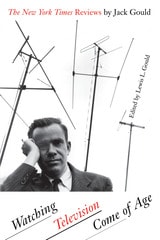
cover of Watching Television Come of Age: The New York Times Reviews by Jack Gould

Watching Television Come of Age

The New York Times Reviews by Jack Gould

Edited by Lewis L. Gould

University of Texas Press, 2002

Providing video companionship for isolated housewives, afternoon babysitting for children, and nonstop evening entertainment for the whole family, television revolutionized American society in the post-World War II years. Helping the first TV generation make sense of the new medium was the mission of Jack Gould, television critic of The New York Times from 1947 to 1972. In columns noteworthy for crisp writing, pointed insights, and fair judgment, he highlighted both the untapped possibilities and the imminent perils of television, becoming "the conscience of the industry" for many people.

In this book, historian Lewis L. Gould, Jack Gould's son, collects over seventy of his father's best columns. Grouped topically, they cover a wide range of issues, including the Golden Age of television drama, McCarthy-era blacklisting, the rise and fall of Edward R. Murrow, quiz show scandals, children's programming, and the impact of television on American life and of television criticism on the medium itself. Lewis Gould also supplies a brief biography of his father that assesses his influence on the evolution of television, as well as prefaces to each section.
[more]
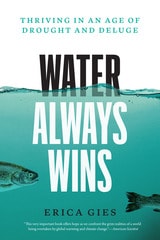
cover of Water Always Wins: Thriving in an Age of Drought and Deluge

Water Always Wins

Thriving in an Age of Drought and Deluge

Erica Gies

University of Chicago Press, 2022

Winner of the Rachel Carson Award for Excellence in Environmental Journalism, Water Always Wins is a hopeful journey around the world and across time, illuminating better ways to live with water. 

Nearly every human endeavor on the planet was conceived and constructed with a relatively stable climate in mind. But as new climate disasters remind us every day, our world is not stable—and it is changing in ways that expose the deep dysfunction of our relationship with water. Increasingly severe and frequent floods and droughts inevitably spur calls for higher levees, bigger drains, and longer aqueducts. But as we grapple with extreme weather, a hard truth is emerging: our development, including concrete infrastructure designed to control water, is actually exacerbating our problems. Because sooner or later, water always wins.

In this quietly radical book, science journalist Erica Gies introduces us to innovators in what she calls the Slow Water movement who start by asking a revolutionary question: What does water want? Using close observation, historical research, and cutting-edge science, these experts in hydrology, restoration ecology, engineering, and urban planning are already transforming our relationship with water. 

Modern civilizations tend to speed water away, erasing its slow phases on the land. Gies reminds us that water’s true nature is to flex with the rhythms of the earth: the slow phases absorb floods, store water for droughts, and feed natural systems. Figuring out what water wants—and accommodating its desires within our human landscapes—is now a crucial survival strategy. By putting these new approaches to the test, innovators in the Slow Water movement are reshaping the future.
[more]
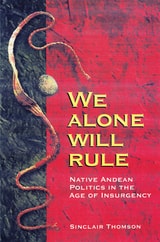
cover of We Alone Will Rule: Native Andean Politics in the Age of Insurgency

We Alone Will Rule

Native Andean Politics in the Age of Insurgency

Sinclair Thomson

University of Wisconsin Press, 2003
In the same era as the American, French, and Haitian revolutions, a powerful anticolonial movement swept across the highland Andes in 1780–1781. Initially unified around Túpac Amaru, a descendant of Inka royalty from Cuzco, it reached its most radical and violent phase in the region of La Paz (present-day Bolivia) where Aymara-speaking Indians waged war against Europeans under the peasant commander Túpaj Katari. The great Andean insurrection has received scant attention by historians of the "Age of Revolution," but in this book Sinclair Thomson reveals the connections between ongoing local struggles over Indian community government and a larger anticolonial movement.
[more]
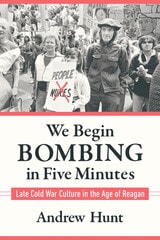
cover of We Begin Bombing in Five Minutes: Late Cold War Culture in the Age of Reagan

We Begin Bombing in Five Minutes

Late Cold War Culture in the Age of Reagan

Andrew Hunt

University of Massachusetts Press, 2021

In the moments before his weekly radio address hit the airwaves in 1984, Ronald Reagan made an off-the-record joke: "I've signed legislation that will outlaw Russia forever. We begin bombing in five minutes." As reports of the stunt leaked to the press, many Americans did not find themselves laughing along with the president. Long a fervent warrior against what he termed the "Evil Empire," by the mid-1980s, Reagan confronted growing domestic opposition to his revival of the Cold War. While numerous histories of the era have glorified the "Decade of Greed," historian Andrew Hunt instead explores the period's robust political and cultural dissent.

We Begin Bombing in Five Minutes focuses on a striking array of protest movements that took up issues such as the nuclear arms race, U.S. intervention in Central America, and American investments in South Africa. Hunt's new history of the eighties investigates how film, television, and other facets of popular culture critiqued Washington's Cold War policies and reveals that activists and cultural rebels alike posed a more meaningful challenge to the Cold War's excesses than their predecessors in the McCarthy era.
[more]
cover of Weathering the Storm: Independent Writing Programs in the Age of Fiscal Austerity

Weathering the Storm

Independent Writing Programs in the Age of Fiscal Austerity

Richard N. Matzen Jr.

Utah State University Press, 2019

Weathering the Storm assesses the socioeconomic and political conditions that have surrounded the rise of independent writing programs (IWPs) and departments. Chapter contributors look at the institutional conditions and challenges that IWPs have faced since the 1980s with a focus on enduring the financial collapse of 2008.
 
Leading writing specialists at the University of Texas at Austin, Syracuse University, the University of Minnesota, and many other institutions document and think carefully about the on-the-ground obstacles that have made the creation of IWPs unique. From institutional naysayers in English departments to skeptical administrators, IWPs and the faculty within them have surmounted not only negative economics but also negative rhetorics. This collection charts the story of this journey as writing faculty continually make the case for the importance of writing in the university curriculum.
 
Independence has, for the most part, allowed IWPs to better respond to the Great Recession, but to do so they have had to define writing studies in relation to other disciplines and departments. Weathering the Storm will be of great interest to faculty and graduate students in rhetoric and composition, writing program administrators, and writing studies and English department faculty.
 
Contributors: Linda Adler-Kassner, Lois Agnew, Alice Batt, David Beard, Davida Charney, Amy Clements, Diane Davis, Frank Gaughan, Heidi Skurat Harris, George H. Jensen, Rodger LeGrand, Drew M. Loewe, Mark Garrett Longaker, Cindy Moore, Peggy O’Neill, Chongwon Park, Louise Wetherbee Phelps, Mary Rist, Valerie Ross, John J Ruszkiewicz, Eileen E. Schell, Madeleine Sorapure, Chris Thaiss, Patrick Wehner, Jamie White-Farnham, Carl Whithaus, Traci A. Zimmerman
 
[more]
cover of When Democrats Won the Heartland: Progressive Populism in the Age of Reagan, 1978-1992

When Democrats Won the Heartland

Progressive Populism in the Age of Reagan, 1978-1992

Cory Haala

University of Illinois Press, 2026

In the 1980s, the Midwestern economic collapse caused by the farm crisis and deindustrialization inspired the region’s liberal politicians to call on progressive populist traditions to rebuild local, state, and national Democratic parties. Cory Haala looks at the Midwest’s central role in asserting an updated populism wielded by grassroots activists, politicians, and a wide-ranging coalition of voters to counter Reagan-era conservativism.

This left-oriented movement resurrected the imagery and policies of twentieth-century radical parties like the Minnesota Farmer-Labor Party and Robert La Follette’s Wisconsin Idea. Delving into progressive populist ideas and tactics, Haala illuminates the work of the activists and politicians who led protests, founded a congressional caucus, and backed presidential campaigns that sought to advance their cause. Haala’s account moves from Iron Range union halls to Iowa farmhouses to South Dakota reservations to revise views of Democratic Party history, the Midwest’s political culture, and populism’s role in US politics.

A counter to established political narratives, When Democrats Won the Heartland takes readers into the history of an unexpected political moment.

[more]
[more]
cover of Winnipeg's Great War: A City Comes of Age

Winnipeg's Great War

A City Comes of Age

Jim Blanchard

University of Manitoba Press, 2010
From the local bestselling author of Winnipeg 1912 comes the riveting next chapter in the city’s history. Winnipeg’s Great War picks up in 1914, just as the city is regrouping after a brief economic downturn. War comes unexpectedly, thoughts of recovery are abandoned, and the city digs in for a hard-fought four years.Using letters, diaries, and newspaper reports, Jim Blanchard brings us into the homes and public offices of Winnipeg and its citizens to illustrate the profound effect the war had on every aspect of the city, from its politics and economy, to its men on the battlefield, and its war-weary families fighting on the home front. We witness the emergence of the city’s social welfare services through the work of women’s volunteer organizations; the political scandals that led to the fall of the Rodmond Roblin government; and the clash between independent jitneys and the city’s private transit company. And we hear the conflicted emotions that echoed in the city’s streets, from anti-foreign sentiment and labour unrest, to patriotic parades, and a spontaneous Victory Day celebration that refused to end.Through these stories, Blanchard reveals how these crucial years set the stage for the decades ahead, and how the First World War transformed Winnipeg into the city it is today.
[more]
cover of Wives Not Slaves: Patriarchy and Modernity in the Age of Revolutions

Wives Not Slaves

Patriarchy and Modernity in the Age of Revolutions

Kirsten Sword

University of Chicago Press, 2021

Wives not Slaves begins with the story of John and Eunice Davis, a colonial American couple who, in 1762, advertised their marital difficulties in the New Hampshire Gazette—a more common practice for the time and place than contemporary readers might think. John Davis began the exchange after Eunice left him, with a notice resembling the ads about runaway slaves and servants that were a common feature of eighteenth-century newspapers. John warned neighbors against “entertaining her or harbouring her. . . or giving her credit.” Eunice defiantly replied, “If I am your wife, I am not your slave.” With this pointed but problematic analogy, Eunice connected her individual challenge to her husband’s authority with the broader critiques of patriarchal power found in the politics, religion, and literature of the British Atlantic world.

Kirsten Sword’s richly researched history reconstructs the stories of wives who fled their husbands between the mid-seventeenth and early nineteenth centuries, comparing their plight with that of other runaway dependents.  Wives not Slaves explores the links between local justice, the emerging press, and transatlantic political debates about marriage, slavery and imperial power. Sword traces the relationship between the distress of ordinary households, domestic unrest, and political unrest, shedding new light on the social changes imagined by eighteenth-century revolutionaries, and on the politics that determined which patriarchal forms and customs the new American nation would—and would not—abolish.

[more]
cover of Women and Music in the Age of Austen

Women and Music in the Age of Austen

Linda Zionkowski

Bucknell University Press, 2024

Women and Music in the Age of Austen highlights the central role women played in musical performance, composition, reception, and representation, and analyzes its formative and lasting effect on Georgian culture. This interdisciplinary collection of essays from musicology, literary studies, and gender studies challenges the conventional historical categories that marginalize women’s experience from Austen’s time. Contesting the distinctions between professional and amateur musicians, public and domestic sites of musical production, and performers and composers of music, the contributors reveal how women’s widespread involvement in the Georgian musical scene allowed for self-expression, artistic influence, and access to communities that transcended the boundaries of gender, class, and nationality. This volume’s breadth of focus advances our understanding of a period that witnessed a musical flourishing, much of it animated by female hands and voices.

Published by Bucknell University Press. Distributed worldwide by Rutgers University Press.

 
[more]
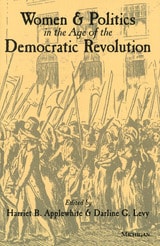
cover of Women and Politics in the Age of the Democratic Revolution

Women and Politics in the Age of the Democratic Revolution

Harriet B. Applewhite and Darline G. Levy, Editors

University of Michigan Press, 1993
Women and Politics in the Age of the Democratic Revolution is a groundbreaking collection that challenges traditional narratives of eighteenth-century political upheaval by centering the experience and agency of women across Europe and North America. Edited by Harriet B. Applewhite and Darline G. Levy, this volume gathers leading historians to explore how gender shaped and was shaped by the processes of revolution and democratization from the 1760s through the early nineteenth century.Bridging comparative and interdisciplinary scholarship, the collection examines the diverse ways that women engaged with, contributed to, and contested revolutionary politics in France, England, the Netherlands, Belgium, and the United States. Essays range from analyses of women’s participation in bread riots, neighborhood activism, and political clubs, to their presence in national insurrections and their influence as writers, petitioners, and public intellectuals. The contributors reveal the ways that women negotiated—and sometimes redefined—the boundaries of citizenship, civic virtue, and political rights during times of extraordinary change.The book also interrogates the limitations of the era’s revolutionary ideals, revealing how promises of liberty and equality were often circumscribed by gendered exclusions from formal political life. Yet, even as new constitutions, legislatures, and parties sidelined women as citizens, these essays show how women’s collective and individual actions laid groundwork for later struggles for suffrage, legal equality, and social reform.Richly documented and theoretically innovative, Women and Politics in the Age of the Democratic Revolution is essential reading for anyone interested in gender, democracy, and the ongoing project of political inclusion. It offers a nuanced portrait not just of women’s defeats and exclusions, but of the complex legacies of empowerment, mobilization, and the reimagining of citizenship that continue to shape modern political cultures.
[more]
cover of World War and World Peace in the Age of Digital Capitalism

World War and World Peace in the Age of Digital Capitalism

By Christian Fuchs

University of Westminster Press, 2025

World politics has become highly polarised, and a new world war has become more likely. The United Nations’ 2024 Pact for the Future expressed concerns about ‘the growing risks of a nuclear war which could pose an existential threat to humanity’. Will humanity descend into barbarism, or will we realise the dangers of our global problems, weapons of mass destruction, and climate catastrophe to avoid annihilation and create perpetual world peace?

In World War and World Peace in the Age of Digital Capitalism, Christian Fuchs asks: how do violence and war manifest themselves in global digital capitalism? How do digital capitalism and digital technologies manifest themselves in violence and warfare? What are the prospects for world peace today?

To prevent world war and advance world peace we need a better understanding of war and violence and their contexts and causes. We need to ask what war is, what violence is, what war and peace look like today and how they have changed in the 21st century. This book addresses these urgent questions and provides possible answers.
[more]
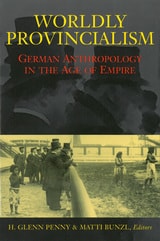
cover of Worldly Provincialism: German Anthropology in the Age of Empire

Worldly Provincialism

German Anthropology in the Age of Empire

H. Glenn Penny and Matti Bunzl, Editors

University of Michigan Press, 2003

Worldly Provincialism introduces readers to the intellectual history that drove the emergence of German anthropology. Drawing on the most recent work on the history of the discipline, the contributors rethink the historical and cultural connections between German anthropology, colonialism, and race. By showing that German intellectual traditions differed markedly from those of Western Europe, they challenge the prevalent assumption that Europeans abroad shared a common cultural code and behaved similarly toward non-Europeans. The eloquent and well-informed essays in this volume demonstrate that early German anthropology was fueled by more than a simple colonialist drive. Rather, a wide range of intellectual history shaped the Germans' rich and multifarious interest in the cultures, religions, physiognomy, physiology, and history of non-Europeans, and gave rise to their desire to connect with the wider world.
Furthermore, this volume calls for a more nuanced understanding of Germany's standing in postcolonial studies. In contrast to the prevailing view of German imperialism as a direct precursor to Nazi atrocities, this volume proposes a key insight that goes to the heart of German historiography: There is no clear trajectory to be drawn from the complex ideologies of imperial anthropology to the race science embraced by the Nazis. Instead of relying on a nineteenth-century explanation for twentieth-century crimes, this volume ultimately illuminates German ethnology and anthropology as local phenomena, best approached in terms of their own worldly provincialism.
H. Glenn Penny is Assistant Professor of History at the University of Missouri, Kansas City.
Matti Bunzl Assistant Professor of Anthropology and History at the University of Illinois at Urbana-Champaign.

[more]
cover of Writing and School Reform: Writing Instruction in the Age of Common Core and Standardized Testing

Writing and School Reform

Writing Instruction in the Age of Common Core and Standardized Testing

Joanne Addison

University Press of Colorado, 2017
In Writing and School Reform, Joanne Addison and Sharon James McGee respond to a testing and accountability movement that has imposed increasingly stronger measures of control over our classrooms, shifted teaching away from best practices, and eroded teacher and student agency. Drawing on historical and empirical research, Writing and School Reform details the origins of the accountability movement, explores its emerging effects on the teaching of writing, and charts a path forward that reasserts the agency of teachers and researchers in the field.
[more]
cover of Writing the Black Diasporic City in the Age of Globalization

Writing the Black Diasporic City in the Age of Globalization

Carol Bailey

Rutgers University Press, 2023
Writing the Black Diasporic City in the Age of Globalization theorizes the city as a generative, “semicircular” social space, where the changes of globalization are most profoundly experienced. The fictive accounts analyzed here configure cities as spaces where movement is simultaneously restrictive and liberating, and where life prospects are at once promising and daunting. In their depictions of the urban experiences of peoples of African descent, writers and other creative artists offer a complex set of renditions of twentieth- and twenty-first-century Black urban citizens’ experience in European or Euro-dominated cities such as Boston, London, New York, and Toronto, as well as Global South cities such as Accra, Kingston, and Lagos—that emerged out of colonial domination, and which have emerged as hubs of current globalization. Writing the Black Diasporic City draws on critical tools of classical postcolonial studies as well as those of globalization studies to read works by Ama Ata Aidoo, Amma Darko, Marlon James, Cecil Foster, Zadie Smith, Michael Thomas, Chika Unigwe, and other contemporary writers. The book also engages the television series Call the Midwife, the Canada carnival celebration Caribana, and the film series Small Axe to show how cities are characterized as open, complicated spaces that are constantly shifting. Cities collapse boundaries, allowing for both haunting and healing, and they can sever the connection from kin and community, or create new connections.
[more]
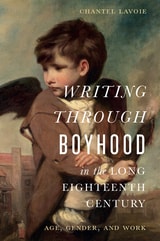
cover of Writing through Boyhood in the Long Eighteenth Century: Age, Gender, and Work

Writing through Boyhood in the Long Eighteenth Century

Age, Gender, and Work

Chantel Lavoie

University of Delaware Press, 2024

Writing through Boyhood in the Long Eighteenth Century explores how boyhood was constructed in different creative spaces that reflected the lived experience of young boys through the long eighteenth century—not simply in children’s literature but in novels, poetry, medical advice, criminal broadsides, and automaton exhibitions. The chapters encompass such rituals as breeching, learning to read and write, and going to school. They also consider the lives of boys such as chimney sweeps and convicted criminals, whose bodily labor was considered their only value and who often did not live beyond boyhood. Defined by a variety of tasks, expectations, and objectifications, boys—real, imagined, and sometimes both—were subject to the control of their elders and were used as tools in the cause of civil society, commerce, and empire. This book argues that boys in the long eighteenth century constituted a particular kind of currency, both valuable and expendable—valuable because of gender, expendable because of youth. 
[more]