Results by title
61 books match the query 'Agribusiness' and 4 start with w
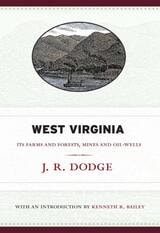
West Virginia
Its Farms and Forests, Mines and Oil-WellsJ. R. Dodge
West Virginia University Press, 2011
West Virginia: Its Farms and Forests, Mines and Oil-Wells celebrates the state of West Virginia. Originally published in 1865 as a series of studies on mineral resources, observations on agriculture, and interviews with businessmen, West Virginia details the industrial statistics, terrain, and population of a state during its infancy. With no record of natural wealth or reported transactions of agriculture or geography prior to this overview, West Virginia sparked the curiosity of non-residents, enticing investment and settlement through descriptions of abundant natural resources and an agreeable industrial condition. With an introduction by Kenneth R. Bailey, this new edition reminds us of the state’s alluring beginning and rich, yet often exploited development.

Western Stock Ranching
Mont H. Saunderson
University of Minnesota Press, 1950
Western Stock Ranching was first published in 1950. Minnesota Archive Editions uses digital technology to make long-unavailable books once again accessible, and are published unaltered from the original University of Minnesota Press editions.
Successful management of a stock ranch today requires a thorough, specialized knowledge of the land, the livestock, and the financial methods involved. This facts and figures study by an expert with long experience as a range economist deals with the working problems of sheep and cattle ranching and provides authoritative information on how to operate a ranch profitably.
The business of ranching is analyzed in terms of markets, prices and incomes, management standards and guides for production, financial planning and reports, production cost analysis, ranch appraisal, rangeland management, and procedures in the use of government lands. The various natural regions of the West are surveyed and the types of ranches found in each section are described.
In addition to considering in detail everyday ranch problems, the author realistically discusses the long-range problems confronting western stock ranchers as a group. Photographs, tables, sample accounting forms, and actual case illustrations add greatly to the usefulness of the book.
Owners and operators of stock ranches, persons planning to enter the business, professional agriculturalists specializing in credit, marketing, or management, and teachers of courses in ranch management and economy will find this an invaluable reference or text.
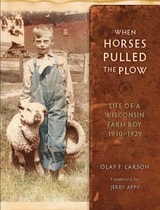
When Horses Pulled the Plow
Life of a Wisconsin Farm Boy, 1910–1929Olaf F. Larson
University of Wisconsin Press, 2011

Wine By Design
Santa Barbara's Quest for TerroirVictor W. Geraci
University of Nevada Press, 2020
As the American demand for premium wine grapes intensified in the late twentieth century, the Northern California wine industry rapidly grew its boutique and innovative local designer winemaking to increase profit to meet demand and compete on a global scale. Set in the context of the regional, national, and global wine community, this story illuminates a regional story of how the Santa Barbara wine industry found solutions to current market conditions while utilizing local traditions to develop a new version of local wine terroir. An accomplishment that allowed them to compete in the global marketplace yet develop highly specialized wine that is unique to the region.
By employing leading-edge technology and entrepreneurship, the California Central Coast region of Santa Barbara became a model for the American vision of agricultural innovation and an integral part of the international wine trade, developing a personalized version of local wine terroir.