Results by title
239 books match the query 'Agriculture' and 9 start with w
Water and Agriculture in Colorado and the American West
First in Line for the Rio GrandeDavid Stiller
University of Nevada Press, 2021
David Stiller’s thoughtful study focuses on the history of agricultural water use of the Rio Grande in Colorado’s San Luis Valley. After surveying the practices of early farmers in the region, he focuses on the impacts of Euro-American settlement and the ways these new agrarians endeavored to control the river. Using the Rio Grande as a case study, Stiller offers an informed and accessible history of the development of practices and technologies to store, distribute, and exploit water in Colorado and other western states, as well as an account of the creation of water rights and laws that govern this essential commodity throughout the West to this day. Stiller’s work ranges from meticulously monitored fields of irrigated alfalfa and potatoes to the local and state water agencies and halls of Congress. He also includes perceptive comments on the future of western water as these arid states become increasingly urbanized during a period of worsening drought and climate change.
An excellent read for anyone curious about important issues in the West, Water and Agriculture in Colorado and the American West offers a succinct summary and analysis of Colorado’s use of water by agricultural interests, in addition to a valuable discussion of the past, present, and future of struggles over this necessary and endangered resource.
Water and Power in Highland Peru
The Cultural Politics of Irrigation and DevelopmentPaul H Gelles
Rutgers University Press, 2000
Cabanaconde, a town of 5,000 people, is located in the arid Andean highlands. It is dominated by the foreboding Hualca Hualca mountain peak that is the source of this town’s much-needed water. How the villagers obtain this water, Paul Gelles writes, is not a simple process: the politics of irrigation in this area reflect a struggle for control of vital resources, deeply rooted in the clash between local, ritualized models of water distribution and the secular model put forth by the Peruvian state. Water and Power in Highland Peru provides an insightful case study on the intense conflicts over water rights, and a framework for studying ethnic conflict and the effects of “development,” not only in Peru, but in other areas as well.
Most of the inhabitants of Cabanaconde do not identify themselves with the dominant Spanish-speaking culture found in Peru. And the Peruvian state, grounded in a racist, post-Colonial ethos, challenges the village’s long-standing, non-Western framework for organizing water management.
Gelles demonstrates that Andean culture is dynamic and adaptive, and it is a powerful source of ethnic identity, even for those who leave the village to live elsewhere. Indigenous rituals developed in this part of the world, he states, have become powerful tools of resistance against interference by local elites and the present-day Peruvian state. Most importantly, the micropolitics of Cabanaconde provide a window into a struggle that is taking place around the world.
Watering the Revolution
An Environmental and Technological History of Agrarian Reform in MexicoMikael D. Wolfe
Duke University Press, 2017
Weathering Risk in Rural Mexico
Climatic, Institutional, and Economic ChangeHallie Eakin
University of Arizona Press, 2006
In Weathering Risk in Rural Mexico, Hallie Eakin draws on ethnographic data collected in three agricultural communities in rural Mexico to show how economic and climatic change are not only linked in cause and effect at the planetary scale but also interact in unpredictable and complex ways in the context of regional political and trade relationships, national economic and social programs, and the decision making of institutions, enterprises, and individuals.She shows how the parallel processes of globalization and climatic change result in populations that are “doubly exposed” and thus particularly vulnerable.
Chapters trace the effects of El Niño in central Mexico in the late 1990s alongside some of the principal changes in the country’s agricultural policy. Eakin argues that in order to develop policies that effectively address rural poverty and agricultural development, we need an improved understanding of how households cope simultaneously with various sources of uncertainty and adjust their livelihoods to accommodate newly evolving environmental, political, and economic realities.
Where the Red-Winged Blackbirds Sing
The Akimel O'odham and Cycles of Agricultural Transformation in the Phoenix BasinJennifer Bess
University Press of Colorado, 2021
Author Jennifer Bess examines the Akimel O’odham’s worldview, which links their origins with a responsibility to farm the Gila River Valley and to honor their history of adaptation and obligations as “world-builders”—co-creators of an evermore life-sustaining environment and participants in flexible networks of economic exchange. Bess considers this worldview in context of the Huhugam–Akimel O’odham agricultural economy over more than a thousand years. Drawing directly on Akimel O’odham traditional ecological knowledge, innovations, and interpretive strategies in archives and interviews, Bess shows how the Akimel O’odham engaged in agricultural economy for the sake of their lifeways, collective identity, enduring future, and actualization of the values modeled in their sacred stories.
Where the Red-Winged Blackbirds Sing highlights the values of adaptation, innovation, and co-creation fundamental to Akimel O’odham lifeways and chronicles the contributions the Akimel O’odham have made to American history and to the history of agriculture. The book will be of interest to scholars of Indigenous, American Southwestern, and agricultural history.
Wildly Successful Farming
Sustainability and the New Agricultural Land EthicBrian DeVore
University of Wisconsin Press, 2020
Written by agricultural journalist Brian DeVore, the book is based on interviews he has conducted at farms, wildlife refuges, laboratories, test plots, and gardens over the past twenty-five years. He documents innovations in cover cropping, managed rotational grazing, perennial polyculture, and integrated pest management. His accounts provide insight into the impacts regenerative farming methods can have on wildlife, water, landscape, soils, and rural communities and suggest ways all of us can support wildly successful farmers.
William J. Spillman and the Birth of Agricultural Economics
Laurie Winn Carlson
University of Missouri Press, 2005
Wisconsin Agriculture
A HistoryJerry Apps
Wisconsin Historical Society Press, 2015
"I'm embarrassed to say I thought I knew anything substantial about Wisconsin agriculture or its history before I read this book. 'Wisconsin Agriculture' should be required reading in history classes from high school to the collegiate level. It makes me thankful that Jerry Apps has such a sense of commitment to Wisconsin's agricultural heritage--and to getting the story right." --Pam Jahnke, Farm Director, Wisconsin Farm Report Radio
Wisconsin has been a farming state from its very beginnings. And though it's long been known as "the Dairy State," it produces much more than cows, milk, and cheese. In fact, Wisconsin is one of the most diverse agricultural states in the nation.
The story of farming in Wisconsin is rich and diverse as well, and the threads of that story are related and intertwined. In this long-awaited volume, celebrated rural historian Jerry Apps examines everything from the fundamental influences of landscape and weather to complex matters of ethnic and pioneer settlement patterns, changing technology, agricultural research and education, and government regulations and policies. Along with expected topics, such as the cranberry industry and artisan cheesemaking, "Wisconsin Agriculture" delves into beef cattle and dairy goats, fur farming and Christmas trees, maple syrup and honey, and other specialty crops, including ginseng, hemp, cherries, sugar beets, mint, sphagnum moss, flax, and hops. Apps also explores new and rediscovered farming endeavors, from aquaculture to urban farming to beekeeping, and discusses recent political developments, such as the 2014 Farm Bill and its ramifications. And he looks to the future of farming, contemplating questions of ethical growing practices, food safety, sustainability, and the potential effects of climate change.
Featuring first-person accounts from the settlement era to today, along with more than 200 captivating photographs, "Wisconsin Agriculture" breathes life into the facts and figures of 150 years of farming history and provides compelling insights into the state's agricultural past, present, and future.
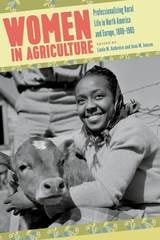
Women in Agriculture
Professionalizing Rural Life in North America and Europe, 1880-1965Linda M. Ambrose and Joan M. Jensen
University of Iowa Press, 2017
The contributors to Women in Agriculture examine how rural women’s expertise was disseminated and how it was received. Through these essays, readers meet subversively lunching ladies in Ontario and African American home demonstration agents in Arkansas. The rural sociologist Emily Hoag made a place for women at the US Department of Agriculture as well as in agricultural research. Canadian rural reformer Madge Watt, British radio broadcaster Mabel Webb, and US ethnobotanists Mary Warren English and Frances Densmore developed new ways to share and preserve rural women’s knowledge. These and the other women profiled here updated and expanded rural women’s roles in shaping their communities and the broader society. Their stories broaden and complicate the history of agriculture in North America and Western Europe.
Contributors:
Linda M. Ambrose, Maggie Andrews, Cherisse Branch-Jones, Joan M. Jensen, Amy McKinney, Anne Moore, Karen Sayer, Margreet van der Burg, Nicola Verdon