Results by title
209 books match the query 'Alaska' and 13 start with w

Wake of the Unseen Object
Travels through Alaska's Native LandscapesTom Kizzia
University of Alaska Press, 2020
Water Mask
Monica Devine
University of Alaska Press, 2019
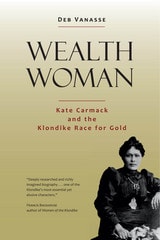
Wealth Woman
Kate Carmack and the Klondike Race for GoldDeb Vanasse
University of Alaska Press, 2016
In Wealth Woman, Deb Vanasse recounts Kate’s life from her early years on the frontier with George, through the history-making discovery of gold, and on to her subsequent fame, when she traveled alone down the West Coast through Washington and California, telling her story and fighting for her wealth, her family, and her reputation. Recovering the lost story of a true pioneer and a fiercely independent woman, Wealth Woman brings gold rush Alaska to life in all its drama and glory.
Whale Snow
Iñupiat, Climate Change, and Multispecies Resilience in Arctic AlaskaChie Sakakibara
University of Arizona Press, 2014
Using multispecies ethnography, Whale Snow explores how everyday the relatedness of the Iñupiat of Arctic Alaska and the bowhead whale forms and transforms “the human” through their encounters with modernity. Whale Snow shows how the people live in the world that intersects with other beings, how these connections came into being, and, most importantly, how such intimate and intense relations help humans survive the social challenges incurred by climate change. In this time of ecological transition, exploring multispecies relatedness is crucial as it keeps social capacities to adapt relational, elastic, and resilient.
In the Arctic, climate, culture, and human resilience are connected through bowhead whaling. In Whale Snow we see how climate change disrupts this ancient practice and, in the process, affects a vital expression of Indigenous sovereignty. Ultimately, though, this book offers a story of hope grounded in multispecies resilience.
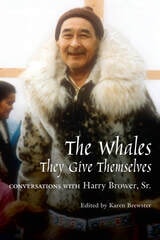
Whales, They Give Themselves
Conversations with Harry Brower, Sr.Karen Brewster
University of Alaska Press, 2004
Brower was deeply committed to Native culture, and his life history is a moving expression of the Inupiaq way of life. He was also influential in traditionally non-Native arenas in which Native and non-Native values sometimes collided. Acting as a mediator between Inupiaq whalers and non-Native scientists, Brower communicated a vast understanding of bowhead whales and whaling that became the basis for a scientific research program and helped protect Inupiaq subsistence whaling. He was a central architect of the Arctic Slope Regional Corporation boundaries, and served for over twenty years as a consultant to scientists at the Naval Arctic Research Laboratory. Brower's role in this collaborative research serves as one of the earliest and best examples of how scientists and Native experts can work together to advance knowledge. Such approaches are now promoted by researchers around the world.
The Whales, They Give Themselves not only conveys Brower's life story, but also is a cross-cultural journey of wisdom and friendship. Whereas academic oral historians once strove to erase the presence of the interviewer in the name of objectivity, Brewster recognizes the influence her specific relationship with Brower had on the way he narrated his life. This volume is a major contribution to our understanding of northern peoples, and a testament to the immense value of collaborative oral history.
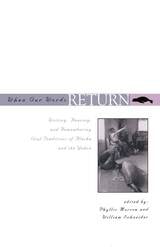
When Our Words Return
Writing, Hearing, and Remembering Oral Traditions from Alasak and the Yukonedited by Phyllis Morrow & William Schneider
Utah State University Press, 1995
The title to this interdisciplinary collection draws on the Yupik Eskimo belief that seals, fish, and other game are precious gifts that, when treated with respect and care, will return to be hunted again. Just so, if oral traditions are told faithfully and respectfully, they will return to benefit future generations. The contributors to this volume are concerned with the interpretation and representation of oral narrative and how it is shaped by its audience and the time, place, and cultural context of the narration. Thus, oral traditions are understood as a series of dialogues between tradition bearers and their listeners, including those who record, write, and interpret.

Wildcat Women
Narratives of Women Breaking Ground in Alaska's Oil and Gas IndustryCarla Williams
University of Alaska Press, 2018
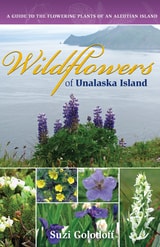
Wildflowers of Unalaska Island
A Guide to the Flowering Plants of an Aleutian Island, Second EditionSuzi Golodoff
University of Alaska Press, 2013
Each species is introduced and clearly defined and is accompanied by a photograph and line drawings. Many of these plants occur across a wide range of coastal Alaska; others are unique to the Aleutians. The introduction includes background on the unique geologic history, climate, and habitats of the archipelago to fully round out the user’s appreciation of the dramatic environment in which these hardy plants thrive.

Williwaw
A NovelGore Vidal
University of Chicago Press, 2003
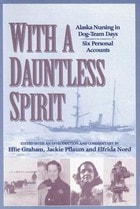
With a Dauntless Spirit
Alaska Nursing in Dog-Team Days.Effie Graham
University of Alaska Press, 2003
With a Dauntless Spirit compiles a unique collection of journals, letters, and memoirs that give immediacy and vitality to the lives of these women. They ventured with a sense of duty and compassion to deliver much-needed medical services before the technical, medical, and social changes brought to Alaska by World War II and later by statehood. Despite physical hardships and emotional isolation, the spirit of these women is reflected in the adventurous, dramatic, and even joyous tone of their narratives. The arctic tests the character of many newcomers, and the nurses recount the very personal challenges that demanded choices and actions that ran contrary to their earlier socialization. Their personal sagas also have significant historical dimensions. They depict the major cultural encounters of their era that were to have such a profound impact on Alaska's future-with Native peoples, prospectors, aviation pioneers, and arctic explorers.
This collection was selected from personal and archival sources by Alaska nurse educators and historians, who provide background and commentary, a brief biography of each person, and historical photos and maps of the nurses' lives and work. With a Dauntless Spirit is a readable and engrossing account that makes an important and overdue contribution to Alaska history and women's history.
With the Wind and the Waves
A Guide to Mental Health Practices in Alaska Native CommunitiesRay M. Droby
University of Alaska Press, 2020
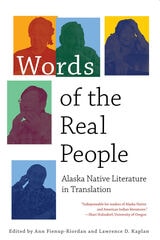
Words of the Real People
Alaska Native Literature in TranslationEdited by Ann Fienup-Riordan and Lawrence D. Kaplan
University of Alaska Press, 2007

Writing Habits
Historicism, Philosophy, and English Benedictine Convents, 1600–1800Jaime Goodrich
University of Alabama Press, 2021
The first in-depth examination of the texts produced in English Benedictine convents between 1600 and 1800.
After Catholicism became illegal in England during the sixteenth century, Englishwomen established more than twenty convents on the Continent that attracted thousands of nuns and served as vital centers of Catholic piety until the French Revolution. Today more than 1,000 manuscripts and books produced by, and for, the Benedictine convents are extant in European archives. Writing Habits: Historicism, Philosophy, and English Benedictine Convents, 1600–1800 provides the first substantive analysis of these works in order to examine how members of one religious order used textual production to address a major dilemma experienced by every English convent on the Continent: How could English nuns cultivate a cloistered identity when the Protestant Reformation had swept away nearly all vestiges of English monasticism?
Drawing on an innovative blend of methodologies, Jaime Goodrich contends that the Benedictines instilled a collective sense of spirituality through writings that created multiple overlapping communities, ranging from the earthly society of the convent to the transhistorical network of the Catholic Church. Because God resides at the heart of these communities, Goodrich draws on the works of Martin Buber, a twentieth-century Jewish philosopher who theorized that human community forms a circle, with each member acting as a radius leading toward the common center of God. Buber’s thought, especially his conception of the I-You framework for personal and spiritual relationships, illuminates a fourfold set of affiliations central to Benedictine textual production: between the nuns themselves, between the individual nun and God, between the convent and God, and between the convent and the Catholic public sphere. By evoking these relationships, the major genres of convent writing—administrative texts, spiritual works, history and life writing, and controversial tracts—functioned as tools for creating community and approaching God.
Through this Buberian reading of the cloister, Writing Habits recovers the works of Benedictine nuns and establishes their broader relevance to literary history and critical theory.