Results by title
76 books match the query 'Animal rights' and 4 start with w
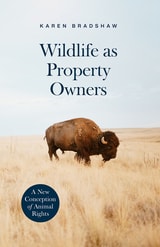
Wildlife as Property Owners
A New Conception of Animal RightsKaren Bradshaw
University of Chicago Press, 2020

Without Offending Humans
A Critique of Animal RightsÉlisabeth de Fontenay
University of Minnesota Press, 2012
A central thinker on the question of the animal in continental thought, Élisabeth de Fontenay moves in this volume from Jacques Derrida’s uneasily intimate writing on animals to a passionate frontal engagement with political and ethical theory as it has been applied to animals—along with a stinging critique of the work of Peter Singer and Paola Cavalieri as well as with other “utilitarian” philosophers of animal–human relations.
Humans and animals are different from one another. To conflate them is to be intellectually sentimental. And yet, from our position of dominance, do we not owe them more than we often acknowledge? In the searching first chapter on Derrida, she sets out “three levels of deconstruction” that are “testimony to the radicalization and shift of that philosopher’s argument: a strategy through the animal, exposition to an animal or to this animal, and compassion toward animals.” For Fontenay, Derrida’s writing is particularly far-reaching when it comes to thinking about animals, and she suggests many other possible philosophical resources including Adorno, Leibniz, and Merleau-Ponty.
Fontenay is at her most compelling in describing philosophy’s ongoing indifference to animal life—shading into savagery, underpinned by denial—and how attempts to exclude the animal from ethical systems have in fact demeaned humanity. But Fontenay’s essays carry more than philosophical significance. Without Offending Humans reveals a careful and emotionally sensitive thinker who explores the unfolding of humans’ assessments of their relationship to animals—and the consequences of these assessments for how we define ourselves.
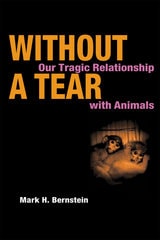
Without a Tear
Our Tragic Relationship with AnimalsMark H. Bernstein
University of Illinois Press, 2004
Most people who write about our ethical obligations concerning animals base their arguments on emotional appeals or contentious philosophical assumptions; Bernstein, however, argues from reasons but carries little theoretical baggage. He considers the issues in a religious context, where he finds that Judaism in particular has the resources to ground moral obligations to animals. Without a Tear also makes novel use of feminist ethics to add to the case for drawing animals more closely into our ethical world.
Bernstein details the realities of factory farms, animal-based research, and hunting fields, and contrasting these chilling facts with our moral imperatives clearly shows the need for fundamental changes to some of our most basic animal institutions. The tightly argued, provocative claims in Without a Tear will be an eye-opening experience for animal lovers, scholars, and people of good faith everywhere.

Women and the Animal Rights Movement
Emily Gaarder
Rutgers University Press, 2011
Animal rights is one of the fastest growing social movements today. Women greatly outnumber men as activists, yet surprisingly, little has been written about the importance and impact of gender on the movement. Women and the Animal Rights Movement combats stereotypes of women activists as mere sentimentalists by exploring the political and moral character of their advocacy on behalf of animals.
Emily Gaarder analyzes the politics of gender in the movement, incorporating in-depth interviews with women and participant observation of animal rights organizations, conferences, and protests to describe struggles over divisions of labor and leadership. Controversies over PETA advertising campaigns that rely on women's sexuality to "sell" animal rights illustrate how female crusaders are asked to prioritize the cause of animals above all else. Gaarder underscores the importance of a paradigm shift in the animal liberation movement, one that seeks a more integrated vision of animal rights that connects universally to other issues--gender, race, economics, and the environment--highlighting that many women activists recognize and are motivated by the connection between the oppression of animals and other social injustices.