Results by title
117 books match the query 'Anthology' and 11 start with w
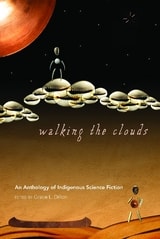
Walking the Clouds
An Anthology of Indigenous Science FictionEdited by Grace L. Dillon
University of Arizona Press, 2012
In this first-ever anthology of Indigenous science fiction Grace Dillon collects some of the finest examples of the craft with contributions by Native American, First Nations, Aboriginal Australian, and New Zealand Maori authors. The collection includes seminal authors such as Gerald Vizenor, historically important contributions often categorized as "magical realism" by authors like Leslie Marmon Silko and Sherman Alexie, and authors more recognizable to science fiction fans like William Sanders and Stephen Graham Jones. Dillon's engaging introduction situates the pieces in the larger context of science fiction and its conventions.
Organized by sub-genre, the book starts with Native slipstream, stories infused with time travel, alternate realities and alternative history like Vizenor's "Custer on the Slipstream." Next up are stories about contact with other beings featuring, among others, an excerpt from Gerry William's The Black Ship. Dillon includes stories that highlight Indigenous science like a piece from Archie Weller's Land of the Golden Clouds, asserting that one of the roles of Native science fiction is to disentangle that science from notions of "primitive" knowledge and myth. The fourth section calls out stories of apocalypse like William Sanders' "When This World Is All on Fire" and a piece from Zainab Amadahy's The Moons of Palmares. The anthology closes with examples of biskaabiiyang, or "returning to ourselves," bringing together stories like Eden Robinson's "Terminal Avenue" and a piece from Robert Sullivan's Star Waka.
An essential book for readers and students of both Native literature and science fiction, Walking the Clouds is an invaluable collection. It brings together not only great examples of Native science fiction from an internationally-known cast of authors, but Dillon's insightful scholarship sheds new light on the traditions of imagining an Indigenous future.
Water Lilies
An Anthology of Spanish Women Writers from the Fifteenth through the Nineteenth CenturyAmy Kaminsky
University of Minnesota Press, 1995
Poetry and prose by Spanish women presented here in both English and Spanish.
A dazzling sampler, Water Lilies brings to light a rich and until now largely invisible version of Spanish literary history. These hard-to-find works, most translated for the first time, are printed on facing pages in Spanish and English and located within a critical, biographical, and historical overview.
Here are five centuries of writing by Spanish women, the unknown recovered from obscurity, the well-known seen as they rarely have been-in the context of a women’s literary history. Some of these writers, like Rosalía de Castro in “The Bluestockings” and Teresa de Cartagena in Wonder at the Work of God, question the relationship between the woman writer and the act of writing. Some, like the poet Carolina Coronado in “The Twin Geniuses: Sappho and Saint Teresa of Jesus,” overtly seek a literary tradition. Others, like Saint Teresa in her Life and Luisa Sigea in her poetry, provide touchstones for women in search of such a tradition.Legends and stories of women’s friendships, the inconstancy of men, and the love of God; Spain’s first autobiographical text; secular and religious poetry from medieval through recent times; an excerpt from one of the few chivalresque novels written by a woman; a full-length Golden Age comedia: this is the wide range of works Water Lilies comprises. Brought together for the first time, the writers articulate their resistance to, and their complicity in, a literary history that, until now, has tried to exclude them.
Welcome to the Neighborhood
An Anthology of American CoexistenceSarah Green
Ohio University Press, 2019
How to live with difference—not necessarily in peace, but with resilience, engagement, and a lack of vitriol—is a defining worry in America at this moment. The poets, fiction writers, and essayists (plus one graphic novelist) who contributed to Welcome to the Neighborhood don’t necessarily offer roadmaps to harmonious neighboring. Some of their narrators don’t even want to be neighbors. Maybe they grieve, or rage. Maybe they briefly find resolution or community. But they do approach the question of what it means to be neighbors, and how we should do it, with open minds and nuance.
The many diverse contributors give this collection a depth beyond easy answers. Their attentions to the theme of neighborliness as an ongoing evolution offer hope to readers: possible pathways for rediscovering community, even just by way of a shared wish for it. The result is an enormously rich resource for the classroom and for anyone interested in reflecting on what it means to be American today, and how place and community play a part.
Contributors include Leila Chatti, Rita Dove, Jonathan Escoffery, Rebecca Morgan Frank, Amina Gautier, Ross Gay, Mark Halliday, Joy Harjo, Edward Hirsch, Marie Howe, Sonya Larson, Dinty W. Moore, Robert Pinsky, Christine Schutt, and many more.

Welcome to the Neighborhood
An Anthology of American CoexistenceSarah Green
Ohio University Press, 2001
How to live with difference—not necessarily in peace, but with resilience, engagement, and a lack of vitriol—is a defining worry in America at this moment. The poets, fiction writers, and essayists (plus one graphic novelist) who contributed to Welcome to the Neighborhood don’t necessarily offer roadmaps to harmonious neighboring. Some of their narrators don’t even want to be neighbors. Maybe they grieve, or rage. Maybe they briefly find resolution or community. But they do approach the question of what it means to be neighbors, and how we should do it, with open minds and nuance.
The many diverse contributors give this collection a depth beyond easy answers. Their attentions to the theme of neighborliness as an ongoing evolution offer hope to readers: possible pathways for rediscovering community, even just by way of a shared wish for it. The result is an enormously rich resource for the classroom and for anyone interested in reflecting on what it means to be American today, and how place and community play a part.
Contributors include Leila Chatti, Rita Dove, Jonathan Escoffery, Rebecca Morgan Frank, Amina Gautier, Ross Gay, Mark Halliday, Joy Harjo, Edward Hirsch, Marie Howe, Sonya Larson, Dinty W. Moore, Robert Pinsky, Christine Schutt, and many more.
When Language Broke Open
An Anthology of Queer and Trans Black Writers of Latin American DescentEdited by Alan Pelaez Lopez
University of Arizona Press, 2023
By exploring themes of memory, care, and futurity, these contributions expand understandings of Blackness in Latin America, the Caribbean, and their U.S.-based diasporas. The volume offers up three central questions: How do queer and/or trans Black writers of Latin American descent address memory? What are the textures of caring, being cared for, and accepting care as Black queer and/or trans people of Latin American descent? And how do queer and trans embodiments help us understand and/or question the past and the present, and construct a Black, queer, and trans future?
The works collected in this anthology encompass a multitude of genres—including poetry, autobiography, short stories, diaries, visual art, and a graphic memoir—and feature the voices of established writers alongside emerging voices. Together, the contributors challenge everything we think we know about gender, sexuality, race, and what it means to experience a livable life.
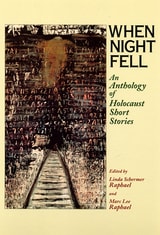
When Night Fell
An Anthology of Holocaust Short StoriesLinda Schermer Raphael and Marc Lee Raphael
Rutgers University Press, 1999
Both survivors of the Holocaust and those who were not there agree that it is impossible to tell what happened as the Nazi Final Solution was put into effect. No writing can adequately imagine the concentration camps, ghettos, and death camps. And that is precisely why writers must tell-and retell-what happened there.
In When Night Fell: An Anthology of Holocaust Short Stories, Linda Schermer Raphael and Marc Lee Raphael have collected twenty-six short stories that tell of the human toll of the Holocaust on those who survived its horrors, as well as later generations touched by its memory. The stories are framed by discussion of the current debate about who owns the Holocaust and who is entitled to speak about it.
Some of the stories included here are by internationally acclaimed authors. Others may be new to many readers. When Night Fell is a fitting memorial to this genocidal horror, putting eloquent voice to human endurance that is-almost-beyond words.
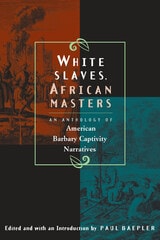
White Slaves, African Masters
An Anthology of American Barbary Captivity NarrativesEdited by Paul Baepler
University of Chicago Press, 1999
Though Barbary privateers began to seize North American colonists as early as 1625, Barbary captivity narratives did not begin to flourish until after the American Revolution. During these years, stories of Barbary captivity forced the U.S. government to pay humiliating tributes to African rulers, stimulated the drive to create the U.S. Navy, and brought on America's first post-revolutionary war. These tales also were used both to justify and to vilify slavery.
The accounts collected here range from the 1798 tale of John Foss, who was ransomed by Thomas Jefferson's administration for tribute totaling a sixth of the annual federal budget, to the story of Ion Perdicaris, whose (probably staged) abduction in Tangier in 1904 prompted Theodore Roosevelt to send warships to Morocco and inspired the 1975 film The Wind and the Lion. Also included is the unusual story of Robert Adams, a light-skinned African American who was abducted by Arabs and used by them to hunt negro slaves; captured by black villagers who presumed he was white; then was sold back to a group of Arabs, from whom he was ransomed by a British diplomat.
Long out of print and never before anthologized, these fascinating tales open an entirely new chapter of early American literary history, and shed new light on the more familiar genres of Indian captivity narrative and American slave narrative.
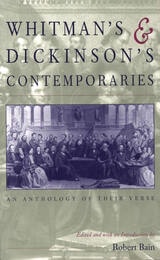
Whitman's & Dickinson's Contemporaries
An Anthology of their VerseEdited and with an Introduction by Robert Bain
Southern Illinois University Press, 1996
Emily Dickinson and Walt Whitman were not the poetic stars of their day; only a few friends knew that Dickinson wrote, and Whitman’s following was minuscule, if influential. But the contemporaries who eclipsed these major poets now have largely disappeared from our literary landscape.
In this distinctive anthology, Robert Bain gathers together thirteen other scholars to re-present the poetry of these former luminaries, allowing readers to rediscover them, reconstruct the poetic contexts of their age, and better understand why Whitman and Dickinson now overshadow other poets of their time.
Arranged chronologically according to the birth dates of the poets, this anthology introduces each poet’s work, providing biographical information and discussing the major forms and themes of the work. Each introduction places the poet in a literary and historical context with Whitman and Dickinson and provides a bibliography of secondary sources.
This remarkable book recovers a part of our literary heritage that has been lost.
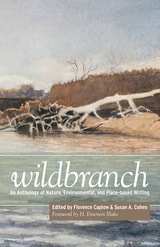
Wildbranch
An Anthology of Nature, Environmental, and Place-based WritingEdited by Florence Caplow and Susan A. Cohen. Foreword by H. Emerson Blake
University of Utah Press, 2010
Wildbranch: An Anthology of Nature, Environmental, and Place-based Writing is a powerful collection of mostly unpublished essays and poetry by both prominent American environmental writers and exciting new voices. The poetry and essays by more than fifty contributors offer the reader glimpses into places as diverse as a forest in West Africa, the moors of Ireland, the canyons of the Sonoran desert mountains, and the fields of New England, and they reflect the varied perspectives of field biologists, hunters, farmers, environmental educators, wilderness guides, academics, writers, and artists.
The collection is an intimate portrait of the natural world drawn through the wisdom, ecological consciousness, and open hearts of these exceptional contributors. The Wildbranch Writing Workshop, cosponsored by Orion magazine and Sterling College, has encouraged thoughtful natural history, outdoor, and environmental writing for more than twenty years. The Wildbranch faculty has included its founder E. Anne Proulx, the essayists Edward Hoagland, Janisse Ray, and Scott Russell Sanders, the poet Alison Hawthorne Deming, and many other notable authors. Many have work included in the anthology.
Winner of the New Mexico Book Association's Southwest Book Design & Production Awards for Excellence in the category Trade Books: Non-illustrated.
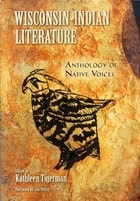
Wisconsin Indian Literature
Anthology of Native VoicesEdited by Kathleen Tigerman; Foreward by Jim Ottery
University of Wisconsin Press, 2006
Literature of the Indian Nations of Wisconsin is a unique anthology that presents the oral traditions, legends, speeches, myths, histories, literature, and historically significant documents of the current twelve independent bands and Indian Nations of Wisconsin. Kathleen Tigerman sought input from tribe elders and educators to provide an accurate chronological portrait of each nation, including the Siouan Ho-Chunk; the Algonquian Menominee, Ojibwe, and Potawatomi; and three groups originally from what is now New York State: the Iroquoian Oneida, the Stockbridge-Munsee band of the Mohican Nations, and the Brothertown Nation.
Some of these works feature a cultural hero or refer to very ancient times—more than six thousand years ago—and others are contemporary. These pieces focus on issues of Wisconsin Native communities by sharing Native knowledge and dialogue about sovereignty, decolonization, cultural genocide, forced removals, assimilation, and other concerns.
This anthology introduces us to a vivid and unforgettable group of voices, enhanced by many maps, photographs, and chronologies. Literature of the Indian Nations of Wisconsin fosters cross-cultural understanding among non-Native readers and the people of the First Nations.
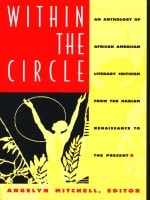
Within the Circle
An Anthology of African American Literary Criticism from the Harlem Renaissance to the PresentAngelyn Mitchell
Duke University Press, 1994
The essays in this collection—many of which are not widely available today—either initiated or gave critical definition to specific periods or movements of African American literature. They address issues such as integration, separatism, political action, black nationalism, Afrocentricity, black feminism, as well as the role of art, the artist, the critic, and the audience. With selections from Langston Hughes, Sterling Brown, W. E. B. DuBois, Zora Neale Hurston, Richard Wright, James Baldwin, Toni Morrison, Barbara Smith, Alice Walker, Henry Louis Gates, Jr., and many others, this definitive collection provides a dynamic model of the cultural, ideological, historical, and aesthetic considerations in African American literature and literary criticism.
A major contribution to the study of African American literature, this volume will serve as a foundation for future work by students and scholars. Its importance will be recognized by all those interested in modern literary theory as well as general readers concerned with the African American experience.
Selections by (partial list): Houston A. Baker, Jr., James Baldwin, Sterling Brown, Barbara Christian, W. E. B. DuBois, Ralph Ellison, LeRoi Jones, Sarah Webster Fabio, Henry Louis Gates, Jr., W. Lawrence Hogue, Langston Hughes, Zora Neale Hurston, Alain Locke, Deborah E. McDowell, Toni Morrison, J. Saunders Redding, George Schuyler, Barbara Smith, Valerie Smith, Hortense J. Spillers, Robert B. Stepto, Alice Walker, Margaret Walker, Mary Helen Washington, Richard Wright