Results by title
1272 books match the query 'Asia' and 40 start with w

Waiting for the Cool Moon
Anti-imperialist Struggles in the Heart of Japan's EmpireWendy Matsumura
Duke University Press, 2024
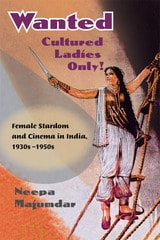
Wanted Cultured Ladies Only!
Female Stardom and Cinema in India, 1930s-1950sNeepa Majumdar
University of Illinois Press, 2008
War and Peace in Asia
International Law and Politics in Armed ConflictsKriangsak Kittichaisaree
National University of Singapore Press, 2026
How do Asian states navigate the complex terrain between international legal obligations and strategic national interests in matters of war and peace? What justifications are invoked to wage war, and what are the legal frameworks used to restore peace? Do bilateral settlements comply with and support the development of international law, or do they undermine it? This comprehensive study examines conflict and peace-building across Asia since 1945, providing a distinctly Asian perspective on international law and relations.
War and Peace in Asia considers how Asian history, including the region's experience of colonialism, shapes ideas of international order. Kriangsak Kittichaisaree considers rules against the threat or use of force; management of sovereignty disputes over borders and territories; insurgencies or conflicts arising from groups seeking self-determination; annexations of one State’s territory by another State; conflicts under the guise of “humanitarian intervention” and the Responsibility to Protect (R2P) doctrine; self-defense against terrorists and non-state actors who are driven by ideology; and armed intervention by invitation. The book offers scholars, policymakers, and practitioners crucial insights into conflict dynamics in this geopolitically volatile region.
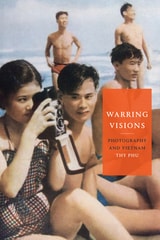
Warring Visions
Photography and VietnamThy Phu
Duke University Press, 2021
Wartime in Burma
A Diary, January to June 1942Theippan Maung Wa
Ohio University Press, 2009
This diary, begun after the Japanese attack on Pearl Harbor and covering the invasion of Burma up to June 1942, is a moving account of the dilemmas faced by the well-loved and prolific Burmese author Theippan Maung Wa (a pseudonym of U Sein Tin) and his family. At the time of the Japanese invasion, U Sein Tin was deputy secretary in the Ministry of Home and Defense Affairs. An Oxford-trained member of the Indian Civil Service, working for the British administration on the eve of the invasion, he lived with his wife and three small children in Rangoon.
Wartime in Burma is a stirring memoir that presents a personal account of U Sein Tin’s feelings about the war, his anxiety for the safety of his family, the bombing of Rangoon, and what happened to them during the next six chaotic months of the British retreat. The author and his family leave Rangoon to live in a remote forest in Upper Burma with several other Burmese civil servants, their staff, and valuable possessions—rich pickings for robbers. His diary ends abruptly on June 5, his forty-second birthday; U Sein Tin was murdered on June 6 by a gang of Burmese bandits. The diary pages, scattered on the floor of the house, were rescued by his wife and eventually published in Burma in 1966. What survives is a unique account that shines new light on the military retreat from Burma.
Washington's China
The National Security World, the Cold War, and the Origins of GlobalismJames L. Peck
University of Massachusetts Press, 2006
This book addresses a central question about the Cold War that has never been adequately resolved. Why did the United States go to such lengths not merely to “contain” the People's Republic of China but to isolate it from all diplomatic, cultural, and economic ties to other nations? Why, in other words, was American policy more hostile to China than to the Soviet Union, at least until President Nixon visited China in 1972?
The answer, as set out here, lies in the fear of China's emergence as a power capable of challenging the new Asian order the United States sought to shape in the wake of World War II. To meet this threat, American policymakers fashioned an ideology that was not simply or exclusively anticommunist, but one that aimed at creating an integrated, cooperative world capitalism under U.S. leadership—an ideology, in short, designed to outlive the Cold War.
In building his argument, James Peck draws on a wide variety of little-known documents from the archives of the National Security Council and the CIA. He shows how American officials initially viewed China as a “puppet” of the Soviet Union, then as “independent junior partner” in a Sino-Soviet bloc, and finally as “revolutionary model” and sponsor of social upheaval in the Third World. Each of these constructs revealed more about U.S. perceptions and strategic priorities than about actual shifts in Chinese thought and conduct. All were based on the assumption that China posed a direct threat not just to specific U.S. interests and objectives abroad but to the larger vision of a new global order dominated by American economic and military power. Although the nature of “Washington's China” may have changed over the years, Peck contends that the ideology behind it remains unchanged, even today.

Water Management in the Yellow River Basin of China
By Charles Greer
University of Texas Press, 1979
Throughout history the Yellow River, or Huang Ho, has repeatedly broken through its levees to rampage over the densely populated North China Plain. In spite of its importance as the major river of China, little has been written on the Yellow River and its management. Charles Greer fills this gap with his comprehensive and thoroughly researched book.
This work deals with the technological problems faced by the Chinese in taming the destructive river and also focuses on cultural attitudes that have governed the Chinese response to nature. For example, water control was not highly regarded by the Taoists, who preferred to let nature take its course; but the Buddhists sought to harness the river against devastating floods and also to benefit their crops.
Greer traces water use and management in the Yellow River Basin through Chinese history and discusses early Western interest in the flood problem and Soviet assistance in Yellow River development. He analyzes traditional methods of control as well as newer strategies and their implications.
The author of this book is one of a small number of social scientists able to master the original Chinese-language historical materials necessary to this undertaking. He has also examined Chinese water management methods first-hand as part of a delegation of water management specialists in 1976.
In addition to geographers and conservationists, China scholars will find this book valuable because of the axial role the control of the Yellow River plays in the fundamental economic health of the People’s Republic of China. Water management engineers will find much useful comparative material.
Waterways of Bangkok
Memory, Landscape and TwilightMichael Hurley
National University of Singapore Press, 2025
This ethnographic study explores memory along the waterways, a realm of boats and hovels, merchants and war captives, temples and ghosts. The river also flows into the dissonant realities of Thailand, a country of deep conflicts over power and national ideology. Based on research in a time of political turmoil, centered on the late years of the long-reigning monarch, Rama IX, this book invites readers to look beyond established images of Thai society. More broadly, this work will speak to readers interested in water, cities, and the bonds of memory and landscape.
Waves Across the South
A New History of Revolution and EmpireSujit Sivasundaram
University of Chicago Press, 2020
We Were Adivasis
Aspiration in an Indian Scheduled TribeMegan Moodie
University of Chicago Press, 2015
Moodie takes readers to a diversity of settings, including households, tribal council meetings, and wedding festivals, to reveal the aspirations that are expressed in each. Crucially, she demonstrates how such aspiration and identity-building are strongly gendered, requiring different dispositions required of men and women in the pursuit of collective social uplift. The Dhanka strategy for occupying the role of adivasi in urban India comes at a cost: young women must relinquish dreams of education and employment in favor of community-sanctioned marriage and domestic life. Ultimately, We Were Adivasis explores how such groups negotiate their pasts to articulate different visions of a yet uncertain future in the increasingly liberalized world.

Weapons of the People
The Culture and Politics of Guns in Modern ChinaLei Duan
University of Michigan Press, 2027
Why did a country that once mobilized millions of armed civilians become one of the most tightly regulated gun societies in the world? Weapons of the People traces the history of private gun ownership in modern China, from the late Qing dynasty to the early People’s Republic of China. Far from being rare, firearms were once embedded in everyday life, used for self-defense, social status, and political struggle. At the same time, government policies toward civilian arms were often inconsistent. These inconsistencies extended beyond uneven enforcement to include shifting official attitudes toward unsanctioned armed groups. The Chinese Communist Party’s treatment of armed individuals and groups repeatedly adapted to changing political conditions and strategic needs.
Drawing on extensive archival research, as well as published documents, legal cases, and personal accounts, Lei Duan reconstructs the social life of firearms and their shifting political meanings across different regimes. By uncovering these patterns of diversity in firearm ownership and inconsistency in government policy, this book highlights the complex interplay between firearms, society, and the state in modern Chinese history. This study invites readers to reconsider the role of firearms in shaping China’s modern trajectory and to challenge conventional understandings of the nation’s sociopolitical landscape. Duan offers a new prism through which to examine state-society relations in modern China.
Wellington Koo
ChinaJonathan Clements
Haus Publishing, 2010
Whampoa and the Canton Trade
Life and Death in a Chinese Port, 1700–1842Paul A. Van Dyke
Hong Kong University Press, 2020
When the Yellow River Floods
Water, Technology, and Nation-Building in Early Twentieth-Century Chinese LiteratureHui-Lin Hsu
Hong Kong University Press, 2024
When the Yellow River Floods explores the relationship between environmental degradation, hydraulic engineering, and nation-building in the context of Liu E’s The Travels of Lao Can. This book provides a unique perspective on modern Chinese literary history that goes beyond conventional narratives that focus solely on political and cultural factors. The main areas covered include the role of water management in literary nation-building and the connections between the novel’s various themes, such as river engineering, medical and political discourses, national sentiment, and landscape description.
By offering a comprehensive analysis of The Travels of Lao Can, this book broadens the understanding of nation-building in early twentieth-century China, highlighting the impact of environmental crises and hydraulics on the formation of national literature and consciousness. When the Yellow River Floods provides a new perspective on the environmental roots of modern Chinese literature, making it an essential read for those seeking to understand the complex interplay between literature, the environment, and national identity in China. This book will be of interest to scholars and students of Chinese literature, history, and environmental studies.
When “I” Was Born
Women’s Autobiography in Modern ChinaJing M. Wang
University of Wisconsin Press, 2008
When “I” Was Born: Women’s Autobiography in Modern China reclaims the voices of these particular writers, voices that have been misinterpreted and overlooked for decades. Tracing women writers as they move from autobiographical fiction, often self-revelatory and personal, to explicit autobiographies that focused on women’s roles in public life, Jing M. Wang reveals the factors that propelled this literary movement, the roles that liberal translators and their renditions of Western life stories played, and the way in which these women writers redefined writing and gender in the stories they told. But Wang reveals another story as well: the evolving history and identity of women in modern Chinese society. When “I” Was Born adds to a growing body of important work in Chinese history and culture, women’s studies, and autobiography in a global context.
Writers discussed include Xie Bingying, Zhang Ailing, Yu Yinzi, Fei Pu, Lu Meiyen, Feng Heyi, Ye Qian, Bai Wei, Shi Wen, Fan Xiulin, Su Xuelin, and Lu Yin.
Where Histories Reside
India as Filmed SpacePriya Jaikumar
Duke University Press, 2019
White Love and Other Events in Filipino History
Vicente L. Rafael
Duke University Press, 2000
With a focus on the contradictions and ironies that suffuse Filipino history, Rafael delineates the multiple ways that colonialism has both inhabited and enabled the nationalist discourse of the present. His topics range from the colonial census of 1903-1905, in which a racialized imperial order imposed by the United States came into contact with an emergent revolutionary nationalism, to the pleasures and anxieties of nationalist identification as evinced in the rise of the Marcos regime. Other essays examine aspects of colonial domesticity through the writings of white women during the first decade of U.S. rule; the uses of photography in ethnology, war, and portraiture; the circulation of rumor during the Japanese occupation of Manila; the reproduction of a hierarchy of languages in popular culture; and the spectral presence of diasporic Filipino communities within the nation-state. A critique of both U.S. imperialism and Filipino nationalism, White Love and Other Events in Filipino History creates a sense of epistemological vertigo in the face of former attempts to comprehend and master Filipino identity.
This volume should become a valuable work for those interested in Southeast Asian studies, Asian-American studies, postcolonial studies, and cultural studies.
Whither China?
Intellectual Politics in Contemporary ChinaXudong Zhang, ed.
Duke University Press, 2001
The contributors to Whither China? describe how, instead of spearheading the popular-mandated and state-sanctioned project of modernization, intellectuals now find themselves caught amid rapidly changing structures of economic, social, political, and cultural relations that are both global in nature and local in an irreducibly political sense. Individual essays interrogate the space of Chinese intellectual production today, lay out the issues at stake, and cover major debates and discursive interventions from the 1990s. Those who write within the Chinese context are joined by Western observers of contemporary Chinese cultural and intellectual life. Together, these two groups undertake a truly international intellectual struggle not only to interpret but to change the world.
Contributors. Rey Chow, Zhiyuan Cui, Michael Dutton, Gan Yang, Harry Harootunian, Peter Hitchcock, Rebecca Karl, Louisa Schein, Wang Hui, Wang Shaoguang, Xudong Zhang
Whitman East and West
New Contexts for Reading Walt WhitmanEd Folsom
University of Iowa Press, 2002
Confirming the growing international spirit of American studies, the essays in Whitman East and West developed out of a landmark conference in Beijing, the first major conference in China to focus on an American poet. Scholars from Asia, Europe, and North America set out to track the ways in which Whitman's poetry has become part of China's cultural landscape as well as the literary landscapes of other countries. By describing his assimilation into other cultures and his resulting transformation into a hybrid poet, these essayists celebrate Whitman's multiple manifestations in other languages and contexts.
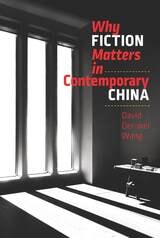
Why Fiction Matters in Contemporary China
David Der-wei Wang
Brandeis University Press, 2020
Contemporary discussions of China tend to focus on politics and economics, giving Chinese culture little if any attention. Why Fiction Matters in Contemporary China offers a corrective, revealing the crucial role that fiction plays in helping contemporary Chinese citizens understand themselves and their nation. Where history fails to address the consequences of man-made and natural atrocities, David Der-Wei Wang argues, fiction arises to bear witness to the immemorial and unforeseeable.
Beginning by examining President Xi Jinping’s call in 2013 to “tell the good China story,” Wang illuminates how contemporary Chinese cultural politics have taken a “fictional turn,” which can trace its genealogy to early modern times. He does so by addressing a series of discourses by critics within China, including Liang Qichao, Lu Xun, and Shen Congwen, as well as critics from the West such as Arendt, Benjamin, and Deleuze. Wang highlights the variety and vitality of fictional works from China as well as the larger Sinophone world, ranging from science fiction to political allegory, erotic escapade to utopia and dystopia. The result is an insightful account of contemporary China, one that affords countless new insights and avenues for understanding.

Why We Can't Have Nice Things
Social Media’s Influence on Fashion, Ethics, and PropertyMinh-Ha T. Pham
Duke University Press, 2022
Widows
Vol. I: The Middle East, Asia, and the PacificHelena Znaniecka Lopata, ed.
Duke University Press, 1987
Widows
Vol. II: North AmericaHelena Znaniecka Lopata, ed.
Duke University Press, 1987
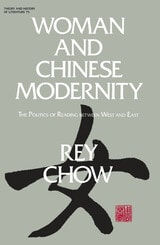
Woman and Chinese Modernity
The Politics of Reading between West and EastRey Chow
University of Minnesota Press, 1991
Examines the relationship of “woman” to issues of non-western culture.
Examines the relationship of "woman" to issues of non-Western culture: ethnic spectatorship, popular literature, the construction of literary history, and the revolutionary production and emotional reception of national literature.
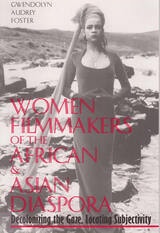
Women Filmmakers of the African & Asian Diaspora
Decolonizing the Gaze, Locating SubjectivityGwendolyn Audrey Foster
Southern Illinois University Press, 1997
Black women filmmakers not only deserve an audience, Gwendolyn Audrey Foster asserts, but it is also imperative that their voices be heard as they struggle against Hollywood’s constructions of spectatorship, ownership, and the creative and distribution aspects of filmmaking.
Foster provides a voice for Black and Asian women in the first detailed examination of the works of six contemporary Black and Asian women filmmakers. She also includes a detailed introduction and a chapter entitled "Other Voices," documenting the work of other Black and Asian filmmakers.
Foster analyzes the key films of Zeinabu irene Davis, "one of a growing number of independent Black women filmmakers who are actively constructing [in the words of bell hooks] ‘an oppositional gaze’"; British filmmaker Ngozi Onwurah and Julie Dash, two filmmakers working with time and space; Pratibha Parmar, a Kenyan/Indian-born British Black filmmaker concerned with issues of representation, identity; cultural displacement, lesbianism, and racial identity; Trinh T. Minh-ha, a Vietnamese-born artist who revolutionized documentary filmmaking by displacing the "voyeuristic gaze of the ethnographic documentary filmmaker"; and Mira Nair, a Black Indian woman who concentrates on interracial identity.
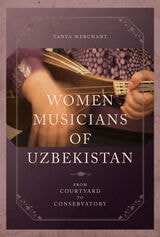
Women Musicians of Uzbekistan
From Courtyard to ConservatoryTanya Merchant
University of Illinois Press, 2015
Drawing on fieldwork and music study carried out between 2001 and 2014, Merchant challenges the Western idea of Central Asian women as sequestered and oppressed. Instead, she notes, Uzbekistan's women stand at the forefront of four prominent genres: maqom, folk music, Western art music, and popular music. Merchant's recounting of the women's experiences, stories, and memories underscores the complex role that these musicians and vocalists play in educational institutions and concert halls, street kiosks and the culturally essential sphere of wedding music. Throughout the book, Merchant ties nationalism and femininity to performances and reveals how the music of these women is linked to a burgeoning national identity.
Important and revelatory, Women Musicians of Uzbekistan looks into music's part in constructing gendered national identity and the complicated role of femininity in a former Soviet republic's national project.
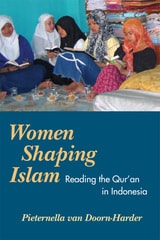
Women Shaping Islam
Reading the Qu'ran in IndonesiaPieternella van Doorn-Harder
University of Illinois Press, 2006
In Women Shaping Islam, Pieternella van Doorn-Harder explores the work of these contemporary women leaders, examining their attitudes toward the rise of radical Islamists; the actions of the authoritarian Soeharto regime; women's education and employment; birth control and family planning; and sexual morality. Ultimately, van Doorn-Harder reveals the many ways in which Muslim women leaders understand and utilize Islam as a significant force for societal change; one that ultimately improves the economic, social, and psychological condition of women in Indonesian society.
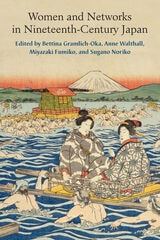
Women and Networks in Nineteenth-Century Japan
Edited by Bettina GRAMLICH-OKA, Anne WALTHALL, MIYAZAKI Fumiko, and SUGANO Noriko
University of Michigan Press, 2020
Most of the essays in this volume are by Japanese scholars; their inclusion here provides either an introduction to their work or the opportunity to explore their scholarship further. Because women are often invisible in historical documentation, the authors use a range of sources (such as diaries, letters, and legal documents) to reconstruct the familial, neighborhood, religious, political, work, and travel networks that women maintained, constructed, or found themselves in, sometimes against their will. In so doing, most but not all of the authors try to decenter historical narratives built on men’s activities and men’s occupational and status-based networks, and instead recover women’s activities in more localized groupings and personal associations.
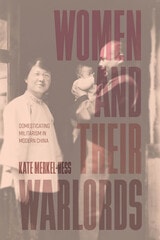
Women and Their Warlords
Domesticating Militarism in Modern ChinaKate Merkel-Hess
University of Chicago Press, 2024
In Women and Their Warlords, historian Kate Merkel-Hess examines the lives and personalities of the female relatives of the military rulers who governed regions of China from 1916 to 1949. Posing for candid photographs and sitting for interviews, these women did not merely advance male rulers’ agendas. They advocated for social and political changes, gave voice to feminist ideas, and shaped how the public perceived them. As the first publicly political partners in modern China, the wives and concubines of Republican-era warlords changed how people viewed elite women’s engagement in politics. Drawing on popular media sources, including magazine profiles and gossip column items, Merkel-Hess draws unexpected connections between militarism, domestic life, and state power in this insightful new account of gender and authority in twentieth-century China.
Women's Movements in Twentieth-Century Taiwan
Doris Chang
University of Illinois Press, 2008
This book is the first in English to consider women's movements and feminist discourses in twentieth-century Taiwan. Doris T. Chang examines the way in which Taiwanese women in the twentieth century selectively appropriated Western feminist theories to meet their needs in a modernizing Confucian culture. She illustrates the rise and fall of women's movements against the historical backdrop of the island's contested national identities, first vis-à-vis imperial Japan (1895-1945) and later with postwar China (1945-2000).
In particular, during periods of soft authoritarianism in the Japanese colonial era and late twentieth century, autonomous women's movements emerged and operated within the political perimeters set by the authoritarian regimes. Women strove to replace the "Good Wife, Wise Mother" ideal with an individualist feminism that meshed social, political, and economic gender equity with the prevailing Confucian family ideology. However, during periods of hard authoritarianism from the 1930s to the 1960s, the autonomous movements collapsed.
The particular brand of Taiwanese feminism developed from numerous outside influences, including interactions among an East Asian sociopolitical milieu, various strands of Western feminism, and even Marxist-Leninist women's liberation programs in Soviet Russia. Chinese communism appears not to have played a significant role, due to the Chinese Nationalists' restriction of communication with the mainland during their rule on post-World War II Taiwan.
Notably, this study compares the perspectives of Madame Chiang Kai-shek, whose husband led as the president of the Republic of China on Taiwan from 1949 to 1975, and Hsiu-lien Annette Lu, Taiwan's vice president from 2000 to 2008. Delving into period sources such as the highly influential feminist monthly magazine Awakening as well as interviews with feminist leaders, Chang provides a comprehensive historical and cross-cultural analysis of the struggle for gender equality in Taiwan.
Women's Transborder Cinema
Authorship, Stardom, and Filmic Labor in South AsiaEsha Niyogi De
University of Illinois Press, 2024
Can we write women’s authorial roles into the history of industrial cinema in South Asia? How can we understand women’s creative authority and access to the film business infrastructure in this postcolonial region? Esha Niyogi De draws on rare archival and oral sources to explore these questions from a uniquely comparative perspective, delving into examples of women holding influential positions as stars, directors, and producers across the film industries in India, Pakistan, and Bangladesh.
De uses film tropes to examine the ways women directors and film entrepreneurs claim creative control within the contexts of anti-colonial nationalism and global capitalism. The region’s fictional cinemas have become staging grounds for postcolonialism, with colonial and local hierarchies merged into new imperial formations. De’s analysis shows how the gendered intersections of inequity and opportunity shape women’s fiction filmmaking while illuminating the impact of state and market formations on the process.
Innovative and essential, Women’s Transborder Cinema examines the works of South Asia’s women filmmakers from a regional perspective.
Women, War, and the Making of Bangladesh
Remembering 1971Yasmin Saikia
Duke University Press, 2011
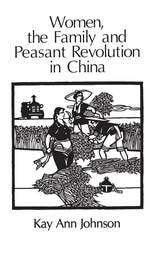
Women, the Family, and Peasant Revolution in China
Kay Ann Johnson
University of Chicago Press, 1983
Johnson's primary focus is on reforms of marriage and family because traditional marriage, family, and kinship practices have had the greatest influence in defining and shaping women's place in Chinese society. Conversant with current theory in political science, anthropology, and Marxist and feminist analysis, Johnson writes with clarity and discernment free of dogma. Her discussions of family reform ultimately provide insights into the Chinese government's concern with decreasing the national birth rate, which has become a top priority. Johnson's predictions of a coming crisis in population control are borne out by the recent increase in female infanticide and the government abortion campaign.

World Deforestation in the Twentieth Century
John F. Richards and Richard P. Tucker
Duke University Press, 1988

World Film Locations
Hong KongEdited by Linda Chiu-Han Lai and Kimburley Wing-Yee Choi
Intellect Books, 2013
World Film Locations
TokyoEdited by Chris MaGee
Intellect Books, 2011
From Tokyo Story to Godzilla, You Only Live Twice to Enter the Void, World Film Locations: Tokyo presents a kaleidoscopic view of one of the world’s most exciting cities through the lens of cinema. Illustrated throughout with dynamic screen shots, this volume in Intellect’s World Film Locations series spotlights fifty key scenes from classic and contemporary films shot in Tokyo, accompanied by insightful essays that take us from the wooden streets of pre-nineteenth-century Edo to the sprawling “what-if” megalopolis of science fiction and fantasy anime. Important themes and players—among them Akira Kurosawa, Samuel Fuller, and Sofia Coppola—are individually considered. For the film scholar, or for all those who love Japanese cinema and want to learn more, World Film Locations: Tokyo will be an essential guide.
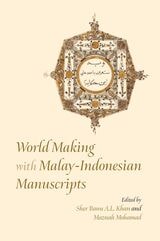
World Making with Malay-Indonesian Manuscripts
Circulation, Contestation and ConnectionEdited by Maznah Mohamad and Sher Banu Khan
National University of Singapore Press, 2026
What new framings emerge when we revisit the vibrant world of Malay-Indonesian manuscripts, looking beyond the boundaries imposed by colonial and nationalist scholarship? This volume revitalizes manuscript studies by using texts in entirely fresh ways, situating them as dynamic instruments of knowledge and cultural transformation. Through contextual readings, it uncovers multiple historical and cultural narratives within and between manuscripts, challenging established understandings of power, identity, and authorship. Chapters explore themes ranging from the origins of kingdoms and intellectual traditions to the reinvention of contemporary lives through politicized readings of older texts.
By foregrounding the diversity and versatility of Malay-Indonesian textual traditions, this book recenters manuscripts as vital agents in shaping Southeast Asian histories, decenters fixed notions of a singular “Malay” worldview, and reveals the fluidity of cultural memory across time and place.
Writing Beijing
History and Knowledge of the CapitalNaixi Feng
University of Michigan Press, 2027
Writing Beijing offers a comprehensive study of the textual representations of the city from the late Ming dynasty through the Republican era, interrogating how urban narratives were actively constructed, adapted, and repurposed across periods of political transformation. Scholars, officials, and travelers reshaped the capital’s identity by rewriting older texts, borrowing new surveys, and even inserting critiques into guidebooks.. This study reveals how the crises brought by intense social transformation, including dynastic collapse and foreign invasion, forced writers to reinvent Beijing on paper. Some turned the city into a monument to lost glory; others documented everyday life to resist imperialism. These narratives served to critique contemporary sociopolitical conditions, assert cultural legitimacy during times of crisis, and ultimately shape Beijing’s enduring cultural image as China’s symbolic capital.
Naixi Feng bridges literary studies, urban history, and critical historiography by examining a wide range of genres—including literary miscellanies, local gazetteers, Qing imperial compilations, Republican textbooks, social reports, and travel guides—to demonstrate how writing about Beijing was never merely descriptive but always a site of cultural and political contestation.
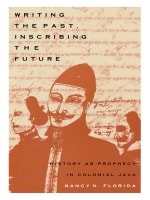
Writing the Past, Inscribing the Future
History as Prophecy in Colonial JavaNancy K. Florida
Duke University Press, 1995
Babad Jaka Tingkir, the historical prophecy that Writing the Past, Inscribing the Future translates and reads, is uniquely suited for such a study. Composing an engaging history of the emergence of Islamic power in central Java around the turn of the sixteenth century, Babad Jaka Tingkir was written from the vantage of colonial exile to contest the more dominant dynastic historical traditions of nineteenth-century court literature. Florida reveals how this history’s episodic form and focus on characters at the margins of the social order work to disrupt the genealogical claims of conventional royal historiography—thus prophetically to open the possibility of an alternative future.
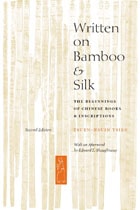
Written on Bamboo and Silk
The Beginnings of Chinese Books and Inscriptions, Second EditionTsuen-Hsuin Tsien
University of Chicago Press, 2004