Results by title
428 books match the query 'Authorship' and 49 start with w
Welcome to the Mountain
A Portable Bread Loaf Writers' ConferenceLauren Francis-Sharma
Four Way Books, 2026
What do Truman Capote, Joan Didion, Archibald MacLeish, and Robert Hayden have in common? They are among the impressive array of American writers who have contributed to the legacy of the Bread Loaf Writers’ Conference in the last one hundred years.
To commemorate this esteemed institution’s centennial, Welcome to the Mountain recreates the experience of being in a writerly community that celebrates literature and invests in literary apprenticeship. This volume, edited by Lauren Francis-Sharma and Jennifer Grotz, comprises an extraordinary sampling of work from the historical to the contemporary, including lectures and readings first delivered at Bread Loaf. Its expansive range showcases everything from highly celebrated texts to rarer pieces and insightful musings by Toni Morrison, Brigit Pegeen Kelly, Randall Kenan, Czesław Miłosz, Julia Alvarez, and so many more.
Welcome to the Mountain tells the endless and thrilling stories of how writers become writers and how literary traditions evolve through our conversations with each other. Through this extraordinary book, we invite readers to make themselves at home in the rich landscape of American letters.
What's Nature Worth
Terre Satterfield
University of Utah Press, 2004
Where the Southern Cross the Yellow Dog
On Writers and WritingLouis D. Rubin, Jr.
University of Missouri Press, 2005
Who Owns This Text?
Plagiarism, Authorship, and Disciplinary CulturesCarol Peterson Haviland and Joan A. Mullin
Utah State University Press, 2008
Less a research report than a conversation, the book offers a wide range of ideas, and the chapters here will provoke discussion on scholarly practice relating to intellectual property, plagiarism, and authorship---and to how these matters are conveyed to students. Although these authors find a good deal of consensus in regard to the ethical issues of plagiarism, they document a surprising variety of practice on the subject of what ownership looks like from one discipline to another. And they discover that students are not often instructed in the conventions of their major field.
Who Paid for Modernism?
Art, Money, and the Fiction of Conrad, Joyce and LawrenceJoyce Piell Wexler
University of Arkansas Press, 1997
Who is Buried in Chaucer's Tomb?
Studies in the Reception of Chaucer's BookJoseph A. Dane
Michigan State University Press, 1998
Wikipedia and the Politics of Openness
Nathaniel Tkacz
University of Chicago Press, 2014
But what does openness mean, and what would a political theory of openness look like? With Wikipedia and the Politics of Openness, Nathaniel Tkacz uses Wikipedia, the most prominent product of open organization, to analyze the theory and politics of openness in practice—and to break its spell. Through discussions of edit wars, article deletion policies, user access levels, and more, Tkacz enables us to see how the key concepts of openness—including collaboration, ad-hocracy, and the splitting of contested projects through “forking”—play out in reality.
The resulting book is the richest critical analysis of openness to date, one that roots media theory in messy reality and thereby helps us move beyond the vaporware promises of digital utopians and take the first steps toward truly understanding what openness does, and does not, have to offer.
Wild Animal Story
edited by Ralph H. Lutts
Temple University Press, 2001
At the beginning of the twentieth century, the wild animal story emerged in Canadian literature as a distinct genre, in which animals pursue their own interests—survival for themselves, their offspring, and perhaps a mate, or the pure pleasure of their wildness.
Bringing together some of the most celebrated wild animal stories, Ralph H. Lutts places them firmly in the context of heated controversies about animal intelligence and purposeful behavior. Widely regarded as entertaining and educational, the early stories—by Charles G. D. Roberts, Ernest Thompson Seton, John Muir, Jack London and others—had an avid readership among adults and children. But some naturalists and at least one hunter—Theodore Roosevelt—discredited these writers as "nature fakers," accusing them of falsely portraying animal behavior.
The stories and commentaries collected here span the twentieth century. As present day animal behaviorists, psychologists, and the public attempt to sort out the meaning of what animals do and our obligations to them, Ralph Lutts maps some of the prominent features of our cultural landscape.
•
•
•
Other selections include essays by Theodore Roosevelt, John Burroughs, Margaret Atwood, and Ralph H. Lutts.
postamble();
Winning the Dust Bowl
Carter Revard
University of Arizona Press, 2001

Women Reading Women Writing
Ann Louise Keating
Temple University Press, 1996
Women's Transborder Cinema
Authorship, Stardom, and Filmic Labor in South AsiaEsha Niyogi De
University of Illinois Press, 2024
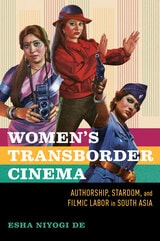
Can we write women’s authorial roles into the history of industrial cinema in South Asia? How can we understand women’s creative authority and access to the film business infrastructure in this postcolonial region? Esha Niyogi De draws on rare archival and oral sources to explore these questions from a uniquely comparative perspective, delving into examples of women holding influential positions as stars, directors, and producers across the film industries in India, Pakistan, and Bangladesh.
De uses film tropes to examine the ways women directors and film entrepreneurs claim creative control within the contexts of anti-colonial nationalism and global capitalism. The region’s fictional cinemas have become staging grounds for postcolonialism, with colonial and local hierarchies merged into new imperial formations. De’s analysis shows how the gendered intersections of inequity and opportunity shape women’s fiction filmmaking while illuminating the impact of state and market formations on the process.
Innovative and essential, Women’s Transborder Cinema examines the works of South Asia’s women filmmakers from a regional perspective.
Women, Celebrity, and Literary Culture between the Wars
By Faye Hammill
University of Texas Press, 2007
As mass media burgeoned in the years between the first and second world wars, so did another phenomenon—celebrity. Beginning in Hollywood with the studio-orchestrated transformation of uncredited actors into brand-name stars, celebrity also spread to writers, whose personal appearances and private lives came to fascinate readers as much as their work. Women, Celebrity, and Literary Culture between the Wars profiles seven American, Canadian, and British women writers—Dorothy Parker, Anita Loos, Mae West, L. M. Montgomery, Margaret Kennedy, Stella Gibbons, and E. M. Delafield—who achieved literary celebrity in the 1920s and 1930s and whose work remains popular even today.
Faye Hammill investigates how the fame and commercial success of these writers—as well as their gender—affected the literary reception of their work. She explores how women writers sought to fashion their own celebrity images through various kinds of public performance and how the media appropriated these writers for particular cultural discourses. She also reassesses the relationship between celebrity culture and literary culture, demonstrating how the commercial success of these writers caused literary elites to denigrate their writing as "middlebrow," despite the fact that their work often challenged middle-class ideals of marriage, home, and family and complicated class categories and lines of social discrimination.
The first comparative study of North American and British literary celebrity, Women, Celebrity, and Literary Culture between the Wars offers a nuanced appreciation of the middlebrow in relation to modernism and popular culture.
Wordcraft
The Complete Guide to Clear, Powerful WritingJack Hart
University of Chicago Press, 2021
Originally published in 2006 as A Writer’s Coach, the book has been updated to address the needs of writers well beyond print journalists. Hart breaks the writing process into a series of manageable steps, from idea to polishing. Filled with real-world examples, both good and bad, Wordcraft shows how to bring such characteristics as force, brevity, clarity, rhythm, and color to any kind of writing.
Wordcraft now functions as a set with the second edition of Hart’s book Storycraft, on the art of storytelling, also available from Chicago.
Words Matter
Writing to Make a DifferenceEdited by Amanda Dahling and Mary Kay Blakely
University of Missouri Press, 2016
Newspapers and magazines have been steadily shrinking, and more and more former subscribers have gone to digital and internet sources for the news. Yet it has become increasingly clear that “short takes” don’t satisfy many readers, who still long for nuanced, long form journalism. By providing examples of classic magazine articles by professional writers, all of whom are graduates of the Missouri School of Journalism, this book fulfills the need for more sophisticated, thought-provoking essays that will resonate with both the general reader and students.
The book is divided into three broad categories: profiles, first person journalism, and personal memoirs, and includes the original articles as well as a “postscript” by the writers in which they discuss what they’ve learned about writing, journalism, and the business of getting published. Useful for students and instructors in writing programs, the book also appeals to writers interested in both the art and the craft of successful writing.
Words for the Taking
The Hunt for a PlagiaristNeal Bowers
Southern Illinois University Press, 2007
In January 1992, poet Neal Bowers received a phone call that changed his life. He learned his poems had been stolen and published under another name. Bowers hired a copyright lawyer and a private detective, and they began the agonizing hunt to track down the person who stole his creative work.
Bowers was dealing with more than the theft of words. He uncovered the plagiarist’s unsavory past when he found convicted child molester David Jones, who published the poems using the name David Sumner.
Determined to hold the plagiarist accountable, Bowers is drawn into a bizarre game of catch-me-if-you-can. His odyssey introduces him to the legal system and a sympathetic female detective, reveals the reactions of fellow poets, and provokes a flood of nationwide publicity and a deluge of letters from strangers interested in the case. Letters from Bowers’s attorney to Jones and phone conversations between the two produce unsatisfactory results. In the end, the plagiarist is not punished, and Bowers deals with the loss of friends, derision from his colleagues, and trouble in his marriage.
Words for the Taking: The Hunt for a Plagiarist, first published in 1997, is as much a commentary on our cultural view of plagiarism as it is a real-life detective story. Bowers’s wry and disturbing account of being the victim of a serial plagiarist offers unexpected twists and startling revelations. This updated edition presents a final consideration of the bizarre case and remains the only book to offer a personal account of the effects of plagiarism.
Ten years after the original publication, Neal Bowers finds his life as a writer altered in ways he could never have foreseen. His responses to the series of events show his vulnerability as an artist and his adjustment to being a victim. In a new chapter, Bowers describes his renewed quest in 2006 for a resolution and explains why he chose to give up writing poetry.
This beautifully written case study about the discovery and attempted resolution of an intellectual crime will appeal to academicians and general readers alike who care about language, the state of poetry, and intellectual property in contemporary America.
Words to Create a World
Daniel Hoffman
University of Michigan Press, 1993
Between these are discussions of books by and about founding modernists (Pound, Moore, Sitwell, Frost, Graves, Auden) who do not “succumb to the imitative fallacy and gibber at the window because the house is on fire.” Hoffman’s historical imagination elucidates the work of many other contemporary American and British poets, including his own. Words to Create a World will appeal to the reader who enjoys poetry and who hopes for guidance over the sprawling terrain of verse in the twentieth century.
Working with Faculty Writers
Anne Ellen Geller and Michele Eodice
Utah State University Press, 2013
Contributors from a variety of institution types and perspectives consider who faculty writers are and who they may be in the future, reveal the range of locations and models of support for faculty writers, explore the ways these might be delivered and assessed, and consider the theoretical, philosophical, political, and pedagogical approaches to faculty writing support, as well as its relationship to student writing support.
With the pressure on faculty to be productive researchers and writers greater than ever, this is a must-read volume for administrators, faculty, and others involved in developing and assessing models of faculty writing support.
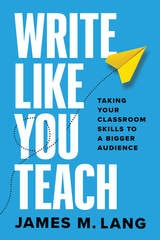
Write Like You Teach
Taking Your Classroom Skills to a Bigger AudienceJames M. Lang
University of Chicago Press, 2025
After years spent cultivating their expertise and passion for a subject, scholars are uniquely positioned to write great books. Yet, accustomed to writing for an audience of their peers, many scholars find it challenging to adapt their writing to a style that is accessible and engaging to the general public. James M. Lang argues that academics are regularly called on to pitch their research to a general audience: their undergraduates. If only there were a way to translate the skills they use in the classroom into their writing. . . .
In Write Like You Teach, Lang—a veteran writer and teacher—distills the elements of good classroom teaching into guidelines for writing for a general audience. He encourages authors to pay attention to how their readers learn and to embrace exploration, experimentation, and creativity in their writing. Lang asks his readers to consider the questions that all great teachers ask themselves: How will I get the attention of my students? How do I make them curious about the subject? What stories or examples will illustrate the more difficult concepts or theories in the course? When will I pause in the class and give students a break from hard thinking? What will I do at the end of the class to remind students about my key messages and leave them wanting to know more?
Write Like You Teach includes examples from successful writers and useful anecdotes from Lang’s own classroom and writing career. Indeed, Lang takes his own advice to heart: like a good teacher, he varies the form of each chapter, making sure to introduce some surprises to keep the reader engaged. Each chapter ends with writing prompts to help readers practice their newly acquired skills, and an appendix provides additional advice on publishing and promoting one’s work. Teachers who follow Lang’s suggestions will find new ways to connect with their readers—and like any good student, they will never approach writing the same way again.
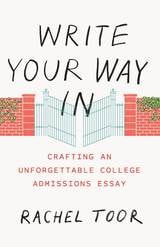
Write Your Way In
Crafting an Unforgettable College Admissions EssayRachel Toor
University of Chicago Press, 2017
The good news? You already have the “secret sauce” for crafting a compelling personal essay: your own experiences and your unique voice.
More than twenty million students apply to college every year; many of them look similar in terms of test scores, grades, courses taken, extracurricular activities. Admissions officers wade through piles of files. As an applicant, you need to think about what will interest an exhausted reader. What can you write that will make her argue to admit you instead of the thousands of other applicants?
A good essay will be conversational and rich in vivid details, and it could only be written by one person—you. This book will help you figure out how to find and present the best in yourself. You’ll acquire some useful tools for writing well—and may even have fun—in the process.
Writing
Marguerite Duras
University of Minnesota Press, 2011
Writing, one of Marguerite Duras’s last works, is a meditation on the process of writing and on her need for solitude in order to do it. In the five short pieces collected in this volume, she explores experiences that had an emotional impact on her and that inspired her to write. These vary from the death of a pilot in World War II, to the death of a fly, to an art exhibition. Two of the pieces were made into documentary films, and one was originally a short film. Both autobiographical and fictional, like much of her work, Writing displays Duras’s unique worldview and sensitive insight in her simple and poetic prose.
Writing Anthropology
Essays on Craft and CommitmentCarole McGranahan, editor
Duke University Press, 2020
Contributors. Whitney Battle-Baptiste, Jane Eva Baxter, Ruth Behar, Adia Benton, Lauren Berlant, Robin M. Bernstein, Sarah Besky, Catherine Besteman, Yarimar Bonilla, Kevin Carrico, C. Anne Claus, Sienna R. Craig, Zoë Crossland, Lara Deeb, K. Drybread, Jessica Marie Falcone, Kim Fortun, Kristen R. Ghodsee, Daniel M. Goldstein, Donna M. Goldstein, Sara L. Gonzalez, Ghassan Hage, Carla Jones, Ieva Jusionyte, Alan Kaiser, Barak Kalir, Michael Lambek, Carole McGranahan, Stuart McLean, Lisa Sang Mi Min, Mary Murrell, Kirin Narayan, Chelsi West Ohueri, Anand Pandian, Uzma Z. Rizvi, Noel B. Salazar, Bhrigupati Singh, Matt Sponheimer, Kathleen Stewart, Ann Laura Stoler, Paul Stoller, Nomi Stone, Paul Tapsell, Katerina Teaiwa, Marnie Jane Thomson, Gina Athena Ulysse, Roxanne Varzi, Sita Venkateswar, Maria D. Vesperi, Sasha Su-Ling Welland, Bianca C. Williams, Jessica Winegar
Writing BLUE HIGHWAYS
The Story of How a Book HappenedWillliam Least Heat-Moon
University of Missouri Press, 2023
Winner, Distinguished Literary Achievement, Missouri Humanities Council, 2015
The story behind the writing of the best-selling Blue Highways is as fascinating as the epic trip itself. More than thirty years after his 14,000-mile, 38-state journey, William Least Heat-Moon reflects on the four years he spent capturing the lessons of the road trip on paper—the stops and starts in his composition process, the numerous drafts and painstaking revisions, the depressing string of rejections by publishers, the strains on his personal relationships, and many other aspects of the toil that went into writing his first book. Along the way, he traces the hard lessons learned and offers guidance to aspiring and experienced writers alike. Far from being a technical manual, Writing Blue Highways: The Story of How a Book Happenedis an adventure story of its own, a journey of “exploration into the myriad routes of heart and mind that led to the making of a book from the first sorry and now vanished paragraph to the last words that came not from a graphite pencil but from a letterpress in Tennessee.”
Readers will not find a collection of abstract formulations and rules for writing; rather, this book gracefully incorporates examples from Heat-Moon’s own experience. As he explains, “This story might be termed an inadvertent autobiography written not by the traveler who took Ghost Dancing in 1978 over the byroads of America but by a man only listening to him. That blue-roadman hasn’t been seen in more than a third of a century, and over the last many weeks as I sketched in these pages, I’ve regretted his inevitable departure.” Filtered as the struggles of the “blue-roadman” are through the awareness of someone more than thirty years older with a half dozen subsequent books to his credit, the story of how his first book “happened” is all the more resonant for readers who may not themselves be writers but who are interested in the tricky balance of intuitive creation and self-discipline required for any artistic endeavor.
Writing Beat and Other Occasions of Literary Mayhem
John Tytell
Vanderbilt University Press, 2014
Approaching the history of post-war twentieth century American literature, and in particular the Beat literary movement of Kerouac, Ginsberg, Burroughs, and others, Tytell finds himself uniquely positioned as an eyewitness to many of these stories. In this book, he shares his insight with the reader. As he interviewed, drank, traveled, and survived countless moments with some of these literary legends, Tytell discovered much about the craft of nonfiction, biography, and the nature of history. Writing Beat demonstrates, through Tytell's growth as a professor and historian of the Beats, lessons learned and hazards encountered for those aspiring to become writers themselves.
As we approach the sixtieth anniversary of Allen Ginsberg's Howl, Writing Beat reminds us writers do not spring to life fully formed, and the struggle to get to literature can be a blast.
Writing Culture and the Life of Anthropology
Orin Starn
Duke University Press, 2015
Contributors. Anne Allison, James Clifford, Michael M.J. Fischer, Kim Fortun, Richard Handler, John L. Jackson, Jr., George E. Marcus, Charles Piot, Hugh Raffles, Danilyn Rutherford, Orin Starn, Kathleen Stewart, Michael Taussig, Kamala Visweswaran
Writing Ethnographic Fieldnotes
Robert M. Emerson, Rachel I. Fretz, and Linda L. Shaw
University of Chicago Press, 1995
Drawing on years of teaching and field research experience, the authors develop a series of guidelines, suggestions, and practical advice about how to write useful fieldnotes in a variety of settings, both cultural and institutional. Using actual unfinished, "working" notes as examples, they illustrate options for composing, reviewing, and working fieldnotes into finished texts. They discuss different organizational and descriptive strategies, including evocation of sensory detail, synthesis of complete scenes, the value of partial versus omniscient perspectives, and of first person versus third person accounts. Of particular interest is the author's discussion of notetaking as a mindset. They show how transforming direct observations into vivid descriptions results not simply from good memory but more crucially from learning to envision scenes as written. A good ethnographer, they demonstrate, must learn to remember dialogue and movement like an actor, to see colors and shapes like a painter, and to sense moods and rhythms like a poet.
The authors also emphasize the ethnographer's core interest in presenting the perceptions and meanings which the people studied attach to their own actions. They demonstrate the subtle ways that writers can make the voices of people heard in the texts they produce. Finally, they analyze the "processing" of fieldnotes—the practice of coding notes to identify themes and methods for selecting and weaving together fieldnote excerpts to write a polished ethnography.
This book, however, is more than a "how-to" manual. The authors examine writing fieldnotes as an interactive and interpretive process in which the researcher's own commitments and relationships with those in the field inevitably shape the character and content of those fieldnotes. They explore the conscious and unconscious writing choices that produce fieldnote accounts. And they show how the character and content of these fieldnotes inevitably influence the arguments and analyses the ethnographer can make in the final ethnographic tale.
This book shows that note-taking is a craft that can be taught. Along with Tales of the Field and George Marcus and Michael Fisher's Anthropology as Cultural Criticism, Writing Ethnographic Fieldnotes is an essential tool for students and social scientists alike.
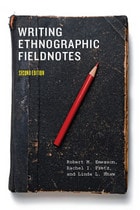
Writing Ethnographic Fieldnotes, Second Edition
Robert M. Emerson, Rachel I. Fretz, and Linda L. Shaw
University of Chicago Press, 2011
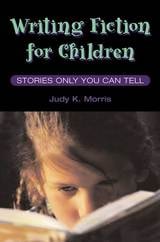
Writing Fiction for Children
STORIES ONLY YOU CAN TELLJudy K. Morris
University of Illinois Press, 2001
A published author of both fiction and nonfiction for children, Morris draws on extensive experience teaching children how to write and teaching adults how to write for children. Here she combines concrete methods and step-by-step techniques with succinct rules of thumb: work at making your novel whole from the start; never underestimate the power of the plain truth; personality quirks are no substitute for character; doing a good job of writing usually means doing a good job of rewriting.
Using judiciously chosen examples from successful children's literature, Writing Fiction for Children covers the building blocks of plot, characters, and setting and addresses common problems such as awkward plotting, oversimplifying, and taking a preachy or self-conscious tone. Pragmatic exercises stimulate writers to scour their experiences, sharpen their powers of observation, and capture the details, voice, and narrative energy that can bring stories vividly to life and keep readers submerged in make-believe. Loaded with practical advice and helpful exercises, Writing Fiction for Children is especially useful for anyone who aspires to write for children in the "middle ages" of eight to twelve.
Children's books should be hopeful, thrilling, funny, interesting, touching, and a pleasure to read, Morris says. Above all, they must have something at stake that matters. While conceding that only the author can provide the spark of a story to tell, Morris offers invaluable guidance on the daily work of crafting, shaping, refining, revising, and publishing a children's novel.
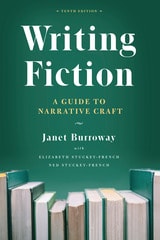
Writing Fiction, Tenth Edition
A Guide to Narrative CraftJanet Burroway, with Elizabeth Stuckey-French, and Ned Stuckey-French
University of Chicago Press, 2019
A creative writer’s shelf should hold at least three essential books: a dictionary, a style guide, and Writing Fiction. Janet Burroway’s best-selling classic is the most widely used creative writing text in America, and for more than three decades it has helped hundreds of thousands of students learn the craft. Now in its tenth edition, Writing Fiction is more accessible than ever for writers of all levels—inside or outside the classroom.
This new edition continues to provide advice that is practical, comprehensive, and flexible. Burroway’s tone is personal and nonprescriptive, welcoming learning writers into the community of practiced storytellers. Moving from freewriting to final revision, the book addresses “showing not telling,” characterization, dialogue, atmosphere, plot, imagery, and point of view. It includes new topics and writing prompts, and each chapter now ends with a list of recommended readings that exemplify the craft elements discussed, allowing for further study. And the examples and quotations throughout the book feature a wide and diverse range of today’s best and best-known creators of both novels and short stories.
This book is a master class in creative writing that also calls on us to renew our love of storytelling and celebrate the skill of writing well. There is a very good chance that one of your favorite authors learned the craft with Writing Fiction. And who knows what future favorite will get her start reading this edition?
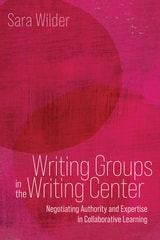
Writing Groups in the Writing Center
Negotiating Authority and Expertise in Collaborative LearningSara Wilder
Utah State University Press, 2025
As many higher education institutions strive to create spaces and systems that increase equity, accessibility, and diversity, they recognize the need for improved mentorship across academic levels. This book analyzes the significant benefits as well as the challenges faced by writing groups in providing such support. Wilder presents a nuanced account of how facilitators scaffold group practice, how members use and build genre knowledge across disciplines, and how institutional contexts shape emotional labor requirements.
For educators and tutors, the book provides an in-depth examination of the facilitator role, describing essential logistical, emotional, and intellectual practices, and addresses common conflicts and challenges. Administrators can find valuable material for training tutor-facilitators and frameworks for conceptualizing writing group functions on campus. For researchers, the book extends scholarship on writing groups, writing transfer, and collaborative learning, bridging writing center and broader writing studies research.
In an era of concern about generative AI’s role in writing education, Writing Groups in the Writing Center extends research on group facilitation, collaborative learning, and authority negotiation in writing center communities of practice and emphasizes the human connections that make collaborative writing meaningful and valuable for student writers.
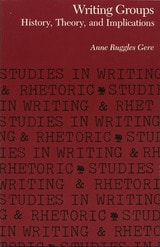
Writing Groups
History, Theory, and ImplicationsAnne Ruggles Gere
Southern Illinois University Press, 1987
Drawing upon previously unpublished archival materials as well as historical accounts, Gere traces the history of writing groups in America, from their origins over a century ago to their recent reappearance in the works of Macrorie, Elbow, Murray, and others.
From this historical perspective Gere examines the theoretical foundations of writing groups, challenging the traditional concept of writing as an individual performance. She offers instead a broader view of authorship that includes both individual and social dimensions, with implications not only for the teaching of composition but also for theories of rhetoric and literacy.
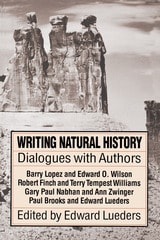
Writing Natural History
Dialogue with AuthorsEdward Lueders
University of Utah Press, 1989
Writing Natural History is the edited record of four public dialogues held at the University of Utah in 1988 between eminent writers in the fields of natural history. In these interchanges the writers discussed their traditions, perspectives, values, purposes, techniques, and personal insights. Their conversations, like their work, link the sciences with the humanities in surprising ways, enhancing our understanding and appreciation of both. This volume maintains the vitality of the spoken dialogues and conveys a lively sense of each speaker’s concern with the processes of the natural world and our human position in it.
Half of the authors began as professionals in the natural sciences before becoming recognized for their literary skills; the other half are established writers whose works reflect their vital human affinity with and respect for nature. Writing Natural History will appeal to all readers involved in conservation, nature study, creative writing, environmental issues, the natural sciences, the outdoors, and the ecological politics of Earth.
Authors dialogues feature Barry Lopez and Edward O. Wilson, Robert Finch and Terry Tempest Williams, Gary Paul Nabhan and Ann Zwinger, Paul Brooks and Edward Lueders.
Writing New Media
Theory and Applications for Expanding the Teaching of CompositionAnne Frances Wysocki, Johndan Johnson-Eilola, Cynthia L. Selfe, & Geoffrey Sirc
Utah State University Press, 2004
As new media mature, the changes they bring to writing in college are many and suggest implications not only for the tools of writing, but also for the contexts, personae, and conventions of writing. An especially visible change has been the increase of visual elements-from typographic flexibility to the easy use and manipulation of color and images. Another would be in the scenes of writing-web sites, presentation "slides," email, online conferencing and coursework, even help files, all reflect non-traditional venues that new media have brought to writing. By one logic, we must reconsider traditional views even of what counts as writing; a database, for example, could be a new form of written work.
The authors of Writing New Media bring these ideas and the changes they imply for writing instruction to the audience of rhetoric/composition scholars. Their aim is to expand the college writing teacher's understanding of new media and to help teachers prepare students to write effectively with new media beyond the classroom. Each chapter in the volume includes a lengthy discussion of rhetorical and technological background, and then follows with classroom-tested assignments from the authors' own teaching.
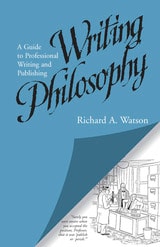
Writing Philosophy
A Guide to Professional Writing and PublishingRichard A. Watson
Southern Illinois University Press, 1992
Richard A. ("Red") Watson has published fiction, general nonfiction, and scholarly books. His essay "On the Zeedijk," about Descartes in Holland and first published in The Georgia Review, was the lead essay in The Pushcart Prize XV, 1990–1991: Best of the Small Presses. Red knows writing.
He also knows academe and has written Writing Philosophy as a kind of survival manual for undergraduates, graduate students, and junior faculty members in philosophy. Also helpful to those in the humanities and the social sciences, the book is a guide to the professional writing and publishing that are essential to an active participation in the conversation and discussion that constitute these professional fields. To the extent that publication is the crucial factor in tenure decisions, it will help the beginning scholar meet tenure criteria.
Despite the importance of the oral tradition in philosophy and the influence of the dialogue, many philosophical points are so intricate and complex that they can be advanced, followed, and criticized only if they are written as stepwise arguments for study and contemplation at length and at leisure. Watson provides a set of basic principles and a plan for writing argumentative papers of 1,500 to 15,000 words (3 to 30 printed pages) and books containing a sequence of sustained arguments of 70,000 to 150,000 words (200 to 300 printed pages).
Because the first book of most professional philosophers is a revised dissertation, Watson presents a plan for writing that dissertation in such a way that its chapters will serve as publishable articles and the dissertation itself will need very little rewriting as a book. His discussion of the principles of reason, clarity, and argument ranges from such topics as dangling participles and the proper usage of ellipses to matters of categorization and univocity.
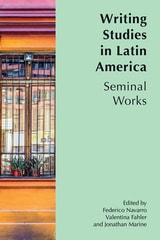
Writing Studies in Latin America
Seminal WorksFederico Navarro
University Press of Colorado, 2026
This edited collection arises from the belief that the field of writing studies, with its deep engagement in the power of language, is uniquely positioned to open new pathways for international scholarly dialogue in writing studies and beyond. Integrating diverse theoretical traditions—including discourse studies, language pedagogy, educational psychology, educational management, and critical sociolinguistics—the editors have brought together work from key Latin American scholars published over the past two decades. The result is a book that points to future directions for the increasingly global field of writing studies. The collection includes work by Natalia Ávila Reyes, Charles Bazerman, Paula Carlino, Valentina Fahler, Ivone Inés Jakob, Judith Kalman, Angela B. Kleiman, Vera Lúcia Lopes Cristovão, Anna Rachel Machado, Jonathan Marine, Juan David Martínez Hincapié, Paulina Meza, Violate Molina Natera, Désirée Motta-Roth, Estela I. Moyano, Elvira Narvaja de Arnoux, Lucía Natale, Federico Navarro, Giovanni Parodi, Luisa Pelizza, María Cecilia Pereira, Pablo Rosales, Daniela Paula Stagnaro, Alicia Vázquez, René Venegas, and Virginia Zavala.
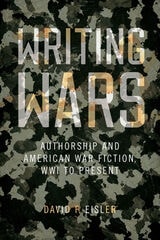
Writing Wars
Authorship and American War Fiction, WWI to PresentDavid F. Eisler
University of Iowa Press, 2022
2024 Senators Bob and Elizabeth Dole Biennial Award for Distinguished Book in Veterans Studies, winner
Who writes novels about war? For nearly a century after World War I, the answer was simple: soldiers who had been there. The assumption that a person must have experienced war in the flesh in order to write about it in fiction was taken for granted by writers, reviewers, critics, and even scholars.
Contemporary American fiction tells a different story. Less than half of the authors of contemporary war novels are veterans. And that’s hardly the only change. Today’s war novelists focus on the psychological and moral challenges of soldiers coming home rather than the physical danger of combat overseas. They also imagine the consequences of the wars from non-American perspectives in a way that defies the genre’s conventions. To understand why these changes have occurred, David Eisler argues that we must go back nearly fifty years, to the political decision to abolish the draft. The ramifications rippled into the field of cultural production, transforming the foundational characteristics— authorship, content, and form—of the American war fiction genre.

Writing and Publishing
The Librarian's HandbookCarol Smallwood
American Library Association, 2009
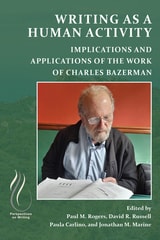
Writing as a Human Activity
Implications and Applications of the Work of Charles BazermanPaul M. Rogers
University Press of Colorado, 2023
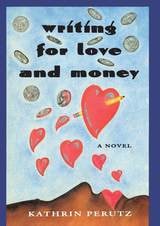
Writing for Love and Money
A NovelKathrin Perutz
University of Arkansas Press, 1991
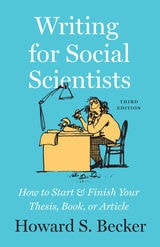
Writing for Social Scientists, Third Edition
How to Start and Finish Your Thesis, Book, or ArticleHoward S. Becker
University of Chicago Press, 2020
This is not a book about sociological writing. Instead, Becker applies his sociologist’s eye to some of the common problems all academic writers face, including trying to get it right the first time, failing, and therefore not writing at all; getting caught up in the trappings of “proper” academic writing; writing to impress rather than communicate with readers; and struggling with the when and how of citations. He then offers concrete advice, based on his own experiences and those of his students and colleagues, for overcoming these obstacles and gaining confidence as a writer.
While the underlying challenges of writing have remained the same since the book first appeared, the context in which academic writers work has changed dramatically, thanks to rapid changes in technology and ever greater institutional pressures. This new edition has been updated throughout to reflect these changes, offering a new generation of scholars and students encouragement to write about society or any other scholarly topic clearly and persuasively.
As Becker writes in the new preface, “Nothing prepared me for the steady stream of mail from readers who found the book helpful. Not just helpful. Several told me the book had saved their lives; less a testimony to the book as therapy than a reflection of the seriousness of the trouble writing failure could get people into.” As academics are being called on to write more often, in more formats, the experienced, rational advice in Writing for Social Scientists will be an important resource for any writer’s shelf.
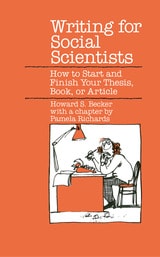
Writing for Social Scientists
How to Start and Finish Your Thesis, Book, or ArticleHoward S. Becker
University of Chicago Press, 1986
Both the means and the reasons for writing a thesis or article or book are socially structured by the organization of graduate study, the requirements for publication, and the conditions for promotion, and the pressures arising from these situations create the writing style so often lampooned and lamented. Drawing on his thirty-five years' experience as a researcher, writer, and teacher, Becker exposes the foibles of the academic profession to the light of sociological analysis and gentle humor. He also offers eminently useful suggestions for ways to make social scientists better and more productive writers. Among the topics discussed are how to overcome the paralyzing fears of chaos and ridicule that lead to writer's block; how to rewrite and revise, again and again; how to adopt a persona compatible with lucid prose; how to deal with that academic bugaboo, "the literature." There is also a chapter by Pamela Richards on the personal and professional risks involved in scholarly writing.
In recounting his own trials and errors Becker offers his readers not a model to be slavishly imitated but an example to inspire. Throughout, his focus is on the elusive work habits that contribute to good writing, not the more easily learned rules of grammar and punctuation. Although his examples are drawn from sociological literature, his conclusions apply to all fields of social science, and indeed to all areas of scholarly endeavor. The message is clear: you don't have to write like a social scientist to be one.
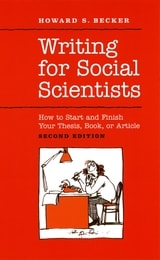
Writing for Social Scientists
How to Start and Finish Your Thesis, Book, or Article: Second EditionHoward S. Becker
University of Chicago Press, 2007
Sociologist Howard S. Becker has written the classic book on how to conquer these pressures and simply write. First published nearly twenty years ago, Writing for Social Scientists has become a lifesaver for writers in all fields, from beginning students to published authors. Becker’s message is clear: in order to learn how to write, take a deep breath and then begin writing. Revise. Repeat.
It is not always an easy process, as Becker wryly relates. Decades of teaching, researching, and writing have given him plenty of material, and Becker neatly exposes the foibles of academia and its “publish or perish” atmosphere. Wordiness, the passive voice, inserting a “the way in which” when a simple “how” will do—all these mechanisms are a part of the social structure of academic writing. By shrugging off such impediments—or at the very least, putting them aside for a few hours—we can reform our work habits and start writing lucidly without worrying about grades, peer approval, or the “literature.”
In this new edition, Becker takes account of major changes in the computer tools available to writers today, and also substantially expands his analysis of how academic institutions create problems for them. As competition in academia grows increasingly heated, Writing for Social Scientists will provide solace to a new generation of frazzled, would-be writers.
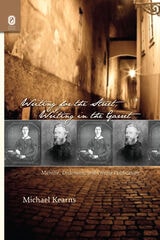
Writing for the Street, Writing in the Garret
Melville, Dickinson, and Private PublicationMichael Kearns
The Ohio State University Press, 2010
Although Herman Melville and Emily Dickinson differed dramatically in terms of their lives and writing careers, they shared not only a distaste for writing “for the street” (mass readership) but a preference for the intimate writer–reader relationship created by private publication, especially in the form of manuscripts. In Writing for the Street, Writing in the Garret: Melville, Dickinson, and Private Publication, Michael Kearns shows that this distaste and preference were influenced by American copyright law, by a growing tendency in America to treat not only publications but their authors as commodities, and by the romantic stereotype of the artist (usually suffering in a garret) living only for her or his own work.
Writing in America
Fischer, John
Rutgers University Press, 2018
In this newly reissued volume in the Rutgers University Press Classics Imprint, Writing in America proves to be as stimulating as it was in 1960. Here, writers including Robert Brustein, Stanley Kunitz, and C.P. Snow examine the state of writing in American novels, films, and television candidly and critically. The result is a collection of essays that showcase a first-rate and highly entertaining piece of reporting on the American literary scene that resonate in 2017.
Writing in and about the Performing and Visual Arts
Creating, Performing, and TeachingSteven J. Corbett
University Press of Colorado, 2020
Writing the Ghetto
Class, Authorship, and the Asian American Ethnic EnclaveChang, Yoonmee
Rutgers University Press, 2010
Yoonmee Chang examines the class structure of Chinatowns, Koreatowns, Little Tokyos, and Little Indias, arguing that ghettoization in these spaces is disguised. She maintains that Asian American literature both contributes to and challenges this masking through its marginalization by what she calls the "ethnographic imperative." Chang discusses texts from the late nineteenth century to the present, including those of Sui Sin Far, Winnifred Eaton, Monica Sone, Fae Myenne Ng, Chang-rae Lee, S. Mitra Kalita, and Nam Le. These texts are situated in the contexts of the Chinese Exclusion Era, Japanese American internment during World War II, the globalization of Chinatown in the late twentieth century, the Vietnam War, the 1992 Los Angeles riots, and the contemporary emergence of the "ethnoburb."
Writing, Directing, and Producing Documentary Films and Digital Videos
Alan Rosenthal and Ned Eckhardt
Southern Illinois University Press, 2016
All twenty-four chapters of the volume have been revised to reflect the latest advances in documentary filmmaking. Rosenthal and Eckhardt discuss the myriad ways in which technological changes have impacted the creation process of documentary films, including how these evolving technologies both complicate and enrich filmmaking today. The book provides crucial insights for the filmmaker from the film’s conception to distribution of the finished film. Topics include creating dynamic proposals, writing narration, and navigating the murky world of contracts. Also included are many practical tips for first-time filmmakers. To provide context and to illustrate techniques, Rosenthal and Eckhardt reference more than one hundred documentaries in detail.
A new appendix, “Using the Web and Social Media to Prepare for Your Career,” guides filmmakers through the process of leveraging social media and crowdsourcing for success in filmmaking, fund-raising, and promotion. A day-to-day field manual packed with invaluable lessons, this volume is essential reading for both novice and experienced documentary filmmakers.
Writing, Directing, and Producing Documentary Films and Videos, Fourth Edition
Alan Rosenthal
Southern Illinois University Press, 2007
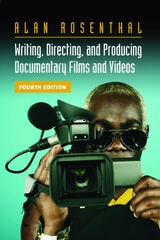
In response to technological advances and the growth of the documentary hybrid in the past five years, Rosenthal reconsiders how one approaches documentary filmmaking in the twenty-first century. Simply and clearly, he explains how to tackle day-to-day problems, from initial concept through distribution. He demonstrates his ideas throughout the book with examples from key filmmakers’ work.
New aspects of this fourth edition include a vital new chapter titled "Making Your First Film," and a considerable enlargement of the section for producers, "Staying Alive," which includes an extensive discussion of financing, marketing, festivals, and distribution. This new edition offers a revised chapter on nonlinear editing, more examples of precise and exacting proposals, and the addition of a complex budget example with explanation of the budgeting process. Discussion of documentary hybrids, with suggestions for mastering changes and challenges, has also been expanded, while the “Family Films” chapter includes updated information that addresses rapid expansion in this genre.
Writing
The Political TestClaude Lefort
Duke University Press, 2000
In Writing: The Political Test, France’s leading political philosopher, Claude Lefort, illuminates the process by which writers negotiate difficult path to free themselves from the ideological and contextual traps that would doom their attempts to articulate a new vision. Lefort examines writers whose works provide special insights into this problem of risk, both literary artists and political philosophers. Among them are Salman Rushdie, Sade, Tocqueville,m Machiavelli, Leo Strauss, Orwell, Kant, Robespierre, Guizot, and Pierre Clastres. In Tocqueville, for example, Lefort finds that the author’s improvisatory and open-ended expression represents the character of the democratic experience. Orwell’s work on totalitarianism shows up the totalitarian subject’s complicity in this political regime. And Rushdie is remarkable for his solid attack on relativism. With the character and fate of the political forms of modernity, democracy, and totalitarianism a central theme, Lefort concludes with some reflections on the collapse of the Soviet Union.
This intriguing and accessible exploration of literature’s political aspects and political philosophy’s literary ones will be welcomed by those who have been stymied by current efforts to bridge these two fields. Taken together, the essays in this volume also stand as an intellectual autobiography of Lefort, making it an excellent introduction to his work for less experience students of political theory or philosophy.
Written in Water, Written in Stone
Twenty Years of Poets on PoetryMartin Lammon, Editor
University of Michigan Press, 1996
Included are selections from, among others, Robert Bly, Hayden Carruth, Amy Clampitt, Robert Creeley, Tess Gallagher, Donald Hall, Robert Hayden, Galway Kinnell, Richard Kostelanetz, Maxine Kumin, Philip Levine, Marge Piercy, Anne Sexton, Charles Simic, Louis Simpson, William Stafford, Diane Wakoski, Charles Wright, and James Wright. This diverse collection of popular contemporary poets is sure to appeal to a wide range of readers.
Martin Lammon teaches creative writing at Fairmont State College. He is a poet and editor of the literary magazine Kestrel.