Results by title
81 books match the query 'Belonging' and 3 start with w
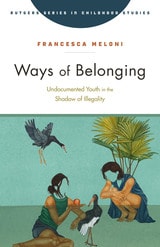
Ways of Belonging
Undocumented Youth in the Shadow of IllegalityFrancesca Meloni
Rutgers University Press, 2024
Ways of Belonging examines the experiences of undocumented young people who are excluded from K–12 schools in Canada and are rendered invisible to the education system. Canadian law doesn’t mention the existence of undocumented children, and thus their access to education rests on discretionary practices and is often denied altogether. This book brings the stories of undocumented young people vividly alive, putting them into conversation with the perspectives of the different actors in schools and courts who fail to include these young people.
Drawing on long-term ethnographic fieldwork, Francesca Meloni shows how ambivalence shapes the lives of young people who are caught between the desire to belong and the impossibility of fully belonging. Meloni pays close attention to these young people’s struggles and hopes, showing us what it means to belong and to endure in contexts of social exclusion. Ways of Belonging reveals the opacities and failures of a system that excludes children from education and puts their lives in invisibility mode.
An interview with the author (https://www.qmul.ac.uk/clpn/news-views/book-interviews/items/interview-with-francesca-meloni-about-her-book-ways-of-belonging-undocumented-youth-in-the-shadow-of-illegality.html)
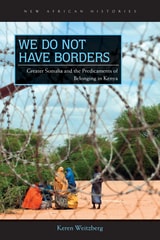
We Do Not Have Borders
Greater Somalia and the Predicaments of Belonging in KenyaKeren Weitzberg
Ohio University Press, 2017
Though often associated with foreigners and refugees, many Somalis have lived in Kenya for generations, in many cases since long before the founding of the country. Despite their long residency, foreign and state officials and Kenyan citizens often perceive the Somali population to be a dangerous and alien presence in the country, and charges of civil and human rights abuses have mounted against them in recent years.
In We Do Not Have Borders, Keren Weitzberg examines the historical factors that led to this state of affairs. In the process, she challenges many of the most fundamental analytical categories, such as “tribe,” “race,” and “nation,” that have traditionally shaped African historiography. Her interest in the ways in which Somali representations of the past and the present inform one another places her research at the intersection of the disciplines of history, political science, and anthropology.
Given tragic events in Kenya and the controversy surrounding al-Shabaab, We Do Not Have Borders has enormous historical and contemporary significance, and provides unique inroads into debates over globalization, African sovereignty, the resurgence of religion, and the multiple meanings of being African.

When Home Is a Photograph
Blackness and Belonging in the WorldLeigh Raiford
Duke University Press, 2026