Results by title
92 books match the query 'Boundaries' and 5 start with w

Wannabes, Goths, and Christians
The Boundaries of Sex, Style, and StatusAmy C. Wilkins
University of Chicago Press, 2008
Amy C. Wilkins’s intimate ethnography of these three subcultures reveals a complex tug-of-war between the demands of race, class, and gender in which transgressing in one realm often means conforming to expectations in another. Subcultures help young people, especially women, navigate these connecting territories by offering them different sexual strategies: wannabes cross racial lines, goths break taboos by becoming involved with multiple partners, and Christians forego romance to develop their bond with God. Avoiding sanctimonious hysteria over youth gone astray, Wilkins meets these kids on their own terms, and the result is a perceptive and provocative portrait of the structure of young lives.
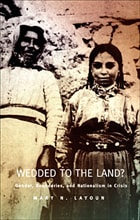
Wedded to the Land?
Gender, Boundaries, and Nationalism in CrisisMary N. Layoun
Duke University Press, 2001
Drawing on readings of literature and of official documents and decrees, songs, poetry, cinema, public monuments, journalism, and conversations with exiles, refugees, and public officials, Layoun uses each historical incident as a means of highlighting a recurring trope within constructs of nationalism. The displacement of the Greek refugees in the 1920s calls into question the very idea of home, as well as the desire for ethnic homogeneity within nations. She reads the Cypriot coup and invasion as an illustration of the gendering of nation and how the notion of the inviolable woman came to represent sovereignity. In her third example she shows how the Palestinian and PLO expulsion from Beirut highlights the ambiguity of the borders upon which many manifestations of nationalism putatively depend. These chapters are preceded and introduced by a discussion of “culturing the nation” and closed by a consideration of citizenship and silence in which Layoun discusses rights ostensibly possessed by all members of a political community.
This book will be of interest to scholars engaged in cultural and critical theory, Middle Eastern and Mediterranean history, literary studies, political science, postcolonial studies, and gender studies.
When Freedom Speaks
The Boundaries and the Boundlessness of Our First Amendment RightLynn Greenky
Brandeis University Press, 2022
When Freedom Speaks chronicles the stories behind our First Amendment right to speak our minds. Lynn Levine Greenky’s background as a lawyer, rhetorician, and teacher gives her a unique perspective on the protection we have from laws that abridge our right to the freedom of speech. Rhetoricians focus on language and how it influences perception and moves people to action. Powerfully employing that rhetorical approach, this book explores concepts related to free speech as moral narratives that proscribe the boundaries of our constitutionally protected right. Using the characters and drama embedded in legal cases that elucidate First Amendment principles, When Freedom Speaks makes the concepts easier to understand and clearly applicable to our lives. With a wide range of examples and accessible language, this book is the perfect overview of the First Amendment.
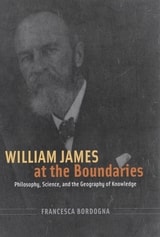
William James at the Boundaries
Philosophy, Science, and the Geography of KnowledgeFrancesca Bordogna
University of Chicago Press, 2008
What was the goal of this unusual speech? Rather than an oddity, Francesca Bordogna asserts that the APA address was emblematic—it was just one of many gestures that James employed as he plowed through the barriers between academic, popular, and pseudoscience, as well as the newly emergent borders between the study of philosophy, psychology, and the “science of man.” Bordogna reveals that James’s trespassing of boundaries was an essential element of a broader intellectual and social project. By crisscrossing divides, she argues, James imagined a new social configuration of knowledge, a better society, and a new vision of the human self. As the academy moves toward an increasingly interdisciplinary future, William James at the Boundaries reintroduces readers to a seminal influence on the way knowledge is pursued.
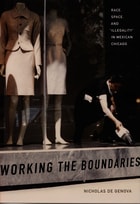
Working the Boundaries
Race, Space, and "Illegality" in Mexican ChicagoNicholas De Genova
Duke University Press, 2005
De Genova worked for two and a half years as a teacher of English in ten industrial workplaces (primarily metal-fabricating factories) throughout Chicago and its suburbs. In Working the Boundaries he draws on fieldwork conducted in these factories, in community centers, and in the homes and neighborhoods of Mexican migrants. He describes how the meaning of “Mexican” is refigured and racialized in relation to a U.S. social order dominated by a black-white binary. Delving into immigration law, he contends that immigration policies have worked over time to produce Mexicans as the U.S. nation-state’s iconic “illegal aliens.” He explains how the constant threat of deportation is used to keep Mexican workers in line. Working the Boundaries is a major contribution to theories of race and transnationalism and a scathing indictment of U.S. labor and citizenship policies.