Results by title
101 books match the query 'Care' and 4 start with w
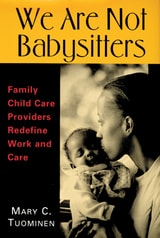
We Are Not Babysitters
Family Childcare Providers Redefine Work and CareTuominen, Mary
Rutgers University Press, 2003
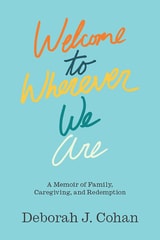
Welcome to Wherever We Are
A Memoir of Family, Caregiving, and RedemptionDeborah J. Cohan
Rutgers University Press, 2020
ESS Public Sociology Award
Recommended Book in Domestic Violence by DomesticShelters.org
How do you go about caregiving for an ill and elderly parent with a lifelong history of abuse and control, intertwined with expressions of intense love and adoration? How do you reconcile the resulting ambivalence, fear, and anger?
Welcome to Wherever We Are is a meditation on what we hold onto, what we let go of, how we remember others and ultimately how we’re remembered. Deborah Cohan shares her story of caring for her father, a man who was simultaneously loud, gentle, loving and cruel and whose brilliant career as an advertising executive included creating slogans like “Hey, how ‘bout a nice Hawaiian punch?” Wrestling with emotional extremes that characterize abusive relationships, Cohan shows how she navigated life with a man who was at once generous and affectionate, creating magical coat pockets filled with chocolate kisses when she was a little girl, yet who was also prone to searing, vicious remarks like “You’d make my life easier if you’d commit suicide.”
In this gripping memoir, Cohan tells her unique personal story while also weaving in her expertise as a sociologist and domestic abuse counselor to address broader questions related to marriage, violence, divorce, only children, intimacy and loss. A story most of us can relate to as we reckon with past and future choices against the backdrop of complicated family dynamics, Welcome to Wherever We Are is about how we might come to live our own lives better amidst unpredictable changes through grief and healing.
Questions for Discussion (https://d3tto5i5w9ogdd.cloudfront.net/wp-content/uploads/2020/05/11140346/Cohan_Discussion.docx)
Who Cares? Women, Care, and Culture
Julia T. Wood
Southern Illinois University Press, 1994
At a time when studies suggest the average American woman spends seventeen years caring for children and eighteen years caring for aging parents, Julia T. Wood examines how culture creates and sustains our definitions of caring, determines who cares along gender lines, and assigns the diminished value that caring has in our society.
Wood argues that America’s expanding need for caring is currently being met at an unacceptably high cost to caregivers. It is time, she believes, to examine caregiving roles and the personal, political, and social issues that surround the question of who cares. Caring must be recognized and promoted as an activity that commands the respect and participation of all members of our society—men and women alike.
Only by implementing changes in the basic fabric of American culture, affecting both the structure and the policies of our society and government, can we, Wood concludes, carve out a system of caring that will recognize caring as everyone’s responsibility.
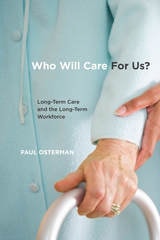
Who Will Care For Us?
Long-Term Care and the Long-Term WorkforcePaul Osterman
Russell Sage Foundation, 2017
Using national surveys, administrative data, and nearly 120 original interviews with workers, employers, advocates, and policymakers, Osterman finds that direct care workers are marginalized and often invisible in the health care system. While doctors and families alike agree that good home care aides and CNAs are crucial to the well-being of their patients, the workers report poverty-level wages, erratic schedules, exclusion from care teams, and frequent incidences of physical injury on the job. Direct care workers are also highly constrained by policies that specify what they are allowed to do on the job, and in some states are even prevented from simple tasks such as administering eye drops.
Osterman concludes that broadening the scope of care workers’ duties will simultaneously boost the quality of care for patients and lead to better jobs and higher wages. He proposes integrating home care aides and CNAs into larger medical teams and training them as “health coaches” who educate patients on concerns such as managing chronic conditions and transitioning out of hospitals. Osterman shows that restructuring direct care workers’ jobs, and providing the appropriate training, could lower health spending in the long term by reducing unnecessary emergency room and hospital visits, limiting the use of nursing homes, and lowering the rate of turnover among care workers.
As the Baby Boom generation ages, Who Will Care for Us? demonstrates the importance of restructuring the long-term care industry and establishing a new relationship between direct care workers, patients, and the medical system.