86 books match the query 'Chile' and 2 start with w
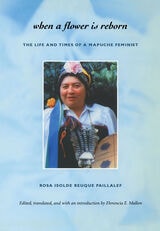
cover of When a Flower Is Reborn: The Life and Times of a Mapuche Feminist

When a Flower Is Reborn

The Life and Times of a Mapuche Feminist

Rosa Isolde Reuque Paillalef, Edited, translated, and with an introduction by Florencia E. Mallon

Duke University Press, 2002

A pathbreaking contribution to Latin American testimonial literature, When a Flower Is Reborn is activist Rosa Isolde Reuque Paillalef’s chronicle of her leadership within the Mapuche indigenous rights movement in Chile. Part personal reflection and part political autobiography, it is also the story of Reuque’s rediscovery of her own Mapuche identity through her political and human rights activism over the past quarter century. The questions posed to Reuque by her editor and translator, the distinguished historian Florencia Mallon, are included in the text, revealing both a lively exchange between two feminist intellectuals and much about the crafting of the testimonial itself. In addition, several conversations involving Reuque’s family members provide a counterpoint to her story, illustrating the variety of ways identity is created and understood.

A leading activist during the Pinochet dictatorship, Reuque—a woman, a Catholic, and a Christian Democrat—often felt like an outsider within the male-dominated, leftist Mapuche movement. This sense of herself as both participant and observer allows for Reuque’s trenchant, yet empathetic, critique of the Mapuche ethnic movement and of the policies regarding indigenous people implemented by Chile’s post-authoritarian government. After the 1990 transition to democratic rule, Reuque collaborated with the government in the creation of the Indigenous Development Corporation (CONADI) and the passage of the Indigenous Law of 1993. At the same time, her deepening critiques of sexism in Chilean society in general, and the Mapuche movement in particular, inspired her to found the first Mapuche feminist organization and participate in the 1996 International Women’s Conference in Beijing. Critical of the democratic government’s inability to effectively address indigenous demands, Reuque reflects on the history of Mapuche activism, including its disarray in the early 1990s and resurgence toward the end of the decade, and relates her hopes for the future.

An important reinvention of the testimonial genre for Latin America’s post-authoritarian, post-revolutionary era, When a Flower Is Reborn will appeal to those interested in Latin America, race and ethnicity, indigenous people’s movements, women and gender, and oral history and ethnography.
[more]
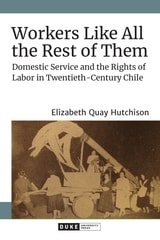
cover of Workers Like All the Rest of Them: Domestic Service and the Rights of Labor in Twentieth-Century Chile

Workers Like All the Rest of Them

Domestic Service and the Rights of Labor in Twentieth-Century Chile

Elizabeth Quay Hutchison

Duke University Press, 2022

In Workers Like All the Rest of Them, Elizabeth Quay Hutchison recounts the long struggle for domestic workers’ recognition and rights in Chile across the twentieth century. Hutchison traces the legal and social history of domestic workers and their rights, outlining their transition from slavery to servitude. For most of the twentieth century, domestic service remained one of the key “underdeveloped” sectors in Chile’s modernizing economy. Hutchison argues that the predominance of women in that underpaid, underregulated labor sector provides one key to persistent gender and class inequality. Through archival research, firsthand accounts, and interviews with veteran activists, Hutchison challenges domestic workers’ exclusion from Chilean history and reveals how and under what conditions they mobilized for change, forging alliances with everyone from Catholic Church leaders and legislators to feminists and political party leaders. Hutchison contributes to a growing global conversation among activists and scholars about domestic workers’ rights, providing a lens for understanding how the changing structure of domestic work and worker activism has both perpetuated and challenged forms of ethnic, gender, and social inequality.
[more]