Results by title
134 books match the query 'Chinese' and 6 start with w
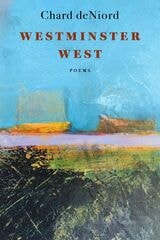
Westminster West
Chard deNiord
Tupelo Press, 2025
Westminster West traverses the worlds of here and beyond. Chard deNiord divines “the everydayness of the mystery . . . in which being and making poetry are the same.” From posthumous correspondence between Abelard and Heloise to such poems as “Skywriting Over The Rockies,” “With A Bone In My Heart,” and “I Call Out To You,” this collection betrays a mortal charge, bearing witness to what Emily Dickinson called “each ecstatic moment/ to which we must an anguish pay” and which Aridjis in his defiance of death calls “dust in love.”
Ambitious and masterful, deNiord renders such ancient subject matter as love, betrayal, landscape, loss, grief, aging, and ecstasy new throughout Westminster West. He transforms the echo chamber of futility, silence, and failure by aspiring to cross over to “the other,” whatever it may be, a stone or cloud or lover or garment, or cancerous lung, with a “negative capability” that allows it, no matter its identity, to speak memorably in a way that transcends simple definition and ultimately any personal connection to it.
Westminster West is divided into three sections that complement each other in their archetypal themes which range historically, mythologically, and cathectically. The poems in the first section imagine correspondences and dialogues between couples, including Heloise and Abelard, Adam and Eve, Gilgamesh and Enkidu, Odysseus and Calypso, a widower and his deceased wife in the time of Covid, and a lovesick husband in the air above the Rocky Mountains and his beloved on the ground. The second section also features love poems but focuses on more instructional and metaphysical themes that vary from metaphorical pedagogy on the topic of sex to “the harsh advice of loss” to the memory of a young couple’s transcendent, romantic walk by a river. Section three moves away from love poems to mortal and environmental themes, including elegies, pastorals, and a concluding confessional credo on the bittersweet reality of poetry’s irony and blessing.
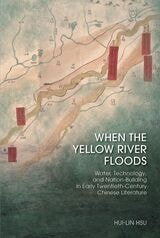
When the Yellow River Floods
Water, Technology, and Nation-Building in Early Twentieth-Century Chinese LiteratureHui-Lin Hsu
Hong Kong University Press, 2024
When the Yellow River Floods explores the relationship between environmental degradation, hydraulic engineering, and nation-building in the context of Liu E’s The Travels of Lao Can. This book provides a unique perspective on modern Chinese literary history that goes beyond conventional narratives that focus solely on political and cultural factors. The main areas covered include the role of water management in literary nation-building and the connections between the novel’s various themes, such as river engineering, medical and political discourses, national sentiment, and landscape description.
By offering a comprehensive analysis of The Travels of Lao Can, this book broadens the understanding of nation-building in early twentieth-century China, highlighting the impact of environmental crises and hydraulics on the formation of national literature and consciousness. When the Yellow River Floods provides a new perspective on the environmental roots of modern Chinese literature, making it an essential read for those seeking to understand the complex interplay between literature, the environment, and national identity in China. This book will be of interest to scholars and students of Chinese literature, history, and environmental studies.
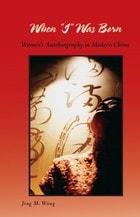
When “I” Was Born
Women’s Autobiography in Modern ChinaJing M. Wang
University of Wisconsin Press, 2008
When “I” Was Born: Women’s Autobiography in Modern China reclaims the voices of these particular writers, voices that have been misinterpreted and overlooked for decades. Tracing women writers as they move from autobiographical fiction, often self-revelatory and personal, to explicit autobiographies that focused on women’s roles in public life, Jing M. Wang reveals the factors that propelled this literary movement, the roles that liberal translators and their renditions of Western life stories played, and the way in which these women writers redefined writing and gender in the stories they told. But Wang reveals another story as well: the evolving history and identity of women in modern Chinese society. When “I” Was Born adds to a growing body of important work in Chinese history and culture, women’s studies, and autobiography in a global context.
Writers discussed include Xie Bingying, Zhang Ailing, Yu Yinzi, Fei Pu, Lu Meiyen, Feng Heyi, Ye Qian, Bai Wei, Shi Wen, Fan Xiulin, Su Xuelin, and Lu Yin.
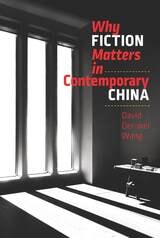
Why Fiction Matters in Contemporary China
David Der-wei Wang
Brandeis University Press, 2020
Contemporary discussions of China tend to focus on politics and economics, giving Chinese culture little if any attention. Why Fiction Matters in Contemporary China offers a corrective, revealing the crucial role that fiction plays in helping contemporary Chinese citizens understand themselves and their nation. Where history fails to address the consequences of man-made and natural atrocities, David Der-Wei Wang argues, fiction arises to bear witness to the immemorial and unforeseeable.
Beginning by examining President Xi Jinping’s call in 2013 to “tell the good China story,” Wang illuminates how contemporary Chinese cultural politics have taken a “fictional turn,” which can trace its genealogy to early modern times. He does so by addressing a series of discourses by critics within China, including Liang Qichao, Lu Xun, and Shen Congwen, as well as critics from the West such as Arendt, Benjamin, and Deleuze. Wang highlights the variety and vitality of fictional works from China as well as the larger Sinophone world, ranging from science fiction to political allegory, erotic escapade to utopia and dystopia. The result is an insightful account of contemporary China, one that affords countless new insights and avenues for understanding.

Writing Beijing
History and Knowledge of the CapitalNaixi Feng
University of Michigan Press, 2027
Writing Beijing offers a comprehensive study of the textual representations of the city from the late Ming dynasty through the Republican era, interrogating how urban narratives were actively constructed, adapted, and repurposed across periods of political transformation. Scholars, officials, and travelers reshaped the capital’s identity by rewriting older texts, borrowing new surveys, and even inserting critiques into guidebooks.. This study reveals how the crises brought by intense social transformation, including dynastic collapse and foreign invasion, forced writers to reinvent Beijing on paper. Some turned the city into a monument to lost glory; others documented everyday life to resist imperialism. These narratives served to critique contemporary sociopolitical conditions, assert cultural legitimacy during times of crisis, and ultimately shape Beijing’s enduring cultural image as China’s symbolic capital.
Naixi Feng bridges literary studies, urban history, and critical historiography by examining a wide range of genres—including literary miscellanies, local gazetteers, Qing imperial compilations, Republican textbooks, social reports, and travel guides—to demonstrate how writing about Beijing was never merely descriptive but always a site of cultural and political contestation.
Writing Pirates
Vernacular Fiction and Oceans in Late Ming ChinaYuanfei Wang
University of Michigan Press, 2021