Results by title
1566 books match the query 'Christianity' and 52 start with w
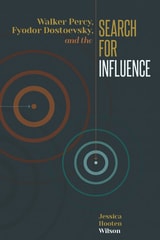
Walker Percy, Fyodor Dostoevsky, and the Search for Influence
Jessica Hooten Wilson
The Ohio State University Press, 2017
From Dostoevsky, Percy learned how to captivate his non-Christian readership with fiction saturated by a Christian vision of reality. Not only was his method of imitation in line with this Christian faith but also the aesthetic mode and very content of his narratives centered on his knowledge of Christ. The influence of Dostoevsky on Percy, then, becomes significant as a modern case study for showing the illusion of artistic autonomy and long-held, Romantic assumptions about artistic originality. Ultimately, Wilson suggests, only by studying the good that came before can one translate it in a new voice for the here and now.
Walking with Jesus Christ
Catholic and Evangelical Visions of the Moral LifeSteven Hoskins
Saint Paul Seminary Press, 2023
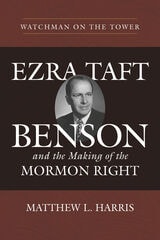
Watchman on the Tower
Ezra Taft Benson and the Making of the Mormon RightMatthew L. Harris
University of Utah Press, 2020
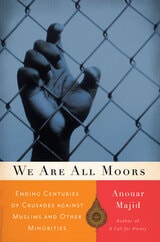
We Are All Moors
Ending Centuries of Crusades against Muslims and Other MinoritiesAnouar Majid
University of Minnesota Press, 2012
In 1609 King Philip III ordered the expulsion of all Moriscos—Spaniards of Muslim descent—from Spain in an ongoing attempt to establish a homogeneous state and remove the last vestiges of Islam from his nation. Four centuries later, Spain and Europe are once again outraged by the presence of Islam within their borders, and, for many, the millions of Muslim immigrants now living there pose a fundamental challenge to European identity. Across the Atlantic Ocean, the vast Hispanic community in the United States, both legal and illegal, has raised similar fears. Exacerbated by globalization and 9/11, these nativist, anti-Islamic, and broadly anti-immigrant attitudes fatally undermine meaningful dialogue and progress essential to creating a more peaceful and just world.
In We Are All Moors, Anouar Majid contends that the acrimonious debates about immigration and Islam in the West are the cultural legacy of the conflict between Christians and Moors. Offering a groundbreaking new history of the West’s perception and treatment of minority cultures, Majid explores how “the Moor” emerged as the archetypal Other against which Europe would define itself. The characteristics attributed to this quintessential minority—racial inferiority, religious impurity, cultural incompatibility—would be reapplied to other non-European and non-Christian peoples: Native Americans, black Africans, Jews, and minority immigrant communities, among others.
The Moor, Majid reveals, has served as an unacknowledged but potent metaphor for all minority peoples in the West, endlessly reincarnated by the majority. Only by recognizing the connections between current fears about immigration and Islam and medieval Christianity’s crusade against the Moor, he argues, can we begin to redress centuries of oppression, learn from the tragedies of the past, and find common ground in a globalized world.
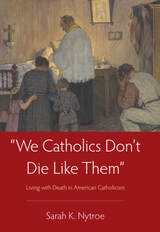
We Catholics Don't Die Like Them
Living with Death Before Vatican IISarah Nytroe
Catholic University of America Press, 2026
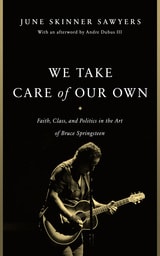
We Take Care of Our Own
Faith, Class, and Politics in the Art of Bruce SpringsteenJune Skinner Sawyers
Rutgers University Press, 2024
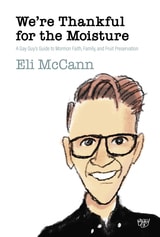
We're Thankful for the Moisture
A Gay Guy's Guide to Mormon Faith, Family, and Fruit PreservationMcCann, Eli
Signature Books, 2026
We're Thankful for the Moisture
A Gay Guy's Guide to Mormon Faith, Family, and Fruit PreservationMcCann, Eli
Signature Books, 2026
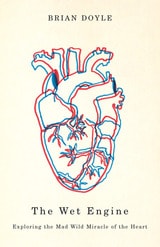
Wet Engine
Exploring the Mad Wild Miracle of the HeartBrian Doyle
Oregon State University Press, 2012
In this poignant and startlingly original book, Brian Doyle examines the heart as a physical organ—how it is supposed to work, how surgeons try to fix it when it doesn’t—and as a metaphor: the seat of the soul, the power house of the body, the essence of spirituality. In a series of profoundly moving ruminations, Doyle considers the scientific, emotional, literary, philosophical, and spiritual understandings of the heart—from cardiology to courage, from love letters and pop songs to Jesus. Weaving these strands together is the torment of Doyle’s own infant son’s heart surgery and the inspiring story of the young heart doctor who saved Liam’s life.
The Wet Engine is a book that will change how you feel and think about the mysterious, fragile human heart. This new paperback edition includes a foreword by Dr. Marla Salmon, dean of the University of Washington School of Nursing.
What Binds Marriage Forever?
Ida Friederike Gorres
Catholic University of America Press, 2025

What Brings a Marriage into Existence?
An Historical Re-examination of the Canon Law of the Latin ChurchBrendan Killeen
University of Scranton Press, 2010
Of the seven sacraments of the Roman Catholic Church, matrimony is the most discussed, debated, disputed, and adjudicated in all of canon law. In this book, Brendan Killeen employs the fundamental question “What brings a marriage into existence?” as the legal and scholarly means to explore the very nature of marriage within the framework of the canon law of the Catholic Church.
Killeen conducts his exploration in two phases. First he scrutinizes the canon law’s primary sources—texts dating as far back as the Roman Empire—and gives readers a fresh perspective of the law’s historical progression. He then examines the papers from the Second Vatican Council and offers both an objective evaluation of the law at present and some possible amendments for its future.
Noteworthy for its diligent research and in-depth analysis, What Brings a Marriage into Existence? will be useful to both newcomers to the canon law of marriage as well as seasoned scholars.
What Does It Mean to be a Christian?
A DebateJohn F. Crosby
St. Augustine's Press, 2016
The debate between the two friends is presented here in the form of a correspondence they conducted over a period of two years (and did not originally intend for publication). It has undergone very little editing and revision; the authors have wanted to preserve the spontaneous give and take of their exchange. Together they have produced a work of philosophical dialogue that is unusually fruitful in its ability to clarify some fundamental issues of religion.

What Does the Lord Require?
How American Christians Think about Economic JusticeHart, Stephen
Rutgers University Press, 1996
What Makes a Carmelite a Carmelite
Exploring Carmel's CharismKeith J. Egan
Catholic University of America Press, 2022
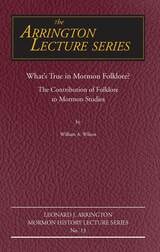
What's True in Mormon Folklore?
The Contribution of Folklore to Mormon StudiesWilliam Wilson
Utah State University Press, 2008
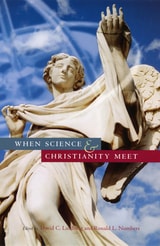
When Science and Christianity Meet
Edited by David C. Lindberg and Ronald L. Numbers
University of Chicago Press, 2003
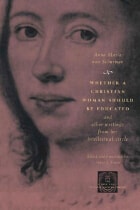
Whether a Christian Woman Should Be Educated and Other Writings from Her Intellectual Circle
Anna Maria van Schurman
University of Chicago Press, 1998
Gathered here in meticulous translation are Anna Maria van Schurman's defense of women's education, her letters to other learned women, and her own account of her early life, as well as responses to her work from male contemporaries, and rare writings by Schurman's mentor, Voetius. This volume will interest the general reader as well as students of women's, religious, and social history.
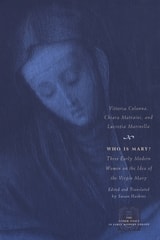
Who Is Mary?
Three Early Modern Women on the Idea of the Virgin MaryVittoria Colonna, Chiara Matraini, and Lucrezia Marinella
University of Chicago Press, 2009
Who Is Mary? testifies to the emotional and spiritual relationships that women had with the figure of Mary, whom they were required to emulate as the epitome of femininity. Now available for the first time in English-language translation, these writings suggest new possibilities for women in both religious and civil culture and provide a window to women’s spirituality, concerning the most important icon set before them, as wives, mothers, and Christians.
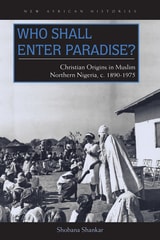
Who Shall Enter Paradise?
Christian Origins in Muslim Northern Nigeria, c. 1890–1975Shobana Shankar
Ohio University Press, 2014
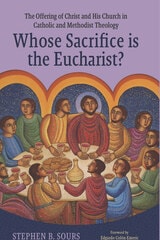
Whose Sacrifice is the Eucharist? The Offering of Christ and His Church in Catholic and Methodist Theology
Stephen B. Sours
Catholic University of America Press, 2024
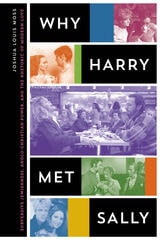
Why Harry Met Sally
Subversive Jewishness, Anglo-Christian Power, and the Rhetoric of Modern LoveBy Joshua Louis Moss
University of Texas Press, 2017
From immigrant ghetto love stories such as The Cohens and the Kellys (1926), through romantic comedies including Meet the Parents (2000) and Knocked Up (2007), to television series such as Transparent (2014–), Jewish-Christian couplings have been a staple of popular culture for over a century. In these pairings, Joshua Louis Moss argues, the unruly screen Jew is the privileged representative of progressivism, secular modernism, and the cosmopolitan sensibilities of the mass-media age. But his/her unruliness is nearly always contained through romantic union with the Anglo-Christian partner. This Jewish-Christian meta-narrative has recurred time and again as one of the most powerful and enduring, although unrecognized, mass-culture fantasies.
Using the innovative framework of coupling theory, Why Harry Met Sally surveys three major waves of Jewish-Christian couplings in popular American literature, theater, film, and television. Moss explores how first-wave European and American creators in the early twentieth century used such couplings as an extension of modernist sensibilities and the American “melting pot.” He then looks at how New Hollywood of the late 1960s revived these couplings as a sexually provocative response to the political conservatism and representational absences of postwar America. Finally, Moss identifies the third wave as emerging in television sitcoms, Broadway musicals, and “gross-out” film comedies to grapple with the impact of American economic globalism since the 1990s. He demonstrates that, whether perceived as a threat or a triumph, Jewish-Christian couplings provide a visceral, easily graspable, template for understanding the rapid transformations of an increasingly globalized world.
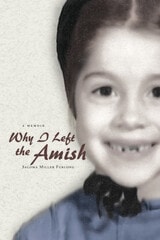
Why I Left the Amish
A MemoirSaloma Miller Furlong
Michigan State University Press, 2011
There are two ways to leave the Amish—one is through life and the other through death. When Saloma Miller Furlong’s father dies during her first semester at Smith College, she returns to the Amish community she had left twenty four years earlier to attend his funeral. Her journey home prompts a flood of memories. Now a mother with grown children of her own, Furlong recalls her painful childhood in a family defined by her father’s mental illness, her brother’s brutality, her mother’s frustration, and the austere traditions of the Amish—traditions Furlong struggled to accept for years before making the difficult decision to leave the community. In this personal and moving memoir, Furlong traces the genesis of her desire for freedom and education and chronicles her conflicted quest for independence. Eloquently told, Why I Left the Amish is a revealing portrait of life within—and without—this frequently misunderstood community.
Why I Stay 2
The Challenges of Discipleship for Contemporary Latter-day SaintsRobert A. Rees
Signature Books, 2021
Twenty-one women and men discuss what it is about Mormonism that keeps them part of the fold. Their deep, unique experiences make their individual travels even more compelling. Kimberly Applewhite Teitter, growing up in the South as a Black Latter-day Saint, often encountered well-meaning Latter-day Saints whose words messaged the idea that she was at some level an outsider or perhaps not as authentically Mormon as others in her congregation. Thus, she writes, “At the end of the day I’m still Black—still have felt the weight of proving that I represent the church I’ve fought so hard for my entire life.” Yet the very episodes that could have driven her from the church became lessons on the meaning of discipleship.
For Carol Lynn Pearson, staying boiled down to two reasons: “I find a great deal of love in this church,” and “where I do not find love, I have an opportunity to help create love.” The stories she shares illuminate that mantra. Mitch Mayne, an openly gay man, has faced many challenges by his decision to stay. “Most days, it seems I can’t be Mormon enough for my LDS community, and I can’t be gay enough for my LGBT fellows.” In his essay, he answers the question many have asked: “Why don’t you just leave the church?”
Why Read Pascal?
Paul J. Griffiths
Catholic University of America Press, 2021
Why Read Pavel Florensky?
John Burgess
Catholic University of America Press, 2024
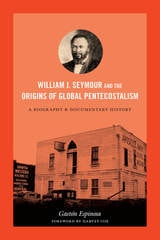
William J. Seymour and the Origins of Global Pentecostalism
A Biography and Documentary HistoryGastón Espinosa
Duke University Press, 2014
The 104 primary sources include all of Seymour's extant writings in full and without alteration and some of Parham's theological, social, and racial writings, which help explain why the two parted company. To capture the revival's diversity and global influence, this book includes Black, Latino, Swedish, and Irish testimonies, along with those of missionaries and leaders who spread Seymour's vision of Pentecostalism globally.
Winter Quarters
Maurine Ward
Utah State University Press, 2002
Volume 1, Life Writings of Frontier Women series, edited by Maureen Ursenbach Beecher
Mary Richard's journals and letters record a young woman's rare, but richly detailed view of life in the temporary Mormon pioneer communities in Iowa.
Witchcraft Mythologies and Persecutions
Gábor Klaniczay
Central European University Press, 2008
Witness through Encounter
The Diplomacy of Benedict XVIBernard J. O'Connor
St. Augustine's Press, 2019
Appealing to dialogue is often just a safe way of referring to something negative, or at best blandly neutral: the avoidance of conflict, the denial of similarity, not stirring deep-seated disagreement, etc. When Bernard o’Connor says pope Benedict XVI facilitated dialogue, however, he means something quite positive, very much tangible and certainly transformative. In providing an account of the pope’s interactions with various groups of the international community, O’Connor attempts to convey Benedict XVI’s diplomacy as encounter, where even in the sphere of international relations exhortations to “dialogue” are invitations to see more clearly and be moved as much as move.
To dialogue is to embrace, revise perception such that our approaches to the great questions of our day are not simply shared but correct. As O’Connor writes, “Pope Benedict attempts to promote the outlook that a renewed emphasis upon objective, critical and structured philosophical reasoning positions practice, diplomatic and otherwise, to regain its lost foundation and framework. the quest for integrity, if nothing else, should motivate our fidelity to academic pursuit, to intellectual investigation, and to rigorous interdisciplinary inquiry. so influenced, practice will then reject what is arbitrary and be guided by what is time-tested and enduring.”
O’Connor illustrates true dialogue emerging from the encounter, and in turn provides scores of characteristics of this encounter as it unfolds in papal diplomacy. In providing scores of addresses and speeches to various bodies, O’Connor presents pope Benedict XVI as an example of effective diplomacy that treats the meetings on the world stage as engaging in true dialogue. encounter is the true basis of dialogue and one that allows it to open to what is truly a catalyst for change toward cooperation––witness, both personal and collective. As o’Connor shows, “where there is authentic encounter, as meeting in mutual trust, what arises is context for witness.” If authentic even the diplomatic encounter has the means to deepen and transform one’s being.
Witness Through Encounter intends to fulfill multiple needs. the diplomatic approach exemplified herein is singular and worthy of study among political scientists, sociologists, philosophers and diplomats eager to embrace a worldview that is more personal than simply humanistic. this work will also be useful in inter-religious settings. An additional advantage of O’Connor’s presentation of Benedict XVI’s diplomatic approach, his witness through encounter, is that it contains insight valuable to the scholar alongside the resources used.
Witness, Warning, and Prophecy
Quaker Women's Writing, 1655-1700Edited by Teresa Feroli and Margaret Olofson Thickstun
Iter Press, 2018
The Other Voice in Early Modern Europe - The Toronto Series: Volume 60
Witnesses to Beatitude
Seven Romanian Greek Catholic Bishops Under CommunismFrancisca Băltăceanu
Catholic University of America Press, 2026
Women and Authority
Re-emerging Mormon FeminismHanks, Maxine
Signature Books, 1992
In 1842, founder Joseph Smith foresaw the LDS Women's Relief Society as "a kingdom of Priests," that he "would ordain them to preside over the society...just the Presidency preside over the church." Originally, the LDS Women's Relief Society paralleled the LDS men's priesthood quorums. Women were "ordained" to various positions, as well as set apart to be healers "with power to rebuke diseases."
In the 19th-century, Mormon theology also spoke of a Mother God, having "all power and glory" with the Father in Heaven. Mormon doctrine also hinted at the divine status of Eve, Mary, and Mary Magdalene.
The 19th-century Woman's Exponent, published by the LDS Women's Relief Society, editorialized in favor of "equal rights before the law, equal pay for equal work, equal political rights." The magazine's masthead read, "The Rights of the Women of Zion and the Rights of Women of All Nations."
One Relief Society founder, Sarah Kimball, referred to herself as "a woman's rights woman," while another leader, Bathsheba Smith, was called on a Relief Society mission in 1870 to preach "woman's rights" throughout southern Utah. According to the Woman's Exponent, a woman's place was not just "in the nursery" but "in the library, the laboratory, the observatory."
Women were encouraged to pursue formal education and career opportunities, study medicine and involve themselves in politics. Mormon women were assured that "when men see that women can exist without them, it will perhaps take a little of the conceit out of some of them."
Women who served inside LDS temples were termed "priestesses," while LDS Women's Relief Society president Eliza R. Snow was known as a "prophetess." Snow discouraged women from confiding their personal issues to male bishops, saying that such matters "should be referred to the Relief Society president and her counselors."
In 1875, LDS Women's Relief Society president, Emmeline B. Wells, could say with confidence: "Let woman speak for herself; she has the right of freedom of speech. Women are too slow in moving forward, afraid of criticism, of being called unwomanly, of being thought masculine. What of it? If men are so much superior to women, the nearer we come up to the manly standard the higher we elevate ourselves."
Women and Communal Worship
Shaping the Early Modern Christian LiturgyMicheline White
University of Delaware Press, 2027
Women and Communal Worship advances our understanding of early modern women by uncovering and analyzing Christian women’s engagement with liturgical and communal worship between 1500 and 1750. The Protestant attack on the medieval liturgy was at the heart of the Reformation and Counter-Reformation, but women’s contributions to those momentous changes have been largely overlooked as scholars have focused on women’s private devotional practices and texts. This collection of essays demonstrates that communal worship was vital to women of all confessional stripes. Although they could not generally lead the liturgy, women shaped public devotion in important ways, whether at the level of the local congregation, the household chapel, the convent, the court, or the national church. Communal worship is thus a key site for examining women’s textual, literary, social, and political agency.
Women and Mormonism
Historical and Contemporary PerspectivesEdited by Kate Holbrook and Matthew Bowman
University of Utah Press, 2016
This engaging and seminal volume employs a variety of sources—vivid primary documents, candid surveys, and illuminating oral histories—to explore the perspectives of Latter-day Saint (LDS) women. The expansive approach of this essay collection highlights an assortment of individuals, viewpoints, and challenges that ultimately invigorate our understanding of women and religion. Contributors include lay members and prominent scholars in multiple disciplines, including both LDS and non-LDS viewpoints.
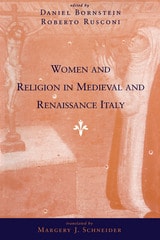
Women and Religion in Medieval and Renaissance Italy
Edited by Daniel Bornstein and Roberto Rusconi
University of Chicago Press, 1996
These essays explore the involvement of women in religious life throughout northern and central Italy and trace the evolution of communities of pious women as they tried to achieve their devotional goals despite the strictures of the ecclesiastical hierarchy. The contributors examine relations between holy women, their devout followers, and society at large.
Including contributions from leading figures in a new generation of Italian historians of religion, this book shows how women were able to carve out broad areas of influence by carefully exploiting the institutional church and by astutely manipulating religious percepts.
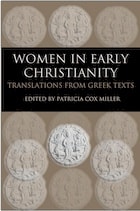
Women in Early Christianity
Translations from Greek TextsPatricia Cox Miller
Catholic University of America Press, 2005
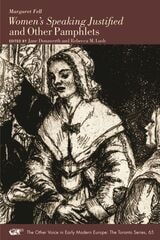
Women's Speaking Justified and Other Pamphlets
Margaret Fell
Iter Press, 2018
The Other Voice in Early Modern Europe - The Toronto Series, volume 65
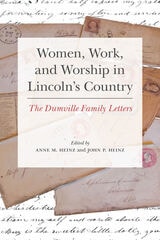
Women, Work, and Worship in Lincoln's Country
The Dumville Family LettersEdited by Anne M. Heinz and John P. Heinz
University of Illinois Press, 2016
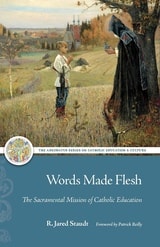
Words Made Flesh
The Sacramental Mission of Catholic EducationR. Jared Staudt
Catholic University of America Press, 2024
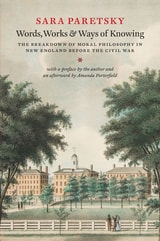
Words, Works, and Ways of Knowing
The Breakdown of Moral Philosophy in New England before the Civil WarSara Paretsky
University of Chicago Press, 2016
What’s less well-known is that before Paretsky began her writing career, she earned a PhD in history from the University of Chicago with a dissertation on moral philosophy and religion in New England in the early and mid-nineteenth century. Now, for the first time, fans of Paretsky can read that earliest work, Words, Works, and Ways of Knowing.
Paretsky here analyzes attempts by theologians at Andover Seminary, near Boston, to square and secure Calvinist religious beliefs with emerging knowledge from history and the sciences. She carefully shows how the open-minded scholasticism of these theologians paradoxically led to the weakening of their intellectual credibility as conventional religious belief structures became discredited, and how this failure then incited reactionary forces within Calvinism. That conflict between science and religion in the American past is of interest on its face, but it also sheds light on contemporary intellectual battles.
Rounding out the book, leading religious scholar Amanda Porterfield provides an afterword discussing where Paretsky’s work fits into the contemporary study of religion. And in a sobering—sometimes shocking—preface, Paretsky paints a picture of what it was like to be a female graduate student at the University of Chicago in the 1970s. A treat for Paretsky’s many fans, this book offers a glimpse of the development of the mind behind the mysteries.
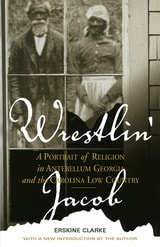
Wrestlin' Jacob
A Portrait of Religion in Antebellum Georgia and the Carolina Low CountryErskine Clarke
University of Alabama Press, 2000
Wrestling with God, scripture, and conscience in the nineteenth‑century South
First published in 1979, Wrestlin’ Jacob offers important insights into the intersection of black and white religious history in the South. Erskine Clarke provides two arenas—one urban and one rural—that show what happened when white ministers tried to bring black slaves into the fold of Christianity. Clarke illustrates how the good intentions—and vain illusions—of the white preachers, coupled with the degradation and cultural strength of the slaves, played a significant role in the development of black churches in the South.
From 1833 to 1847, Reverend Charles Colcock Jones served as an itinerant minister to slaves on the rice and cotton plantations in Liberty County, Georgia. The aim of Jones, and of the largely Puritan-descended slave owners, was to harvest not only good Christians but also obedient and hard-working slaves. At the same time, similar efforts were under way in cosmopolitan Charleston, South Carolina. Charleston permitted blacks to worship only under the supervision of whites, and partially as a result, whites and blacks worshiped together in ways that would be unheard of later in the segregated South.
Clarke examines not only the white ministers’ motivation in their missionary work but also the slaves’ reasons for becoming a part of the church. He addresses the important issue of the continuity of African traditions with the religious life of slaves and provides a significant introduction to the larger issues of slavery and religion in the South.
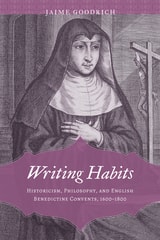
Writing Habits
Historicism, Philosophy, and English Benedictine Convents, 1600–1800Jaime Goodrich
University of Alabama Press, 2021
The first in-depth examination of the texts produced in English Benedictine convents between 1600 and 1800.
After Catholicism became illegal in England during the sixteenth century, Englishwomen established more than twenty convents on the Continent that attracted thousands of nuns and served as vital centers of Catholic piety until the French Revolution. Today more than 1,000 manuscripts and books produced by, and for, the Benedictine convents are extant in European archives. Writing Habits: Historicism, Philosophy, and English Benedictine Convents, 1600–1800 provides the first substantive analysis of these works in order to examine how members of one religious order used textual production to address a major dilemma experienced by every English convent on the Continent: How could English nuns cultivate a cloistered identity when the Protestant Reformation had swept away nearly all vestiges of English monasticism?
Drawing on an innovative blend of methodologies, Jaime Goodrich contends that the Benedictines instilled a collective sense of spirituality through writings that created multiple overlapping communities, ranging from the earthly society of the convent to the transhistorical network of the Catholic Church. Because God resides at the heart of these communities, Goodrich draws on the works of Martin Buber, a twentieth-century Jewish philosopher who theorized that human community forms a circle, with each member acting as a radius leading toward the common center of God. Buber’s thought, especially his conception of the I-You framework for personal and spiritual relationships, illuminates a fourfold set of affiliations central to Benedictine textual production: between the nuns themselves, between the individual nun and God, between the convent and God, and between the convent and the Catholic public sphere. By evoking these relationships, the major genres of convent writing—administrative texts, spiritual works, history and life writing, and controversial tracts—functioned as tools for creating community and approaching God.
Through this Buberian reading of the cloister, Writing Habits recovers the works of Benedictine nuns and establishes their broader relevance to literary history and critical theory.
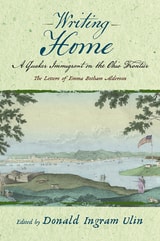
Writing Home
A Quaker Immigrant on the Ohio Frontier; the Letters of Emma Botham AldersonDonald Ingram Ulin
Bucknell University Press, 2020
Introductions and notes situate the letters in relation to their critical, biographical, literary, and historical contexts. Editor Donald Ulin discusses the relationship between Alderson’s letters and her sister Mary Howitt’s Our Cousins in Ohio (1849), a remarkable instance of transatlantic literary collaboration.
Writing Home offers an unparalleled opportunity for studying immigrant correspondence due to Alderson’s unusually well-documented literary and religious affiliations. The notes and introductions provide background on nearly all the places, individuals, and events mentioned in the letters.
Published by Bucknell University Press. Distributed worldwide by Rutgers University Press.
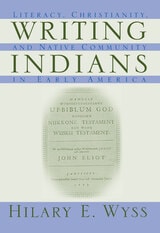
Writing Indians
Literacy, Christianity, and Native Community in Early AmericaHilary E. Wyss
University of Massachusetts Press, 2000
A study of cultural encounter, this book takes a fresh look at the much ignored and often misunderstood experience of Christian Indians in early America. Focusing on New England missionary settlements from the mid-seventeenth to the early nineteenth centuries, Hilary E. Wyss examines the ways in which Native American converts to Christianity developed their own distinct identity within the context of a colonial culture.
With an approach that weaves together literature, religious studies, and ethno-history, Wyss grounds her work in the analysis of a rarely read body of “autobiographical” writings by Christian Indians, including letters, journal entries, and religious confessions. She then juxtaposes these documents to the writings of better known Native Americans like Samson Occom as well as to the published works of Anglo-Americans, such as Mary Rowlandson's famous captivity narrative and Eleazor Wheelock's accounts of his charity schools.
In their search for ostensibly “authentic” Native voices, scholars have tended to overlook the writings of Christian Indians. Yet, Wyss argues, these texts reveal the emergence of a dynamic Native American identity through Christianity. More specifically, they show how the active appropriation of New England Protestantism contributed to the formation of a particular Indian identity that resisted colonialism by using its language against itself.
Writing Mormon History 2
Authors' Stories Behind Their WorksGeisner, Joseph W.
Signature Books, 2024
Like its predecessor, Writing Mormon History, this book delves into the captivating narratives of multiple historians as they unfold the backstories of their various publishing endeavors. The authors detail their journeys in crafting influential books, articles, newspaper pieces, and anthologies that have significantly shaped our comprehension of Mormon history. Beyond the polished final products that readers typically encounter, the book explores the driving forces compelling authors to explore their topics and the sacrifices they make along the way.
The volume invites readers to ponder the motivations that fuel an author’s commitment to rigorous research and writing, and sheds light on the substantial time, ranging from minutes to long hours, invested in the sources they cite. Through these narratives, readers gain an appreciation for the dedication and passion that goes into the making of historical scholarship.
Whether you're an avid historian, a student of history, a scholar, or an aspiring author, Writing Mormon History 2 offers an important glimpse into the minds of these writers. This anthology provides a unique opportunity to connect with the human stories behind the academic works that have left an indelible mark on our understanding of Mormon history.
Writings Against the Saracens
Catholic University of America Press, 2016
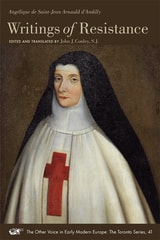
Writings of Resistance
Angélique de Saint-Jean Arnauld d’Andilly
Iter Press, 2015
An erudite abbess of Port-Royal, Angélique de Saint-Jean Arnauld d’Andilly (1624 – 1684) resisted the demands of church and state to condemn the Jansenist theological doctrines which the convent had long upheld. In her autobiographical Report on Captivity, Angélique de Saint-Jean recounts her personal methods of spiritual resistance as she and her fellow nuns underwent waves of persecution resulting in exile, house arrest, interdict, and excommunication. Her voluminous theological writings present the theoretical basis for this resistance, limiting the claims of political and ecclesiastical authorities over the conscience of the individual. In particular, she defends the right of women to refuse to surrender their convictions due to specious appeals to obedience and humility.
Writings of Warner Mifflin
Forgotten Quaker Abolitionist of the Revolutionary EraGary B. Nash
University of Delaware Press, 2021
Writings on Grace
The Complete <i>Ecrits sur la grace</i>Blaise Pascal
Catholic University of America Press, 2025
Writings on the Apocalypse
Francis X. Gumerlock
Catholic University of America Press, 2022