Results by title
255 books match the query 'Church of Jesus Christ of Latter-day Saints (Mormon)' and 10 start with w
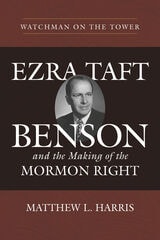
Watchman on the Tower
Ezra Taft Benson and the Making of the Mormon RightMatthew L. Harris
University of Utah Press, 2020
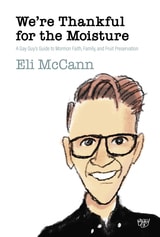
We're Thankful for the Moisture
A Gay Guy's Guide to Mormon Faith, Family, and Fruit PreservationMcCann, Eli
Signature Books, 2026
We're Thankful for the Moisture
A Gay Guy's Guide to Mormon Faith, Family, and Fruit PreservationMcCann, Eli
Signature Books, 2026
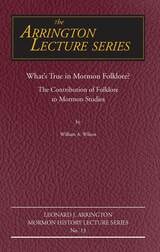
What's True in Mormon Folklore?
The Contribution of Folklore to Mormon StudiesWilliam Wilson
Utah State University Press, 2008

Why I Stay 2
The Challenges of Discipleship for Contemporary Latter-day SaintsRobert A. Rees
Signature Books, 2021
Twenty-one women and men discuss what it is about Mormonism that keeps them part of the fold. Their deep, unique experiences make their individual travels even more compelling. Kimberly Applewhite Teitter, growing up in the South as a Black Latter-day Saint, often encountered well-meaning Latter-day Saints whose words messaged the idea that she was at some level an outsider or perhaps not as authentically Mormon as others in her congregation. Thus, she writes, “At the end of the day I’m still Black—still have felt the weight of proving that I represent the church I’ve fought so hard for my entire life.” Yet the very episodes that could have driven her from the church became lessons on the meaning of discipleship.
For Carol Lynn Pearson, staying boiled down to two reasons: “I find a great deal of love in this church,” and “where I do not find love, I have an opportunity to help create love.” The stories she shares illuminate that mantra. Mitch Mayne, an openly gay man, has faced many challenges by his decision to stay. “Most days, it seems I can’t be Mormon enough for my LDS community, and I can’t be gay enough for my LGBT fellows.” In his essay, he answers the question many have asked: “Why don’t you just leave the church?”
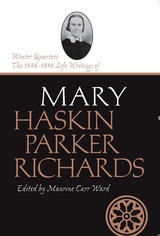
Winter Quarters
Maurine Ward
Utah State University Press, 2002
Volume 1, Life Writings of Frontier Women series, edited by Maureen Ursenbach Beecher
Mary Richard's journals and letters record a young woman's rare, but richly detailed view of life in the temporary Mormon pioneer communities in Iowa.
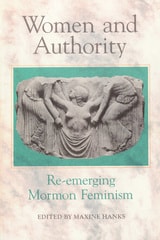
Women and Authority
Re-emerging Mormon FeminismHanks, Maxine
Signature Books, 1992
In 1842, founder Joseph Smith foresaw the LDS Women's Relief Society as "a kingdom of Priests," that he "would ordain them to preside over the society...just the Presidency preside over the church." Originally, the LDS Women's Relief Society paralleled the LDS men's priesthood quorums. Women were "ordained" to various positions, as well as set apart to be healers "with power to rebuke diseases."
In the 19th-century, Mormon theology also spoke of a Mother God, having "all power and glory" with the Father in Heaven. Mormon doctrine also hinted at the divine status of Eve, Mary, and Mary Magdalene.
The 19th-century Woman's Exponent, published by the LDS Women's Relief Society, editorialized in favor of "equal rights before the law, equal pay for equal work, equal political rights." The magazine's masthead read, "The Rights of the Women of Zion and the Rights of Women of All Nations."
One Relief Society founder, Sarah Kimball, referred to herself as "a woman's rights woman," while another leader, Bathsheba Smith, was called on a Relief Society mission in 1870 to preach "woman's rights" throughout southern Utah. According to the Woman's Exponent, a woman's place was not just "in the nursery" but "in the library, the laboratory, the observatory."
Women were encouraged to pursue formal education and career opportunities, study medicine and involve themselves in politics. Mormon women were assured that "when men see that women can exist without them, it will perhaps take a little of the conceit out of some of them."
Women who served inside LDS temples were termed "priestesses," while LDS Women's Relief Society president Eliza R. Snow was known as a "prophetess." Snow discouraged women from confiding their personal issues to male bishops, saying that such matters "should be referred to the Relief Society president and her counselors."
In 1875, LDS Women's Relief Society president, Emmeline B. Wells, could say with confidence: "Let woman speak for herself; she has the right of freedom of speech. Women are too slow in moving forward, afraid of criticism, of being called unwomanly, of being thought masculine. What of it? If men are so much superior to women, the nearer we come up to the manly standard the higher we elevate ourselves."

Women and Mormonism
Historical and Contemporary PerspectivesEdited by Kate Holbrook and Matthew Bowman
University of Utah Press, 2016
This engaging and seminal volume employs a variety of sources—vivid primary documents, candid surveys, and illuminating oral histories—to explore the perspectives of Latter-day Saint (LDS) women. The expansive approach of this essay collection highlights an assortment of individuals, viewpoints, and challenges that ultimately invigorate our understanding of women and religion. Contributors include lay members and prominent scholars in multiple disciplines, including both LDS and non-LDS viewpoints.
Writing Mormon History 2
Authors' Stories Behind Their WorksGeisner, Joseph W.
Signature Books, 2024
Like its predecessor, Writing Mormon History, this book delves into the captivating narratives of multiple historians as they unfold the backstories of their various publishing endeavors. The authors detail their journeys in crafting influential books, articles, newspaper pieces, and anthologies that have significantly shaped our comprehension of Mormon history. Beyond the polished final products that readers typically encounter, the book explores the driving forces compelling authors to explore their topics and the sacrifices they make along the way.
The volume invites readers to ponder the motivations that fuel an author’s commitment to rigorous research and writing, and sheds light on the substantial time, ranging from minutes to long hours, invested in the sources they cite. Through these narratives, readers gain an appreciation for the dedication and passion that goes into the making of historical scholarship.
Whether you're an avid historian, a student of history, a scholar, or an aspiring author, Writing Mormon History 2 offers an important glimpse into the minds of these writers. This anthology provides a unique opportunity to connect with the human stories behind the academic works that have left an indelible mark on our understanding of Mormon history.

Written to the Lamanites
Indigenous Perspectives on Mormon Narratives of IndigeneityFarina King and Michael Ing
University of Utah Press, 2027