Results by title
155 books match the query 'Civil rights movements' and 9 start with w
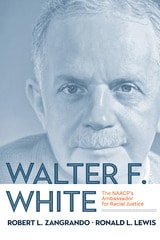
Walter F. White
The NAACP's Ambassador for Racial JusticeRONALD L. LEWIS
West Virginia University Press, 2018
Walter F. White of Atlanta, Georgia, joined the National Association for the Advancement of Colored People (NAACP) in 1918 as an assistant to Executive Secretary James Weldon Johnson. When Johnson retired in 1929, White replaced him as head of the NAACP, a position he maintained until his death in 1955. During his long tenure, White was in the vanguard of the struggle for interracial justice. His reputation went into decline, however, in the era of grassroots activism that followed his death. White’s disagreements with the US Left, and his ambiguous racial background—he was of mixed heritage, could “pass” as white, and divorced a black woman to marry a white woman—fueled ambivalence about his legacy.
In this comprehensive biography, Zangrando and Lewis seek to provide a reassessment of White within the context of his own time, revising critical interpretations of his career. White was a promoter of and a participant in the Harlem Renaissance, a daily fixture in the halls of Congress lobbying for civil rights legislation, and a powerful figure with access to the administrations of Roosevelt (via Eleanor) and Truman. As executive secretary of the NAACP, White fought incessantly to desegregate the American military and pushed to ensure equal employment opportunities. On the international stage, White advocated for people of color in a decolonized world, and for economic development aid to nations like India and Haiti, bridging the civil rights struggles at home and abroad.
Watching Jim Crow
The Struggles over Mississippi TV, 1955–1969Steven D. Classen
Duke University Press, 2004
During the 1990s, Classen conducted extensive interviews with more than two dozen African Americans living in Jackson, several of whom, decades earlier, had fought to integrate television programming. He draws on these interviews not only to illuminate their perceptions—of the civil rights movement, what they accomplished, and the present as compared with the past—but also to reveal the inadequate representation of their viewpoints in the legal proceedings surrounding WLBT’s licensing. The story told in Watching Jim Crow has significant implications today, not least because the Telecommunications Act of 1996 effectively undid many of the hard-won reforms achieved by activists—including those whose stories Classen relates here.
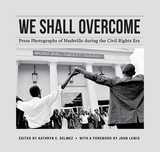
We Shall Overcome
Press Photographs of Nashville during the Civil Rights EraKathryn E. Delmez
Vanderbilt University Press, 2023
Fifty years after Martin Luther King Jr.'s death—and at a time when race relations and social justice are again at the forefront of our country's consciousness—this book expands on a Frist Art Museum exhibition to present a selection of approximately one hundred photographs that document an important period in Nashville's struggle for racial equality. The images were taken between 1957, the year that desegregation in public schools began, and 1968, when the National Guard was called in to surround the state capitol in the wake of the civil rights leader's assassination in Memphis.
Of central significance are photographs of lunch counter sit-ins in early 1960, led by a group of students, including John Lewis (who contributed the book's foreword) and Diane Nash, from local historically black colleges and universities. The demonstrations were so successful that King stated just a few weeks later at Fisk University: "I did not come to Nashville to bring inspiration but to gain inspiration from the great movement that has taken place in this community." The role that Nashville played in the national civil rights movement as a hub for training students in nonviolent protest and as the first Southern city to integrate places of business is a story that warrants reexamination.
The book also provides an opportunity to consider the role of images and the media in shaping public opinion, a relevant subject in today's news-saturated climate. Photographs from the archives of both daily newspapers are included: the Tennessean, which was the more liberal publication, and the Nashville Banner, a conservative paper whose leadership seemed less interested in covering events related to racial issues. Some of the photographs in the exhibition had been selected to be published in the papers, but many were not, and their disclosure reveals insight into the editorial process. In several images, other photojournalists and news crews are visible, serving as a reminder of the almost constant presence of the camera during these historic times.
Essays by Linda Wynn of Fisk University and the Tennessee Historical Commission and Susan H. Edwards, executive director of the Frist Art Museum, offer historical context on Nashville during the civil rights era and on photojournalism, respectively. Congressman John Lewis's foreword recounts memories of his time in Nashville and reminds us that there is still work to be done to build King's Beloved Community.
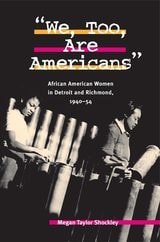
We, Too, Are Americans
African American Women in Detroit and Richmond, 1940-54Megan Taylor Shockley
University of Illinois Press, 2003
As demands on them intensified, the women working to provide American troops with clothing, medical supplies, and other services became increasingly aware of their key role in the war effort. A considerable number of the African Americans among them began to use their indispensability to leverage demands for equal employment, welfare and citizenship benefits, fair treatment, good working conditions, and other considerations previously denied them.
Shockley shows that as these women strove to redefine citizenship, backing up their claims to equality with lawsuits, sit-ins, and other forms of activism, they were forging tools that civil rights activists would continue to use in the years to come.
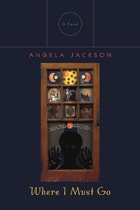
Where I Must Go
A NovelAngela Jackson
Northwestern University Press, 2009
Lyrical, penetrating, and highly charged, this novel displays a delicately tuned sense of difference and belonging. Poet Angela Jackson brings her superb sense of language and of human possibility to the story of young Magdalena Grace, whose narration takes readers through both privilege and privation at the time of the American civil rights movement.
The novel moves from the privileged yet racially exclusive atmosphere of the fictional Eden University to the black neighborhoods of a Midwestern city and to ancestral Mississippi. Magdalena’s story includes a wide range of characters—black and white, male and female, favored with opportunity or denied it, the young in love and elders wise with hope. With and through each other, they struggle to understand the history they are living and making. With dazzling perceptiveness, Jackson’s narrator Magdalena tells of the complex interactions of people around her who embody the personal and the political at a crucial moment in their own lives and in the making of America.
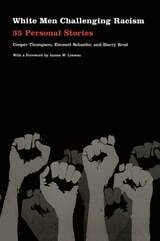
White Men Challenging Racism
35 Personal StoriesCooper Thompson, Emmett Schaefer, and Harry Brod
Duke University Press, 2003
Ranging in age from twenty-six to eighty-six, the men whose stories are presented here include some of the elder statesmen of antiracism work as well as members of the newest generation of activists. They come from across the United States—from Denver, Nashville, and San Jose; rural North Carolina, Detroit, and Seattle. Some are straight; some are gay. A few—such as historian Herbert Aptheker, singer/songwriter Si Kahn, Stetson Kennedy (a Klan infiltrator in the 1940s), and Richard Lapchick (active in organizing the sports community against apartheid)—are relatively well known; most are not. Among them are academics, ministers, police officers, firefighters, teachers, journalists, union leaders, and full-time community organizers. They work with Latinos and African-, Asian-, and Native-Americans. Many ground their work in spiritual commitments. Their inspiring personal narratives—whether about researching right-wing groups, organizing Central American immigrants, or serving as pastor of an interracial congregation—connect these men with one another and with their allies in the fight against racism in the United States.
All authors’ royalties go directly to fund antiracist work. To read excerpts from the book, please visit http://www.whitemenchallengingracism.com/
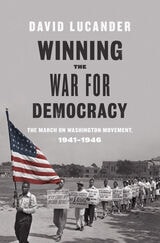
Winning the War for Democracy
The March on Washington Movement, 1941-1946David Lucander
University of Illinois Press, 2014
Winning the War for Democracy: The March on Washington Movement, 1941-1946 recalls that triumph, but also looks beyond Randolph and the MOWM's national leadership to focus on the organization's evolution and actions at the local level. Using the personal papers of previously unheralded MOWM members such as T.D. McNeal, internal government documents from the Roosevelt administration, and other primary sources, David Lucander highlights how local affiliates fighting for a double victory against fascism and racism helped the national MOWM accrue the political capital it needed to effect change.
Lucander details the efforts of grassroots organizers to implement MOWM's program of empowering African Americans via meetings and marches at defense plants and government buildings and, in particular, focuses on the contributions of women activists like Layle Lane, E. Pauline Myers, and Anna Arnold Hedgeman. Throughout he shows how local activities often diverged from policies laid out at MOWM's national office, and how grassroots participants on both sides ignored the rivalry between Randolph and the leadership of the NAACP to align with one another on the ground.
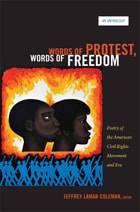
Words of Protest, Words of Freedom
Poetry of the American Civil Rights Movement and EraJeffrey Lamar Coleman, ed.
Duke University Press, 2012
Some of the poems address crucial movement-related events—such as the integration of the Little Rock schools, the murders of Emmett Till and Medgar Evers, the emergence of the Black Panther party, and the race riots of the late 1960s—and key figures, including Martin Luther King Jr., Malcolm X, and John and Robert Kennedy. Other poems speak more broadly to the social and political climate of the times. Along with Jeffrey Lamar Coleman's headnotes, the poems recall the heartbreaking and jubilant moments of a tumultuous era. Altogether, more than 150 poems by approximately 100 poets showcase the breadth of the genre of civil rights poetry.
Selected contributors. Maya Angelou, W. H. Auden, Amiri Baraka, Gwendolyn Brooks, Lucille Clifton Lawrence Ferlinghetti, Allen Ginsberg, Langston Hughes, June Jordan, Philip Levine, Audre Lorde, Robert Lowell, Pauli Murray, Huey P. Newton, Adrienne Rich, Sonia Sanchez, Léopold Sédar Senghor, Derek Walcott, Alice Walker, Yevgeny Yevtushenko
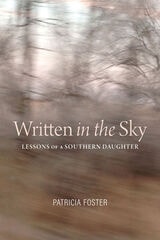
Written in the Sky
Lessons of a Southern DaughterPatricia Foster
University of Alabama Press, 2023
In Written in the Sky: Lessons of a Southern Daughter, Patricia Foster presents a double portrait of place and family, a book of deeply personal essays that interrogate the legacy of racial tensions in the South, the constriction of caste and gender, and the ways race, class, and white privilege are entwined in her family story. After interviewing girls at Booker T. Washington High School in Tuskegee, Alabama, visiting the National Memorial for Peace and Justice in Montgomery, Alabama, and exploring Africatown in Plateau, Alabama, Patricia Foster was moved to reflect on the racial scars and crossroads in her southern past as well as to reckon with the intimate places of her own wounding and grief.
The story of place, she discovers, emerges not only from family histories and cultural traditions but also from wrestling with a culture’s irreconcilable ideas: the hard push to determine what matters. What matters to her are the shadow stories beneath our mythologies, the complicated and radiant narratives that must be excavated and reckoned with, stories that have no neat or binary resolution, stories full of luminous moments and riveting facts, and stories where the secrets hide. Written in the Sky presents the best of nonfiction storytelling: searingly honest portraits, dramatic encounters, and lyrical narratives that will interest teachers and students as well as social justice advocates, policymakers, and readers compelled by stories of awakening and the white-hot beauty of language.