Results by title
173 books match the query 'Collective Memory' and 6 start with w
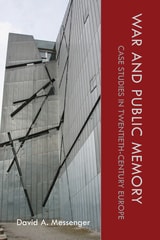
War and Public Memory
Case Studies in Twentieth-Century EuropeDavid A. Messenger
University of Alabama Press, 2020
In order to understand the history of twentieth-century Europe, we must first appreciate and accept how different societies and cultures remember their national conflicts. We must also be aware of the ways that those memories evolve over time. In War and Public Memory: Case Studies in Twentieth-Century Europe, Messenger outlines the relevant history of war and its impact on different European nations and assesses how and where the memory of these conflicts emerges in political and public discourse and in the public sphere and public spaces of Europe.
The case studies presented emphasize the major wars fought on European soil as well as the violence perpetrated against civilian populations. Each chapter begins with a brief overview of the conflict and then proceeds with a study of how memory of that struggle has entered into public consciousness in different national societies. The focus throughout is on collective social, cultural, and public memory, and in particular how memory has emerged in public spaces throughout Europe, such as parks, museums, and memorial sites.
Messenger discusses memories of the First World War for both the victors and the vanquished as well as their successor states. Other events discussed include the Bolshevik Revolution and subsequent conflicts in the former Soviet Union, the Armenian genocide, the collapse of Yugoslavia, the legacy of the civil war in Spain, Germanys reckoning with its Nazi past, and the memory of occupation and the Holocaust in France and Poland.
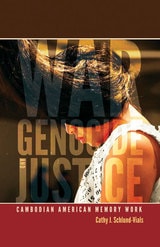
War, Genocide, and Justice
Cambodian American Memory WorkCathy J. Schlund-Vials
University of Minnesota Press, 2012
In the three years, eight months, and twenty days of the Khmer Rouge’s deadly reign over Cambodia, an estimated 1.7 million Cambodians perished as a result of forced labor, execution, starvation, and disease. Despite the passage of more than thirty years, two regime shifts, and a contested U.N. intervention, only one former Khmer Rouge official has been successfully tried and sentenced for crimes against humanity in an international court of law to date. It is against this background of war, genocide, and denied justice that Cathy J. Schlund-Vials explores the work of 1.5-generation Cambodian American artists and writers.
Drawing on what James Young labels “memory work”—the collected articulation of large-scale human loss—War, Genocide, and Justice investigates the remembrance work of Cambodian American cultural producers through film, memoir, and music. Schlund-Vials includes interviews with artists such as Anida Yoeu Ali, praCh Ly, Sambath Hy, and Socheata Poeuv. Alongside the enduring legacy of the Killing Fields and post-9/11 deportations of Cambodian American youth, artists potently reimagine alternative sites for memorialization, reclamation, and justice. Traversing borders, these artists generate forms of genocidal remembrance that combat amnesic politics and revise citizenship practices in the United States and Cambodia.
Engaged in politicized acts of resistance, individually produced and communally consumed, Cambodian American memory work represents a significant and previously unexamined site of Asian American critique.
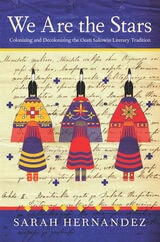
We Are the Stars
Colonizing and Decolonizing the Oceti Sakowin Literary TraditionSarah Hernandez
University of Arizona Press, 2023
Women and land form the core themes of the book, which brings tribal and settler colonial narratives into comparative analysis. Divided into two parts, the first section of the work explores how settler colonizers used the printing press and boarding schools to displace Oceti Sakowin women as traditional culture keepers and culture bearers with the goal of internally and externally colonizing the Dakota, Nakota, and Lakota nations. The second section focuses on decolonization and explores how contemporary Oceti Sakowin writers and scholars have started to reclaim Dakota, Nakota, and Lakota literatures to decolonize and heal their families, communities, and nations.
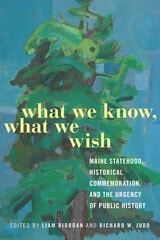
What We Know, What We Wish
Maine Statehood, Historical Commemoration, and the Urgency of Public HistoryEdited by Liam Riordan and Richard W. Judd
University of Massachusetts Press, 2025
Cities, states, and nations are grappling with how best to commemorate historical events and anniversaries in ways that are fair, accurate, and open public dialogue about the often contested past. This volume springs from varied approaches to the historical commemoration of Maine’s state bicentennial in 2020 that involved academics, independent scholars, local and statewide cultural organizations, sovereign Wabanaki nations, and the state itself in the form of the Maine State Bicentennial Commission. While wide-ranging in their goals and values, all sought to take advantage of opportunities for collaboration to contribute to a dynamic and multi-faceted practice of public history. These new essays use Maine’s bicentennial as a focal point to put public history theory into action. Its diverse contributors share stories about the past that move beyond celebration to reflect crucial ways that the past shapes our understanding of the present and our aspirations for the future.
This volume’s core argument is that academics need to collaborate more fully with independent scholars, history-based cultural institutions, and the general public in order for public history to thrive and to improve the quality of civic life. What We Know, What We Wish does this through wide ranging essays that discuss the long statehood era in Maine from the 1770s to 1820s as well as its legacies in the state centennial commemoration of 1920 and museum exhibits from the 2020 bicentennial. The occupational and cultural diversity of the collection’s contributors together with the content of their essays offer a model for how to put public history principles into practice to foreground meaningful historical reflection that is urgently needed in divided communities around the world.
Contributors include the volume editors, as well as Maulian Bryant, Osihkiyol (Zeke) Crofton-Macdonald, Charles H. Lagerbom, Ryan LaRochelle, Stuart Kestenbaum, Michael McVaugh, Kevin D. Murphy, Micah A. Pawling, Jessica Skwire Routhier, Donald Soctomah, Laura Fecych Sprague, Alan Taylor, and Laurel Thatcher Ulrich.
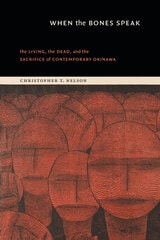
When the Bones Speak
The Living, the Dead, and the Sacrifice of Contemporary OkinawaChristopher T. Nelson
Duke University Press, 2025
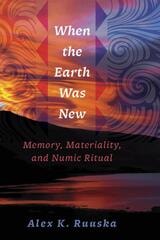
When the Earth Was New
Memory, Materiality, and Numic RitualAlex K. Ruuska
University of Utah Press, 2025
In When the Earth Was New, Alex K. Ruuska explores riveting multigenerational memories of Numic-speaking communities that extend back, potentially, to the late Pleistocene. These diverse oral traditions describe geological, climatic, and ecological events that occurred over thousands of years and were passed down across many generations. Through the examination of place-based memories and the architecture of Numic knowledge, Ruuska demonstrates convergences of oral traditions, ethnography, ethnohistory, archaeology, and geology.
When the Earth Was New critically compares and considers multiple forms of knowledge that contribute to overlapping as well as disparate understandings of both recent and distant pasts in the regions of California, the Great Basin, and the Colorado Plateau. It works at balancing key themes in these regions’ histories within a more holistic framework, exploring ancient and modern strands of knowledge with the assistance of twenty-four Tribes and Consolidated Organizations.