118 books match the query 'College teachers' and 7 start with w
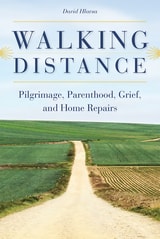
cover of Walking Distance: Pilgrimage, Parenthood, Grief, and Home Repairs

Walking Distance

Pilgrimage, Parenthood, Grief, and Home Repairs

David Hlavsa

Michigan State University Press, 2015

In the summer of 2000, David Hlavsa and his wife Lisa Holtby embarked on a pilgrimage. After trying for three years to conceive a child and suffering through the monthly cycle of hope and disappointment, they decided to walk the Camino de Santiago, a joint enterprise—and an act of faith—they hoped would strengthen their marriage and prepare them for parenthood.

Though walking more than 400 miles across the north of Spain turned out to be more difficult than they had anticipated, after a series of misadventures, including a brief stay in a Spanish hospital, they arrived in Santiago. Shortly after their return to Seattle, Lisa became pregnant, and the hardships of the Camino were no comparison to what followed: the stillbirth of their first son and Lisa’s harrowing second pregnancy.

Walking Distance is a moving and disarmingly funny book, a good story with a happy ending—the safe arrival of David and Lisa’s second son, Benjamin. David and Lisa get more than they bargained for, but they also get exactly what they wanted: a child, a solid marriage, and a richer life.

[more]
cover of Walking George: The Life of George John Beto and the Rise of the Modern Texas Prison System

Walking George

The Life of George John Beto and the Rise of the Modern Texas Prison System

David M. Horton

University of North Texas Press, 2005
[more]
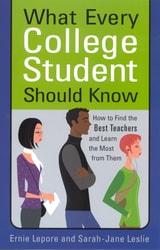
cover of What Every College Student Should Know: How to Find the Best Teachers and Learn the Most from Them

What Every College Student Should Know

How to Find the Best Teachers and Learn the Most from Them

Lepore, Ernie

Rutgers University Press, 2002

Students do months of research before choosing just the right college, but once theyre on campus, how many of them actually research the professors who are teaching their classes? To optimize your college education you need to find your schools best teachers but how?

What Every College Student Should Know is a guide to discovering the best teachers at your school and learning everything you can from them. Here, the unique writing combination of a professor and a student provides you with perspectives from both sides of the equation. You'll learn:

    • What questions to ask in selecting an instructor
    • How to evaluate professors based on the first class sessions
    • What to look for in a syllabus and grading policies
    • How to identify a professors teaching style and how to adapt to it
​Even the most outgoing students can expect only limited contact with their professors in the classroom, so the authors also provide tactics to take full advantage of meetings outside regular class time, such as:
    • Advice on how to review your exam or paper with your professor
    • Ways to build a relationship with a teacher and get invaluable feedback on your work
    • Tips on how to get the best recommendations from proffessors
[more]
cover of White Boy: A Memoir

White Boy

A Memoir

Mark D. Naison

Temple University Press, 2002
How does a Jewish boy who spent the bulk of his childhood on the basketball courts of Brooklyn wind up teaching in one of the city's pioneering black studies departments? Naison's odyssey begins as Brooklyn public schools respond to a new wave of Black migrants and Caribbean immigrants, and established residents flee to virtually all-white parts of the city or suburbs. Already alienated by his parents' stance on race issues and their ambitions for him, he has started on a separate ideological path by the time he enters Columbia College. Once he embarks on a long-term interracial relationship, becomes a member of SDS, focuses his historical work on black activists, and organizes community groups in the Bronx, his immersion in the radical politics of the 1960s has emerged as the center of his life. Determined to keep his ties to the Black community, even when the New Left splits along racial lines, Naison joined the fledgling African American studies program at Fordham, remarkable then as now for its commitment to interracial education.This memoir offers more than a participant's account of the New Left's racial dynamics; it eloquently speaks to the ways in which political commitments emerge from and are infused with the personal choices we all make.
[more]
cover of Working with Faculty Writers

Working with Faculty Writers

Anne Ellen Geller and Michele Eodice

Utah State University Press, 2013

 The imperative to write and to publish is a relatively new development in the history of academia, yet it is now a significant factor in the culture of higher education. Working with Faculty Writers takes a broad view of faculty writing support, advocating its value for tenure-track professors, adjuncts, senior scholars, and graduate students. The authors in this volume imagine productive campus writing support for faculty and future faculty that allows for new insights about their own disciplinary writing and writing processes, as well as the development of fresh ideas about student writing. 

Contributors from a variety of institution types and perspectives consider who faculty writers are and who they may be in the future, reveal the range of locations and models of support for faculty writers, explore the ways these might be delivered and assessed, and consider the theoretical, philosophical, political, and pedagogical approaches to faculty writing support, as well as its relationship to student writing support.

With the pressure on faculty to be productive researchers and writers greater than ever, this is a must-read volume for administrators, faculty, and others involved in developing and assessing models of faculty writing support.
[more]
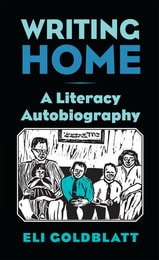
cover of Writing Home: A Literacy Autobiography

Writing Home

A Literacy Autobiography

Eli Goldblatt

Southern Illinois University Press, 2012

In this engrossing memoir, poet and literacy scholar Eli Goldblatt shares the intimate ways reading and writing influenced the first thirty years of his life—in the classroom but mostly outside it. Writing Home: A Literacy Autobiography traces Goldblatt’s search for home and his growing recognition that only through his writing life can he fully contextualize the world he inhabits.
 
Goldblatt connects his educational journey as a poet and a teacher to his conception of literacy, and assesses his intellectual, emotional, and political development through undergraduate and postgraduate experiences alongside the social imperatives of the era. He explores his decision to leave medical school after he realized that he could not compartmentalize work and creative life or follow in his surgeon father’s footsteps. A brief first marriage rearranged his understanding of gender and sexuality, and a job teaching in an innercity school initiated him into racial politics. Literacy became a dramatic social reality when he witnessed the start of the national literacy campaign in postrevolutionary Nicaragua and spent two months finding his bearings while writing poetry in Mexico City.
Goldblatt presents a thoughtful and exquisitely crafted narrative of his life to illustrate that literacy exists at the intersection of individual and social life and is practiced in relationship to others. While the concept of literacy autobiography is a common assignment in undergraduate and graduate writing courses, few books model the exercise. Writing Home helps fill that void and, with Goldblatt’s emphasis on “out of school” literacy, fosters an understanding of literacy as a social practice.  
[more]
cover of Writing in Disguise: Academic Life in Subordination

Writing in Disguise

Academic Life in Subordination

Terry Caesar

Ohio University Press, 1998

Writing in Disguise is a series of increasingly personal essays that both discuss and dramatize through firsthand experience the significance of subordination in academic life, in terms of issues and structures but above all in terms of texts. Some are written: memos, rejection letters, even resignation letters. Some are not: anecdotes, protests, jokes, parodies.

All of these texts have in common the imperative of disguise, represented as the most crucial consequence of dominant discourse, within which subordination might speak only by knowing its place, and write only by producing hidden transcripts.

Caustic, pointed, satiric, Writing in Disguise is an engaging critique of aspects of academia involving the misuse, misappropriation, and misappreciation of verbal communication in its many guises.
[more]