Results by title
65 books match the query 'Comedy' and 4 start with w

West African Screen Media
Comedy, TV Series, and TransnationalizationBoukary Sawadogo
Michigan State University Press, 2019
The culturally rooted comic traditions of koteba theater and joking kinship have shaped West African comedies through various forms of humor. Débrouillardise (hustle) has turned the urban scene into a comic scene, a site for individual realization. To highlight the ever-growing production and success of comedies and other popular genres, West African Screen Media: Comedy, TV Series, and Transnationalization explores the distribution and reception of selected productions by emphasizing the public’s strong resonance with local stories and a character-based comedy involving popular comedians. In contrast to art films or “auteur films” that tend to be confined to the festival circuit, comedies and popular genres reach a far wider audience through local distribution networks, satellite TV channels, pirated DVDs, and online distribution platforms. This book engages a discussion of contemporary African media productions as seen outside the usual frameworks of cinéma engagé, the art house, or auteur approaches. While examining production and distribution through the lenses of proximity, appropriation, and transnationalization, this volume invites readers to reconsider the way genre films, as well as other kinds of productions, have been previously evaluated and in doing so addresses the critical neglect of comedy and other popular genres in the scholarship on African cinema.
[more]
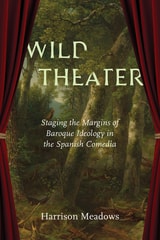
Wild Theater
Staging the Margins of Baroque Ideology in the Spanish ComediaHarrison Meadows
Vanderbilt University Press, 2025
In Wild Theater, Harrison Meadows critically examines the genealogy of one of world literature’s most well-known figures: the “Wildman.” From its earliest manifestations in works such as The Epic of Gilgamesh to more recent films like The Green Knight, the transhistorical figure of the Wildman has fascinated generations of scholars and the broader public for centuries. Despite this widespread interest, the place of the Wildman—and ideas of wildness more generally—have been underexplored in scholarship on the Spanish Baroque period. Wild Theater addresses this lacuna in scholarship by exploring the ideas of wildness in the Spanish comedia, a popular Spanish Golden Age theater genre that combined elements of tragedy and comedy.
In five compelling chapters, Meadows argues that a major shift occurred during the Baroque period, whereby the largely positive quality of previous iterations in the genealogy of wildness take on a negative character in the cultural ethos—and that this fundamental shift was representative of the influence of Spanish colonialism on racial thinking and a larger set of changes in how early modern people viewed gender and class. In this way, the book identifies the wild figure’s dramatic roots in the carnivalesque as an indispensable point of departure to plot the trajectory of wild representation in the theater of the Hispanic Baroque. From this guiding premise, Meadows traces the carryovers, transformations, and negations of the carnivalesque into early modern dramaturgy, specifically the Spanish comedia, which are emblematic of the poetic and ideological features of the emerging commercial theater in Iberia.
In five compelling chapters, Meadows argues that a major shift occurred during the Baroque period, whereby the largely positive quality of previous iterations in the genealogy of wildness take on a negative character in the cultural ethos—and that this fundamental shift was representative of the influence of Spanish colonialism on racial thinking and a larger set of changes in how early modern people viewed gender and class. In this way, the book identifies the wild figure’s dramatic roots in the carnivalesque as an indispensable point of departure to plot the trajectory of wild representation in the theater of the Hispanic Baroque. From this guiding premise, Meadows traces the carryovers, transformations, and negations of the carnivalesque into early modern dramaturgy, specifically the Spanish comedia, which are emblematic of the poetic and ideological features of the emerging commercial theater in Iberia.
[more]
Women and Comedy
Rewriting the British Theatrical TraditionSusan Carlson
University of Michigan Press, 1991
The first comprehensive study of its kind, this book explores the contradictory connections between women and dramatic comedy. Women and Comedy shows how a genre that has been used historically to restrict women's behavior is being reconfigured to express women's triumphs. It thus redefines the assumptions with which both traditional comedy and contemporary women's plays are read and viewed. Challenging a critical consensus that has seen comedy as a haven for female power, Carlson argues that traditional comedy is deeply sexist, welcoming strong women characters only because it can contain their power. Through an analysis of a range of comedies by Shakespeare, Congreve, Maugham, Shaw, and Ayckbourn, the author shows that even in these plays self-consciously about liberated females, women gain only a limited freedom, a freedom that the endings of the plays work to negate. This negotiation is seen to result in part from the comic structure itself, which privileges a merely temporary inversion and an ultimate return to the status quo. Carlson then examines the transitional work of three writers – Aphra Behn, Henry James, and Ann Jellicoe – whose heroines follow an unorthodox trajectory through their comic worlds. While the work of these writers clearly remains within the mainstream comic tradition, the author notes in them a subtle departure, most notably in their description of the heroine as subject rather than object, which prefigures the full-scale transformations of women in comedy by contemporary women writers. The book then examines contemporary comedy that revises traditional comic structure at the same time as it explores fundamental social change. In making her case for the difference of contemporary comedy by women, Carlson examines the reformulations of structure and character and considers issues of community, self, and sexuality in a broad range of plays by individual playwrights and by the new women's theater collectives. Women and Comedy is an important work for students of British drama and will appeal to theater practitioners, critics, feminist scholars, and all those interested in the performing arts.
[more]
Women and Laughter in Medieval Comic Literature
Lisa Perfetti
University of Michigan Press, 2003
Exploring literary representations of women's laughter from the thirteenth through the sixteenth centuries, this volume offers an intriguing look into a culture of women's laughter, illustrating the many contexts that shaped the way women told jokes, as well as the ways their joking reflected their limited position in a society dominated by men. The book also considers the uses male authors made of the laughter of their fictional creations and the pleasures offered to both male and female audiences.
This study is the first to investigate women's laughter as a particular kind of "talking back" to medieval discourse on women, the subject of recent feminist medievalist studies. Female characters openly embrace women's laughter, associated with the body and castigated for its unruliness in conduct literature. Acknowledging that comic works were grounded in antifeminist traditions and that their female characters were in fact targets of laughter for male authors, this study argues that female characters who laugh and tell jokes also offer traces of how women might have used their laughter to respond to negative pronouncements about women in medieval culture. Both laughable and laughing, the female protagonists studied in this book will engage modern readers with their witty, sometimes bawdy jokes, allowing us to imagine the pleasures that medieval comic literature, so often labeled misogynous, offered to women as well as to men.
Lisa Perfetti is Assistant Professor of French, Muhlenberg College.
[more]