Results by title
198 books match the query 'Community' and 9 start with w

Water, Community, and the Culture of Owning
Eric T. Freyfogle
University of Utah Press, 2018
Building on these cultural critiques, Freyfogle takes up the issue of private property rights, highlighting the longstanding flexibility of this key American institution as well as the moral imperative to ensure that property rights aren’t used in ways that harm communities. Outdated understandings about private property, he concludes, have further confused our understanding and made sensible solutions to water problems even harder to imagine. Water-policy reform won’t happen, Freyfogle argues, until we reconsider how we understand nature and take charge of the institution of ownership, recasting it so as to increase the benefits it generates for everyone. If we can do that, solutions to water troubles could prove easier than we expect. The work concludes with an original, sweeping policy proposal to resolve the West’s water shortages and meet environmental needs in ways fair to all.
This lecture was presented on March 22, 2017, at the 22nd annual symposium sponsored by the Wallace Stegner Center for Land, Resources and the Environment at the S. J. Quinney College of Law, University of Utah.
While Waiting for Rain
Community, Economy, and Law in a Time of ChangeJohn Henry Schlegel
University of Michigan Press, 2022
What might a sensible community choose to do if its economy has fallen apart and becoming a ghost town is not an acceptable option? Unfortunately, answers to this question have long been measured against an implicit standard: the postwar economy of the 1950s. After showing why that economy provides an implausible standard—made possible by the lack of economic competition from the European and Asian countries, winners or losers, touched by the war—John Henry Schlegel attempts to answer the question of what to do.
While Waiting for Rain first examines the economic history of the United States as well as that of Buffalo, New York: an appropriate stand-in for any city that may have seen its economy start to fall apart in the 1960s, 70s, and 80s. It makes clear that neither Buffalo nor the United States as a whole has had an economy in the sense of “a persistent market structure that is the fusion of an understanding of economic life with the patterns of behavior within the economic, political, and social institutions that enact that understanding” since both economies collapsed. Next, this book builds a plausible theory of how economic growth might take place by examining the work of the famous urbanist, Jane Jacobs, especially her book Cities and the Wealth of Nations. Her work, like that of many others, emphasizes the importance of innovation for economic growth, but is singular in its insistence that such innovation has to come from local resources. It can neither be bought nor given, even by well-intentioned political actors. As a result Americans generally, as well as locally, are like farmers in the midst of a drought, left to review their resources and wait. Finally, it returns to both the local Buffalo and the national economies to consider what these political units might plausibly do while waiting for an economy to emerge.
Widow City
Gender, Emotion, and Community in the Italian RenaissanceAnna Wainwright
University of Delaware Press, 2025
Winter Carnival in a Western Town
Identity, Change and the Good of the CommunityLisa Gabbert
Utah State University Press, 2011
Held annually, the McCall, Idaho, winter carnival has become a modern tradition. A festival and celebration, it is also a source of community income and opportunity for shared community effort; a chance to display the town attractively to outsiders and to define and assert McCall's identity; and consequently, a source of disagreement among citizens over what their community is, how it should be presented, and what the carnival means.
Though rooted in the broad traditions of community festival, annual civic events, often sponsored by chambers of commerce, such as that in McCall, are as much expressions of popular culture and local commerce as of older traditions. Yet they become dynamic, newer community traditions, with artistic, informal, and social meanings and practices that make them forms of folklore as well as commoditized culture. Winter Carnival is the first volume in a new Utah State University Press series titled Ritual, Festival, and Celebration and edited by folklorist Jack Santino.

Work and Community in the Jungle
Chicago's Packinghouse Workers, 1894-1922James R. Barrett
University of Illinois Press, 1987

Working Knowledge
Skill and Community in a Small ShopDouglas Harper
University of Chicago Press, 1987
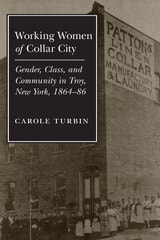
Working Women of Collar City
Gender, Class, and Community in Troy, 1864-86Carole Turbin
University of Illinois Press, 1992
Why have some working women succeeded at organizing in spite of obstacles to labor activity? Under what circumstances were they able to form alliances with male workers?
Carole Turbin explores these and other questions by examining the case of Troy, New York. In the 1860s, Troy produced nearly all the nation's detachable shirt collars and cuffs. The city's collar laundresses were largely Irish immigrants. Their union was officially the nation's first women's labor organization, and one of the best organized. Turbin provides a new perspective on gender and shows that women's family ties are not necessarily a conservative influence but may encourage women's and men's collective action.
Working-Class America
Essays on Labor, Community, and American SocietyEdited by Michael H. Frisch and Daniel J. Walkowitz
University of Illinois Press, 1983
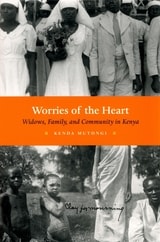
Worries of the Heart
Widows, Family, and Community in KenyaKenda Mutongi
University of Chicago Press, 2007
Throughout the twentieth century and into the twenty-first, rates of widowhood have been remarkably high in Kenya. Yet despite their numbers, widows and their families exist at the margins of society, and their lives act as a barometer for the harsh realities of rural Kenya. Mutongi here argues that widows survive by publicly airing their social, economic, and political problems, their “worries of the heart.” Initially aimed at the men in their community, and then their colonial rulers, this strategy changed after independence as widows increasingly invoked the language of citizenship to demand their rights from the new leaders of Kenya—leaders whose failure to meet the needs of ordinary citizens has led to deep disenchantment and altered Kenyans’ view of their colonial past. An innovative blend of ethnography and historical research, Worries of the Heart is a poignant narrative rich with insights into postcolonial Africa.