Results by title
80 books match the query 'Community development' and 3 start with w
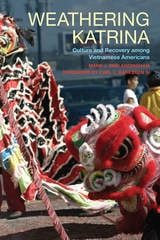
Weathering Katrina
Culture and Recovery among Vietnamese AmericansMark J. VanLandingham
Russell Sage Foundation, 2017
In 2005, Hurricane Katrina devastated New Orleans. The principal Vietnamese-American enclave was a remote, low-income area that flooded badly. Many residents arrived decades earlier as refugees from the Vietnam War and were marginally fluent in English. Yet, despite these poor odds of success, the Vietnamese made a surprisingly strong comeback in the wake of the flood. In Weathering Katrina, public health scholar Mark VanLandingham analyzes their path to recovery, and examines the extent to which culture helped them cope during this crisis.
Contrasting his longitudinal survey data and qualitative interviews of Vietnamese residents with the work of other research teams, VanLandingham finds that on the principal measures of disaster recovery—housing stability, economic stability, health, and social adaptation—the Vietnamese community fared better than other communities. By Katrina’s one-year anniversary, almost 90 percent of the Vietnamese had returned to their neighborhood, higher than the rate of return for either blacks or whites. They also showed much lower rates of post-traumatic stress disorder than other groups. And by the second year after the flood, the employment rate for the Vietnamese had returned to its pre-Katrina level.
While some commentators initially attributed this resilience to fairly simple explanations such as strong leadership or to a set of vague cultural strengths characteristic of the Vietnamese and other “model minorities”, VanLandingham shows that in fact it was a broad set of factors that fostered their rapid recovery. Many of these factors had little to do with culture. First, these immigrants were highly selected—those who settled in New Orleans enjoyed higher human capital than those who stayed in Vietnam. Also, as a small, tightly knit community, the New Orleans Vietnamese could efficiently pass on information about job leads, business prospects, and other opportunities to one another. Finally, they had access to a number of special programs that were intended to facilitate recovery among immigrants, and enjoyed a positive social image both in New Orleans and across the U.S., which motivated many people and charities to offer the community additional resources. But culture—which VanLandingham is careful to define and delimit—was important, too. A shared history of overcoming previous challenges—and a powerful set of narratives that describe these successes; a shared set of perspectives or frames for interpreting events; and a shared sense of symbolic boundaries that distinguish them from broader society are important elements of culture that provided the Vietnamese with some strong advantages in the post-Katrina environment.
By carefully defining and disentangling the elements that enabled the swift recovery of the Vietnamese in New Orleans, Weathering Katrina enriches our understanding of this understudied immigrant community and of why some groups fare better than others after a major catastrophe like Katrina.
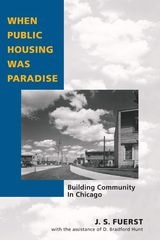
When Public Housing Was Paradise
BUILDING COMMUNITY IN CHICAGOJ. S. Fuerst, with the assistance of D. Bradford Hunt
University of Illinois Press, 2003
J. S. Fuerst has been involved with public housing in Chicago for more than half a century. He retired from Loyola University, where he was a professor of social welfare policy. He was the editor of Public Housing in Europe and America. D. Bradford Hunt is an assistant professor of social science at Roosevelt University. John Hope Franklin is James B. Duke Professor Emeritus of History at Duke University. He has served as president of the Organization of American Historians, the American Historical Association, and many more.
Working Together for Change
Collaborative Change Research, Evaluation, and Design, Volume 5Edited by Lisa M. Vaughn, Sara Neyer, and Kathie Maynard
University of Minnesota Press, 2023
Strategies for engaging key stakeholders—evaluators, researchers, and designers—to discuss frameworks for promoting collaborative change.
Collaborative Change Research, Evaluation, and Design (CCRED) is a framework and collection of participatory practices that engage people and the systems around them to drive community outcomes. This framework emerged out of the recognition that deep participation (or engagement) is frequently missing in collaborative impact approaches. When collaborative change is implemented effectively, community members are viewed as valuable owners and experts instead of being seen as disinterested or unqualified partners.
CCRED is a social action process with dual goals of collective empowerment and the deepening of social knowledge. Executed successfully, CCRED has the potential to increase the rigor, reach, and relevance of research, evaluation, and design translated to meaningful action. Written in an easily accessible, narrative style, Working Together for Change, the fourth volume in the Interdisciplinary Community Engaged Research for Health series edited by Farrah Jacquez and Lela Svedin brings together evaluators, researchers, and designers to describe collaborative change by describing their own work in the space.