Results by title
56 books match the query 'Community organization' and 2 start with w
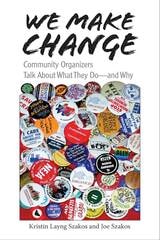
We Make Change
Community Organizers Talk About What They Do--and WhyKristin Layng Szakos
Vanderbilt University Press, 2007
Community organizers work at their jobs because they are passionate, because they believe that change is possible, and because they enjoy working with people. Although it's not an occupation that leads to great wealth, community organizers can make a living at it. They get salaries, pensions and health insurance. They raise families. They do well by doing good. This book explores the world of community organizing through the voices of real people working in the field, in small towns and city neighborhoods--women and men of different races and economic backgrounds, ranging in age from those in their twenties to those in their sixties. Fourteen in-depth profiles tell the life stories of a cross-section of the diverse people who choose the life of an organizer. Other chapters, focused on issues of organizing, are tapestries of experience woven from the 81 interviews the authors conducted.
[more]

Work and Community in the Jungle
Chicago's Packinghouse Workers, 1894-1922James R. Barrett
University of Illinois Press, 1987
Mythologized by Upton Sinclair as hopeless, Chicago's packinghouse workers were in fact active agents in the early twentieth century transformation that swept urban industrial America. James R. Barrett's award-winning study explores how the lives and neighborhoods of packinghouse workers convey the experience of mass production work, the quality of working class life, the process of class formation and fragmentation, the effects of unionization, and the changing character of class relations. Merging history and analysis with contemporary social surveys and a computer-assisted analysis of census data, Barrett delves into a wide range of social, economic, and cultural factors that resulted in class cohesion and fragmentation.
[more]