Results by title
69 books match the query 'Conduct of life' and 5 start with w
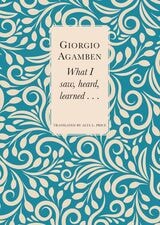
What I Saw, Heard, Learned . . .
Giorgio Agamben
Seagull Books, 2023
What can the senses of an attentive philosopher see, hear, and learn that can, in turn, teach us about living better lives? Perhaps it’s less a matter of asking what and more a matter of asking how. These latest reflections from Italy’s foremost philosopher form a sort of travelogue that chronicles Giorgio Agamben’s profound interior journey. Here, with unprecedented immediacy, Agamben shares his final remarks, late-life observations, and reflections about his life that flashed before his eyes. What did he see in that brief flash? What did he stay faithful to? What remains of all those places, friends, and teachers?
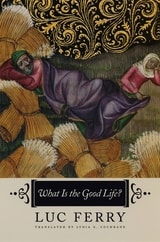
What Is the Good Life?
Luc Ferry
University of Chicago Press, 2005
In What Is the Good Life? Ferry argues that the question of the meaning of life, on which much philosophical debate throughout the centuries has rested, has not vanished, but at the very least the question is posed differently today. Ferry points out the pressures in our secularized world that tend to reduce the idea of a successful life or "good life" to one of wealth, career satisfaction, and prestige. Without deserting the secular presuppositions of our world, he shows that we can give ourselves a richer sense of life's possibilities. The "good life" consists of harmonizing life's different forces in a way that enables one to achieve a sense of personal satisfaction in the realization of one's creative abilities.
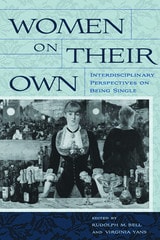
Women on Their Own
Interdisciplinary Perspectives on Being SingleEdited by Rudolph M. Bell and Virginia Yans
Rutgers University Press, 2007
Modern American culture has raised generations of women who believed that their true and most important role in society was to get married and have children. Anything short of this role was considered abnormal, unfulfilling, and suspect. This female stereotype has been exploited and perpetuated by some key films in the late 40's and early 50's. But more recently we have seen a shift in the cultural view of the spinster. The erosion of the traditional nuclear family, as well as a larger range of acceptable life choices, has caused our perceptions of unmarried women to change. The film industry has reflected this shift with updated stereotypes that depict this cultural trend. The shift in the way we perceive spinsters is the subject of current academic research which shows that a person's perception of particular societal roles influences the amount of stress or depression they experience when in that specific role. Further, although the way our culture perceives spinsters and the way the film industry portrays them may be evolving, we still are still left with a negative stereotype.
Themes of choice and power have informed the lives of single women in all times and places. When considered at all in a scholarly context, single women have often been portrayed as victims, unhappily subjected to forces beyond their control. This collection of essays about "women on their own" attempts to correct that bias, by presenting a more complex view of single women in nineteenth- and twentieth-century United States and Europe.
Topics covered in this book include the complex and ambiguous roles that society assigns to widows, and the greater social and financial independence that widows have often enjoyed; widow culture after major wars; the plight of homeless, middle-class single women during the Great Depression; and comparative sociological studies of contemporary single women in the United States, Britain, Ireland, and Cuba.
Composed of papers presented to the Rutgers Center for Historical Analysis project on single women, this collection incorporates the work of specialists in anthropology, art history, history, and sociology. It is deeply connected with the emerging field of singleness studies (to which the RCHA has contributed an Internet-based bibliography of more than 800 items). All of the essays are new and have not been previously published.
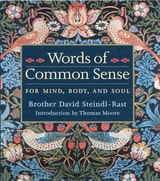
Words Of Common Sense
Brother David Steindl-Rast
Templeton Press, 2002
Brother David Steindl-Rast takes us on a journey to discover the wisdom preserved in common sense sayings that have been passed down through generations. These timeless words reflect the shared values cherished by people all over the world.
"When you drink from a stream,” says one Chinese proverb, “remember the spring." From these simple words we are reminded to be grateful for even the smallest graces that we receive. Another homespun phrase tells us that "a contented heart is a continual feast," reminding us to look within, rather than without, for the source of our happiness.
Words of Common Sense reveals the thread of human experience expressed in the world’s proverbs and sayings. It helps us connect with cultures other than our own and recognize our shared humanity. These words resonate around the world because they are timeless reflections on how to cultivate a life of love, gratitude, and meaning.
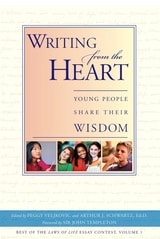
Writing From The Heart
Young People Share Their WisdomPeggy Veljkovic
Templeton Press, 2000
Writing from the Heart offers us a unique window into what young people have learned about life. This collection of essays captures the values that matter most to teens—values such as love, perseverance, family, and helping others—in their own words. As the young writers reflect on their own experience, readers of all ages will be inspired by their wisdom and hope.