Results by title
77 books match the query 'Congress' and 4 start with w
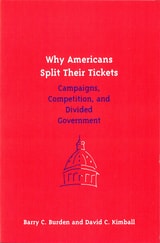
Why Americans Split Their Tickets
Campaigns, Competition, and Divided GovernmentBarry C. Burden and David C. Kimball
University of Michigan Press, 2004
In Why Americans Split Their Tickets, Barry C. Burden and David C. Kimball argue that divided government is produced unintentionally. Using a new quantitative method to analyze voting in presidential, House, and Senate elections from 1952 to 1996, they reject the dominant explanation for divided government, that ticket splitting is done to balance parties that are far from the center. The ideological positions of candidates do not matter in American elections, but voters favor centrist candidates rather than a mix of extremists. When candidates of opposing parties adopt similar platforms, ticket splitting arises. For voters, ideological differences between the parties blur and other considerations such as candidate characteristics exert a greater influence on their voting decisions. Among their other findings, the authors link changes in congressional campaigns--namely the rise of incumbency advantage and the greater importance of money in the 1960s and 1970s--to ticket splitting and argue, in addition, that the transformation of the South from a Democratic stronghold to a Republican-leaning environment has made regional factors less important.
Burden and Kimball draw upon a diverse and unique range of data as evidence for their argument. Their analyses rely on survey data, aggregate election returns, and new ecological inference estimates for every House and Senate election from 1952 to 1996. This approach allows for the examination of divided voting in traditional ways, such as choosing a Democratic presidential candidate and a Republican House candidate on a single ballot, to less traditional forms, such as voting in a midterm House election and choosing a state's Senate delegation.
Barry C. Burden is Assistant Professor of Government, Harvard University. David C. Kimball is Assistant Professor of Political Science, University of Missouri, St. Louis.
[more]
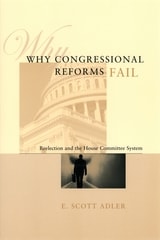
Why Congressional Reforms Fail
Reelection and the House Committee SystemE. Scott Adler
University of Chicago Press, 2002
For decades, advocates of congressional reforms have repeatedly attempted to clean up the House committee system, which has been called inefficient, outmoded, unaccountable, and even corrupt. Yet these efforts result in little if any change, as members of Congress who are generally satisfied with existing institutions repeatedly obstruct what could fairly be called innocuous reforms.
What lies behind the House's resistance to change? Challenging recent explanations of this phenomenon, Scott Adler contends that legislators resist rearranging committee powers and jurisdictions for the same reason they cling to the current House structure—the ambition for reelection. The system's structure works to the members' advantage, helping them obtain funding (and favor) in their districts. Using extensive evidence from three major reform periods—the 1940s, 1970s, and 1990s—Adler shows that the reelection motive is still the most important underlying factor in determining the outcome of committee reforms, and he explains why committee reform in the House has never succeeded and probably never will.
What lies behind the House's resistance to change? Challenging recent explanations of this phenomenon, Scott Adler contends that legislators resist rearranging committee powers and jurisdictions for the same reason they cling to the current House structure—the ambition for reelection. The system's structure works to the members' advantage, helping them obtain funding (and favor) in their districts. Using extensive evidence from three major reform periods—the 1940s, 1970s, and 1990s—Adler shows that the reelection motive is still the most important underlying factor in determining the outcome of committee reforms, and he explains why committee reform in the House has never succeeded and probably never will.
[more]
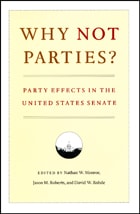
Why Not Parties?
Party Effects in the United States SenateEdited by Nathan W. Monroe, Jason M. Roberts, and David W. Rohde
University of Chicago Press, 2008
Recent research on the U.S. House of Representatives largely focuses on the effects of partisanship, but the strikingly less frequent studies of the Senate still tend to treat parties as secondary considerations in a chamber that gives its members far more individual leverage than congressmen have. In response to the recent increase in senatorial partisanship, Why Not Parties? corrects this imbalance with a series of original essays that focus exclusively on the effects of parties in the workings of the upper chamber.
Illuminating the growing significance of these effects, the contributors explore three major areas, including the electoral foundations of parties, partisan procedural advantage, and partisan implications for policy. In the process, they investigate such issues as whether party discipline can overcome Senate mechanisms that invest the most power in individuals and small groups; how parties influence the making of legislation and the distribution of pork; and whether voters punish senators for not toeing party lines. The result is a timely corrective to the notion that parties don’t matter in the Senate—which the contributors reveal is far more similar to the lower chamber than conventional wisdom suggests.
[more]
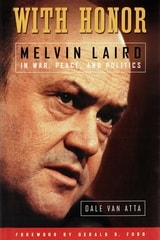
With Honor
Melvin Laird in War, Peace, and PoliticsVan Atta
University of Wisconsin Press, 2008
In 1968, at the peak of the Vietnam War, centrist Congressman Melvin Laird (R-WI) agreed to serve as Richard Nixon’s secretary of defense. It was not, Laird knew, a move likely to endear him to the American public—but as he later said, “Nixon couldn’t find anybody else who wanted the damn job.” For the next four years, Laird deftly navigated the morass of the war he had inherited. Lampooned as a “missile head,” but decisive in crafting an exit strategy, he doggedly pursued his program of Vietnamization, initiating the withdrawal of U.S. military personnel and gradually ceding combat responsibilities to South Vietnam. In fighting to bring the troops home faster, pressing for more humane treatment of POWs, and helping to end the draft, Laird employed a powerful blend of disarming Midwestern candor and Washington savvy, as he sought a high moral road bent on Nixon’s oft-stated (and politically instrumental) goal of peace with honor.
The first book ever to focus on Laird’s legacy, this authorized biography reveals his central and often unrecognized role in managing the crisis of national identity sparked by the Vietnam War—and the challenges, ethical and political, that confronted him along the way. Drawing on exclusive interviews with Laird, Henry Kissinger, Gerald Ford, and numerous others, author Dale Van Atta offers a sympathetic portrait of a man striving for open government in an atmosphere fraught with secrecy. Van Atta illuminates the inner workings of high politics: Laird’s behind-the-scenes sparring with Kissinger over policy, his decisions to ignore Nixon’s wilder directives, his formative impact on arms control and health care, his key role in the selection of Ford for vice president, his frustration with the country’s abandonment of Vietnamization, and, in later years, his unheeded warning to Donald Rumsfeld that “it’s a helluva lot easier to get into a war than to get out of one.”
The first book ever to focus on Laird’s legacy, this authorized biography reveals his central and often unrecognized role in managing the crisis of national identity sparked by the Vietnam War—and the challenges, ethical and political, that confronted him along the way. Drawing on exclusive interviews with Laird, Henry Kissinger, Gerald Ford, and numerous others, author Dale Van Atta offers a sympathetic portrait of a man striving for open government in an atmosphere fraught with secrecy. Van Atta illuminates the inner workings of high politics: Laird’s behind-the-scenes sparring with Kissinger over policy, his decisions to ignore Nixon’s wilder directives, his formative impact on arms control and health care, his key role in the selection of Ford for vice president, his frustration with the country’s abandonment of Vietnamization, and, in later years, his unheeded warning to Donald Rumsfeld that “it’s a helluva lot easier to get into a war than to get out of one.”
Best Books for Regional Special Interests, selected by the American Association of School Librarians, and Best Books for Special Interests, selected by the Public Library Association
[more]