Results by title
851 books match the query 'Congresses' and 22 start with w

WORLDS OF MEDIEVAL WOMEN
"CREATIVITY, INFLUENCE, AND IMAGINATION"CONSTANCE H. BERMAN
West Virginia University Press, 1985

Walking with Jesus Christ
Catholic and Evangelical Visions of the Moral LifeSteven Hoskins
Saint Paul Seminary Press, 2023

War and Diplomacy
The Russo-Turkish War of 1877-1878 and the Treaty of BerlinM Hakan Yavuz
University of Utah Press, 2011
Combining different disciplinary perspectives, War and Diplomacy argues that the key events that portended the beginning of the end of the multiethnic Ottoman Empire were the The Russo-Turkish War of 1877–1878 and the Treaty of Berlin. The essays in this volume analyze how the war and the treaty permanently transformed the political landscape both in the Balkans and in the Caucasus. The treaty marked the end of Ottoman hegemony in the Balkans by formally recognizing the independence or de facto sovereignty of Romania, Serbia, and Montenegro, and the autonomy of Bulgaria.
By introducing the unitary nation-state as the new organizing concept, the treaty planted the seeds of future conflict, from the Balkan Wars of 1912–1913 and the First World War to the recent civil wars and ethnic cleansing in former Yugoslavia. The magnitude of the defeat of the Ottoman Empire by Russia—and eventually by the other great powers—and the human, material, and territorial losses that followed proved fatal to the project of Muslim liberal reform and modernization that the Ottoman state had launched in the middle of the 19th century.
War and Diplomacy offers the first comparative examination of the treaty and its socio-political implications for the Balkans and the Caucasus by utilizing the theoretical tools and approaches of political science, sociology, history, and international relations. Representing the latest scholarship in the field of study, this volume documents the proceedings of a conference on the Treaty of Berlin that was held at the University of Utah in 2010. It provides an important contribution to understanding the historical background of these events.
War and Diplomacy documents the proceedings of the first of three conferences:
1878 Treaty of Berlin (in 2010)
Balkan Wars (in 2011)
World War I (in 2012)
Proceedings of the final two conferences will also be published by the University of Utah Press.

Warfare and the Dynamics of Political Control
Edited by Brian R. Billman
University of Arizona Press, 2025
Warfare and the Dynamics of Political Control draws on a wealth of interdisciplinary perspectives to explore how conflict shapes the establishment and maintenance of political institutions, from small-scale societies to expansive empires. The book examines the material and ideological factors that drive warfare, the organization of combatants, the ways leaders use violence to consolidate power, and how groups resist political domination in times of conflict. By posing critical questions about the efficacy of strategies and the varied outcomes of conflict-driven power struggles, this volume offers profound insights into the dynamics of political control throughout history.
Bringing together case studies from diverse regions and time periods, Warfare and the Dynamics of Political Controlilluminates the multifaceted nature of political violence. The volume includes discussions of human sacrifice, slave-taking, ideological signaling, and military strategy and tactics. The case studies reveal how different forms of political violence influence societal structures. From the fortifications of the Māori in New Zealand to the city walls of early historic India, each contribution provides a detailed analysis of how warfare has been used to both to challenge and to establish political hierarchies. Featuring examples from small foraging communities to large empires across various regions and time periods, the book offers a wide-ranging exploration of how different groups have used and resisted political violence.
This essential work contributes to our understanding of the intersections between conflict and political power, making it a vital resource for scholars of anthropology, archaeology, political science, and history.

Waterfowl in Winter
Milton W. Weller, Editor
University of Minnesota Press, 1988
Waterfowl in Winter was first published in 1988. Minnesota Archive Editions uses digital technology to make long-unavailable books once again accessible, and are published unaltered from the original University of Minnesota Press editions.
The emphasis in research on waterfowl has traditionally focused on breeding as opposed to migrant or wintering birds. Scientists have long been interested in courtship, nest sites, laying, and brood-rearing, and they have also been concerned about losses of eggs, young, nesting hens, and breeding habitats, especially as they have affected the goal of increasing populations. But lately there has been an upsurge of interest and research on the migratory and wintering phases, and this volume offers ample evidence of the knowledge gained.
The authors—105 waterfowl biologists—have contributed 47 chapters that range geographically from Alaska to northern South America, and from the Pacific Northwest to Nova Scotia and Florida. Their subjects include: distributional changes due to human influence; population trends and concerns over less common species; pairing and other behavior that occurs in the wintering areas and is vital to the success of the species; feeding ecology and body condition during winter; new habitats created by such activities as aquaculture and park development; losses of habitat due to development and drainage for alternate uses; lead poisoning and pollutants that are detrimental to waterfowl; habitat management for maintenance of successful populations now and in the future. Also presented are reports of workshop discussions outlining current issues and future research needs. Preparation of this volume was assisted by an editorial board comprising Bruce J. J. Batt, Robert H. Chabreck, Leigh H. Fredrickson, and Dennis G. Raveling.
What Is A Poet?
Hank Lazer
University of Alabama Press, 1987
This book discusses the extent of distrust and the extent of the misunderstandings that exist in the poetry world.
When Public Sector Workers Unionize
Edited by Richard B. Freeman and Casey Ichniowski
University of Chicago Press, 1988
Contributors to When Public Sector Workers Unionize—which was developed from the NBER's program on labor studies—examine these and other questions using newly collected data on public sector labor laws, labor relations practices of state and local governments, and labor market outcomes. Topics considered include the role, effect, and evolution of public sector labor law and the effects that public sector bargaining has on both wage and nonwage issues.
Several themes emerge from the studies in this volume. Most important, public sector labor law has a strong and pervasive effect on bargaining and on wage and employment outcomes in public sector labor markets. Also, public sector unionism affects the economy in ways that are different from, and in many cases opposite to, the ways private sector unionism does, appearing to stimulate rather than reduce employment, reducing rather than increasing layoff rates, and developing innovate ways to settle labor disputes such as compulsory interest arbitration instead of strikes and lockouts found in the private sector.
Why Not Parties?
Party Effects in the United States SenateEdited by Nathan W. Monroe, Jason M. Roberts, and David W. Rohde
University of Chicago Press, 2008

Why the Science and Religion Dialogue Matters
Voices from the International Society for Science and ReligionFraser Watts
Templeton Press, 2006
•Munawar Anees on Islam
•B.V. Subbarayappa on Hinduism
•Trinh Xuan Thuan on Buddhism
•Heup Young Kim on Asian Christianity
Wild Ideas
David Rothenberg
University of Minnesota Press, 1995
A new view of what’s “wild,” and a new path for environmentalism.
At the very heart of American respect for nature, historically and philosophically, is the notion of the wild. This notion comes under scrutiny in Wild Ideas, a collection of essays that bring a fresh and refreshing perspective to the wilderness paradoxically at the center of our civilization.
Blending well-known and new voices, the volume surveys classical and romantic concepts of wilderness, from the scary to the sublime, and shows why neither serves us anymore. Instead, the authors argue for a “wild culture,” in which nature is not opposed to humanity, a mere matter of resources and consumers. A cogent reassessment of the ideas that drive the conservation movement, Wild Ideas points out a new direction for future environmentalism.Among the topics discussed are the confluence of wilderness, empire, and race in the United States; the way the ecology movement uses language; gendered views of the wilderness; maps and topology, and how they affect our view of the wild; healing by the wilderness experience; and the idea of an urban wilderness. Contributors: David Abram; Douglas Buege, U of Wisconsin; Denis Cosgrove, U of London; Robert Greenway, Sonoma State U; Ed Grumbine, Sierra Institute; Marvin Henberg, Linfield College; Irene Klaver, Montana State U; Andrew Light, U of Alberta; Lois Lorentzen, U of San Francisco; Max Oelschlaeger, U of North Texas; R. Murray Schafer; Tom Wolf.
Wilderness Tapestry
An Eclectic Approach To PreservationVause Zeveloff
University of Nevada Press, 1992
To further understanding of the meanings and values of wilderness, this volume explores wilderness and its significance to humans from myriad viewpoints, based on a meeting of the North American Interdisciplinary Wilderness Conference.
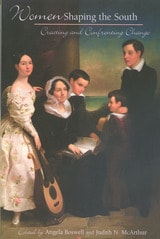
Women Shaping the South
Creating and Confronting ChangeEdited by Angela Boswell & Judith N. McArthur
University of Missouri Press, 2006
Shifting the focus to the local level, the authors demonstrate how women participated in creating change, even as they confronted conditions over which they had little power. In addition to exploring southern women’s lives, this collection shows how women shaped southern history. Using new and extensive primary research, each of these authors presents a new perspective on the important roles that women of different races and classes have played in transforming the South at some of its most crucial turning points, including post-Revolution, Civil War, Jim Crow era, World War I, and the civil rights movement.
Expanded from papers presented at the Sixth Southern Conference on Women’s History in Athens, Georgia, these essays reflect the depth and breadth of current vibrant research in southern women’s history and contribute exciting and important new scholarship to the field. Just as significant, the volume highlights the trends in southern women’s historical scholarship and points toward new directions for future scholars.

Women and National Development
The Complexities of ChangeEdited by Wellesley Editorial Committee
University of Chicago Press, 1978
Women and Welfare
Theory and Practice in the United States and EuropeHirschmann, Nancy J
Rutgers University Press, 2001
The social welfare state is believed by many to be one of the great achievements of Western democracy in the twentieth century. It institutionalized for the first time a collective commitment to improving individual life chances and social well-being. However, as we move into a new century, the social welfare state everywhere has come under increasing pressure, raising serious doubts about its survival.
Featuring essays by experts from a variety of fields, including law, comparative politics, sociology, economics, cultural studies, philosophy, and political theory, Women and Welfare represents an interdisciplinary, multimethodological and multicultural feminist approach to recent changes in the welfare system of Western industrialized nations. The broad perspective, from the philosophical to the quantitative, provides an excellent overview of the subject and the most recent scholarly literature. The volume offers a crosscultural analysis of welfare “reform” in the 1990s, visions of what a “woman-friendly” welfare state requires, and an examination of theoretical and policy questions feminists and concerned others should be asking.
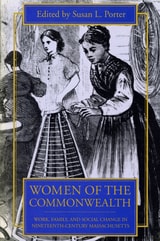
Women of the Commonwealth
Work, Family, and Social Change in Ninteenth-Century MassachusettsSusan L. Porter
University of Massachusetts Press, 1996
These essays reflect the complexity and richness of current scholarship in women's history. Informed by a variety of source materials and methodologies, the ten chapters break down a generalized construct of “womanhood” to explore the dynamics between gender, race, ethnicity, and class.
The first section of the book focuses on women's work, paid and unpaid, and the effects of class, ethnicity, and gender on the structure of the job market and on power relations within the family. The second section revisits the concept of “sisterhood” by looking at women in relation to their families, social and cultural networks, and civic and private institutions. The editor's introduction sets the essays in the current historiographical context of women's studies and provides a bibliographical essay for the nonspecialist reader.
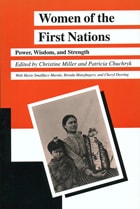
Women of the First Nations
Power, Wisdom, and StrengthChristine Miller
University of Manitoba Press, 1996
Women, State, and Party in Eastern Europe
Sharon L. Wolchik and Alfred Meyer, eds.
Duke University Press, 1985
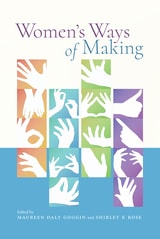
Women’s Ways of Making
Maureen Daly Goggin
Utah State University Press, 2021
Since the Enlightenment, embodied knowledge creation has been overlooked, ignored, or disparaged as inferior to other forms of expression or thinking that seem to leave the material world behind. Privileging the hand over the eye, as the work in this collection does, thus problematizes the way in which the eye has been co-opted by thinkers as the mind’s tool of investigation. Contributors to this volume argue that other senses—touch, taste, smell, hearing—are keys to knowing one’s materials. Only when all these ways of knowing are engaged can making be understood as a rhetorical practice.
In Women’s Ways of Making contributors explore ideas of making that run the gamut from videos produced by beauty vloggers to zine production and art programs at women’s correctional facilities. Bringing together senior scholars, new voices, and a fresh take on material rhetoric, this book will be of interest to a broad range of readers in composition and rhetoric.
Contributors: Angela Clark-Oates, Jane L. Donawerth, Amanda Ellis, Theresa M. Evans, Holly Fulton-Babicke, Bre Garrett, Melissa Greene, Magdelyn Hammong Helwig, Linda Hanson, Jackie Hoermann, Christine Martorana, Aurora Matzke, Jill McCracken, Karen S. Neubauer, Daneryl Nier-Weber, Sherry Rankins-Roberson, Kathleen J. Ryan, Rachael Ryerson, Andrea Severson, Lorin Shellenberger, Carey Smitherman-Clark, Emily Standridge, Charlese Trower, Christy I. Wenger, Hui Wu, Kathleen Blake Yancey
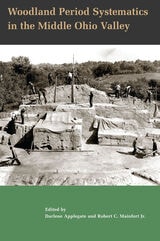
Woodland Period Systematics in the Middle Ohio Valley
Edited by Darlene Applegate and Robert C. Mainfort Jr.
University of Alabama Press, 2005
The important questions are diverse. What criteria are useful in defining periods and cultural types, and over what spatial and temporal boundaries do those criteria hold? How can we accommodate regional variation in the development and expression of traits used to delineate periods and cultural types? How does the concept of tradition relate to periods and cultural types? Is it prudent to equate culture types with periods? Is it prudent to equate archaeological cultures with ethnographic cultures? How does the available taxonomy hinder research? Contributing authors address these issues and others in the context of their Middle Ohio Valley Woodland Period research
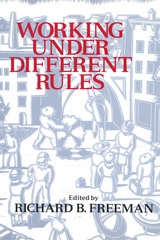
Working Under Different Rules
Richard B. Freeman
Russell Sage Foundation, 1994
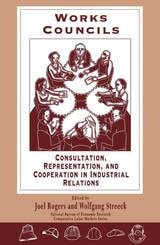
Works Councils
Consultation, Representation, and Cooperation in Industrial RelationsEdited by Joel Rogers and Wolfgang Streeck
University of Chicago Press, 1995
Works councils—institutionalized bodies for representative communication between an employer and employees in a single workplace—are rare in the Anglo-American world, but are well-established in other industrialized countries. The contributors to this volume survey the history, structure, and functions of works councils in the Netherlands, Germany, France, Spain, Sweden, Italy, Poland, Canada, and the United States. Special attention is paid to the relations between works councils and unions and collective bargaining, works councils and management, and the role and interest of governments in works councils. On the basis of extensive comparative data from other Western countries, the book demonstrates powerfully that well-designed works councils may be more effective than labor unions at solving management-labor problems.

Writings through John Cage's Music, Poetry, and Art
Edited by David W. Bernstein and Christopher Hatch
University of Chicago Press, 2001
The essays in this collection grew out of a pivotal gathering during which a spectrum of participants including composers, music scholars, and visual artists, literary critics, poets, and filmmakers convened to examine Cage's extraordinary artistic legacy. Beginning with David Bernstein's introductory essay on the reception of Cage's music, the volume addresses topics ranging from Cage's reluctance to discuss his homosexuality, to his work as a performer and musician, and his forward-looking, provocative experimentation with electronic and other media. Several of the essays draw upon previously unseen sketches and other source materials. Also included are transcripts of lively panel discussions among some of Cage's former colleagues. Taken together, this collection is a much-needed contribution to the study of one of the most significant American artists of the twentieth century.