Results by title
54 books match the query 'Constitution' and 2 start with w
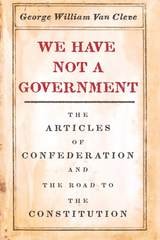
We Have Not a Government
The Articles of Confederation and the Road to the ConstitutionGeorge William Van Cleve
University of Chicago Press, 2017
In 1783, as the Revolutionary War came to a close, Alexander Hamilton resigned in disgust from the Continental Congress after it refused to consider a fundamental reform of the Articles of Confederation. Just four years later, that same government collapsed, and Congress grudgingly agreed to support the 1787 Philadelphia Constitutional Convention, which altered the Articles beyond recognition. What occurred during this remarkably brief interval to cause the Confederation to lose public confidence and inspire Americans to replace it with a dramatically more flexible and powerful government? We Have Not a Government is the story of this contentious moment in American history.
In George William Van Cleve’s book, we encounter a sharply divided America. The Confederation faced massive war debts with virtually no authority to compel its members to pay them. It experienced punishing trade restrictions and strong resistance to American territorial expansion from powerful European governments. Bitter sectional divisions that deadlocked the Continental Congress arose from exploding western settlement. And a deep, long-lasting recession led to sharp controversies and social unrest across the country amid roiling debates over greatly increased taxes, debt relief, and paper money. Van Cleve shows how these remarkable stresses transformed the Confederation into a stalemate government and eventually led previously conflicting states, sections, and interest groups to advocate for a union powerful enough to govern a continental empire.
Touching on the stories of a wide-ranging cast of characters—including John Adams, Patrick Henry, Daniel Shays, George Washington, and Thayendanegea—Van Cleve makes clear that it was the Confederation’s failures that created a political crisis and led to the 1787 Constitution. Clearly argued and superbly written, We Have Not a Government is a must-read history of this crucial period in our nation’s early life.
[more]
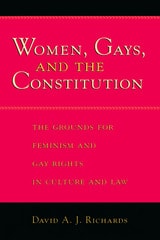
Women, Gays, and the Constitution
The Grounds for Feminism and Gay Rights in Culture and LawDavid A. J. Richards
University of Chicago Press, 1998
In this remarkable study, David A. J. Richards combines an interpretive history of culture and law, political philosophy, and constitutional analysis to explain the background, development, and growing impact of two of the most important and challenging human rights movements of our time, feminism and gay rights.
Richards argues that both movements are extensions of rights-based dissent, rooted in antebellum abolitionist feminism that condemned both American racism and sexism. He sees the progressive role of such radical dissent as an emancipated moral voice in the American constitutional tradition. He examines the role of dissident African Americans, Jews, women, and homosexuals in forging alternative visions of rights-based democracy. He also draws special attention to Walt Whitman's visionary poetry, showing how it made space for the silenced and subjugated voices of homosexuals in public and private culture.
According to Richards, contemporary feminism rediscovers and elaborates this earlier tradition. And, similarly, the movement for gay rights builds upon an interpretation of abolitionist feminism developed by Whitman in his defense, both in poetry and prose, of love between men. Richards explores Whitman's impact on pro-gay advocates, including John Addington Symonds, Havelock Ellis, Edward Carpenter, Oscar Wilde, and André Gide. He also discusses other diverse writers and reformers such as Margaret Sanger, Franz Boas, Elizabeth Stanton, W. E. B. DuBois, and Adrienne Rich.
Richards addresses current controversies such as the exclusion of homosexuals from the military and from the right to marriage and concludes with a powerful defense of the struggle for such constitutional rights in terms of the principles of rights-based feminism.
[more]