Results by title
90 books match the query 'Constitutional history' and 2 start with w
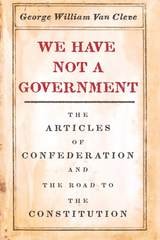
We Have Not a Government
The Articles of Confederation and the Road to the ConstitutionGeorge William Van Cleve
University of Chicago Press, 2017
In 1783, as the Revolutionary War came to a close, Alexander Hamilton resigned in disgust from the Continental Congress after it refused to consider a fundamental reform of the Articles of Confederation. Just four years later, that same government collapsed, and Congress grudgingly agreed to support the 1787 Philadelphia Constitutional Convention, which altered the Articles beyond recognition. What occurred during this remarkably brief interval to cause the Confederation to lose public confidence and inspire Americans to replace it with a dramatically more flexible and powerful government? We Have Not a Government is the story of this contentious moment in American history.
In George William Van Cleve’s book, we encounter a sharply divided America. The Confederation faced massive war debts with virtually no authority to compel its members to pay them. It experienced punishing trade restrictions and strong resistance to American territorial expansion from powerful European governments. Bitter sectional divisions that deadlocked the Continental Congress arose from exploding western settlement. And a deep, long-lasting recession led to sharp controversies and social unrest across the country amid roiling debates over greatly increased taxes, debt relief, and paper money. Van Cleve shows how these remarkable stresses transformed the Confederation into a stalemate government and eventually led previously conflicting states, sections, and interest groups to advocate for a union powerful enough to govern a continental empire.
Touching on the stories of a wide-ranging cast of characters—including John Adams, Patrick Henry, Daniel Shays, George Washington, and Thayendanegea—Van Cleve makes clear that it was the Confederation’s failures that created a political crisis and led to the 1787 Constitution. Clearly argued and superbly written, We Have Not a Government is a must-read history of this crucial period in our nation’s early life.
[more]
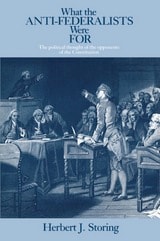
What the Anti-Federalists Were For
The Political Thought of the Opponents of the ConstitutionHerbert J. Storing
University of Chicago Press, 1981
The Anti-Federalists, in Herbert J. Storing's view, are somewhat paradoxically entitled to be counted among the Founding Fathers and to share in the honor and study devoted to the founding. "If the foundations of the American polity was laid by the Federalists," he writes, "the Anti-Federalist reservations echo through American history; and it is in the dialogue, not merely in the Federalist victory, that the country's principles are to be discovered." It was largely through their efforts, he reminds us, that the Constitution was so quickly amended to include a bill of rights.
Storing here offers a brilliant introduction to the thought and principles of the Anti-Federalists as they were understood by themselves and by other men and women of their time. His comprehensive exposition restores to our understanding the Anti-Federalist share in the founding its effect on some of the enduring themes and tensions of American political life. The concern with big government and infringement of personal liberty one finds in the writings of these neglected Founders strikes a remarkably timely note.
Storing here offers a brilliant introduction to the thought and principles of the Anti-Federalists as they were understood by themselves and by other men and women of their time. His comprehensive exposition restores to our understanding the Anti-Federalist share in the founding its effect on some of the enduring themes and tensions of American political life. The concern with big government and infringement of personal liberty one finds in the writings of these neglected Founders strikes a remarkably timely note.
[more]