Results by title
57 books match the query 'Corporations' and 2 start with w
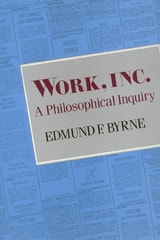
Work, Inc.
A Philosophical InquiryEdmund F. Byrne
Temple University Press, 1992
Many workers today feel that the longstanding social contract between government, business, and labor has been broken. This book examines legal and philosophical problems that must be addressed if there is to be a new social contract that is fair to workers. Drawing on a wide variety of sources, from the popular press to technical philosophy, Edmund F. Byrne brings into focus ethical issues involved in corporate decisions to reorganize, relocate, or automate. In assessing the human costs of these decisions, he shows why, to a worker, "corporations are not reducible to their assets and liabilities any more than a government is merely its annual budget. That they are organizations, that these organizations do things, and that they are socially responsible for what they do."
In support of this assignment of responsibility, Byrne seeks to demythologize corporate hegemony by confronting a variety of intellectual "dragons" that guard the gates of the status quo. These include legal assumptions about corporate personhood and commodification, private property and eminent domain; management ideas about the autonomous employee and profit without payrolls; technocratic dreams of a dehumanized workplace: ideological belief in progress and competition; and philosophical arguments for libertarian freedom, liberal welfare, and global justice.
Because of these and other mainstream perspectives, workers today are widely perceived, in law and in common parlance, to be isolated atoms. But, Byrne emphasizes, work. including work done for a transnational corporation, is done in a community. Since corporate leaders make decisions that have an impact on people’s lives and on communities, involvement in such decisions must be not only corporate or governmental but community-based as well.
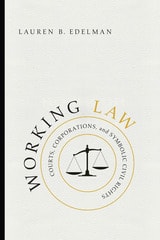
Working Law
Courts, Corporations, and Symbolic Civil RightsLauren B. Edelman
University of Chicago Press, 2016
One reason for the limited success of antidiscrimination policies, argues Lauren B. Edelman, is that the law regulating companies is broad and ambiguous, and managers therefore play a critical role in shaping what it means in daily practice. Often, what results are policies and procedures that are largely symbolic and fail to dispel long-standing patterns of discrimination. Even more troubling, these meanings of the law that evolve within companies tend to eventually make their way back into the legal domain, inconspicuously influencing lawyers for both plaintiffs and defendants and even judges. When courts look to the presence of antidiscrimination policies and personnel manuals to infer fair practices and to the presence of diversity training programs without examining whether these policies are effective in combating discrimination and achieving racial and gender diversity, they wind up condoning practices that deviate considerably from the legal ideals.