Results by title
459 books match the query 'Criminology' and 24 start with w
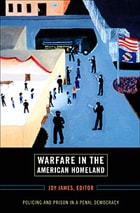
Warfare in the American Homeland
Policing and Prison in a Penal DemocracyJoy James, ed.
Duke University Press, 2007
Contributors consider the interning or policing of citizens of color, the activism of radicals, structural racism, destruction and death in New Orleans following Hurricane Katrina, and the FBI Counterintelligence Program designed to quash domestic dissent. Among the first-person accounts are an interview with Dhoruba Bin Wahad, a Black Panther and former political prisoner; a portrayal of life in prison by a Plowshares nun jailed for her antinuclear and antiwar activism; a discussion of the Puerto Rican Independence Movement by one of its members, now serving a seventy-year prison sentence for sedition; and an excerpt from a 1970 letter by the Black Panther George Jackson chronicling the abuses of inmates in California’s Soledad Prison. Warfare in the American Homeland also includes the first English translation of an excerpt from a pamphlet by Michel Foucault and others. They argue that the 1971 shooting of George Jackson by prison guards was a murder premeditated in response to human-rights and justice organizing by black and brown prisoners and their supporters.
Contributors. Hishaam Aidi, Dhoruba Bin Wahad (Richard Moore), Marilyn Buck, Marshall Eddie Conway, Susie Day, Daniel Defert, Madeleine Dwertman, Michel Foucault, Carol Gilbert, Sirène Harb, Rose Heyer, George Jackson, Joy James, Manning Marable, William F. Pinar, Oscar Lòpez Rivera, Dylan Rodríguez, Jared Sexton, Catherine vön Bulow, Laura Whitehorn, Frank B. Wilderson III
Way Down in the Hole
Race, Intimacy, and the Reproduction of Racial Ideologies in Solitary ConfinementAngela J. Hattery
Rutgers University Press, 2023
Way Down the Hole Video 1 (https://youtu.be/UuAB63fhge0)
Way Down the Hole Video 2 (https://youtu.be/TwEuw1cTrcQ)
Way Down the Hole Video 3 (https://youtu.be/bOcBv_UnHIs)
Way Down the Hole Video 4 (https://youtu.be/cx_l1S8D77c)
Wayward Icelanders
Punishment, Boundary Maintenance, And TheHelgi Gunnlaugsson
University of Wisconsin Press, 2000
Wayward Icelanders explores how the threat of crime has affected Icelanders’ collective self-identity, producing an ever greater need for social control. Historically Iceland has provided stiff sanctions for the use and abuse of mind-altering substances. Drunk driving has long been systematically punished, and even beer was prohibited for more than seventy years. The rate of conviction for these crimes is high, even in a democracy that prides itself on protecting civil liberties. Even more troubling, however, is the low rate of convictions for rape cases, which suggests that such crimes receive less attention from the state. Drawing on the classic work of Durkheim as well as Kai Erikson’s Wayward Puritans, Gunnlaugsson and Galliher demonstrate that an escalating war on crime can threaten freedom even in a small, affluent, and relatively nonviolent nation like Iceland with a long-standing commitment to democracy and individual rights.
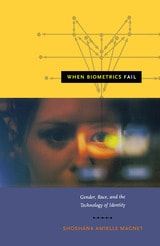
When Biometrics Fail
Gender, Race, and the Technology of IdentityShoshana Amielle Magnet
Duke University Press, 2011
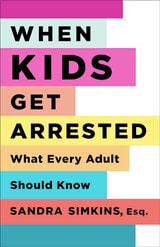
When Kids Get Arrested
What Every Adult Should KnowSandra Simkins, Esq.
Rutgers University Press, 2009
Sandra Simkins provides straight answers to common questions such as:
- Should I let my child talk to the police without a lawyer?
- How can I help my child succeed on probation?
- Should my child admit to the charges or take the case to trial?
- How will this case impact my child's future? Will it prevent him from getting a job or going into the army?
- My child has mental health issues. Can the juvenile justice system help?
- My daughter is out of control. Should I call the police?
- My son got arrested at school and is now suspended. What should I do next?
Simkins takes complicated legal concepts and breaks them down into easy-to-understand guidelines. She includes information on topics such as police interrogation, detention hearings, and bail, along with state-by-state specifics. When Kids Get Arrested is a perfect resource for parents, social workers, guidance counselors, teachers, principals, coaches, and anyone else who works with children.
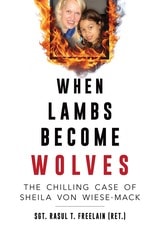
When Lambs Become Wolves
The Chilling Case of Sheila von Wiese-MackSgt. Rasul T. Freelain (Ret.)
Southern Illinois University Press, 2026
A bold firsthand account of the circumstances surrounding the notorious Bali “Suitcase Murder” and the human cost of overlooking child-to-parent violence and abuse
On August 12, 2014, the body of 62-year-old Sheila von Wiese-Mack—the wealthy Oak Park, Illinois, widow of famed composer James L. Mack—was found stuffed inside a suitcase in the trunk of a taxi in Bali. Back in the Midwest, listening to the radio, Sgt. Rasul Freelain of the Oak Park Police Department pulled his car over to absorb the unthinkable news. Amid his shock, one coherent thought surfaced: “Heather did this.”
Freelain had met the Macks more than three years earlier, when Sheila first reached out to the police for help with her increasingly volatile daughter. Although Heather Mack was just a teenager, she had already displayed a disturbing pattern of escalating violence. Freelain did everything he could to intervene. But as the abuse worsened, he found himself sidelined by a justice system unprepared to deal with child-to-parent violence and abuse (CPVA).
In this gripping and empathetic memoir, Freelain traces the Mack family’s descent from privilege to tragedy, bringing overdue attention to CPVA as a critical yet overlooked public health crisis. He recounts the glamorous but troubled world of the Macks—the parties, the talent, the dysfunction—and his efforts to support both mother and daughter. With rare insight into the web of trauma, race, wealth, and grief that surrounded them, he shows how the system failed them both—and how, even after Sheila’s death, he remained committed to seeking justice and change.
When Lambs Become Wolves moves beyond sensational headlines to examine the roots of one of America’s most hidden forms of domestic violence. While media coverage fixated on the exotic setting and shocking brutality of the crime, along with the growing notoriety of the teenage killer, Freelain urges readers—and institutions in law enforcement, child welfare, and mental health—to focus instead on those harmed. Sheila was more than a victim; she was a sharp, compassionate, creative woman who loved her daughter to the very end. Through meticulous research and raw personal reflection, Freelain explores how abuse cycles form, how institutions look away, and what it means to try—and fail—to protect someone in crisis.
This memoir, with a foreword by Sheila’s brother William Wiese, is a call to action, offering a rare blend of true crime, compassion, and advocacy. This deeply human account of a police officer caught in an impossible situation shows the price of ignoring the violence that starts at home.
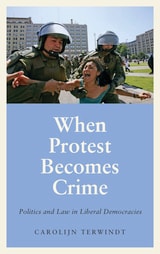
When Protest Becomes Crime
Politics and Law in Liberal DemocraciesCarolijn Terwindt
Pluto Press, 2019
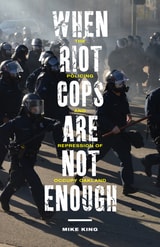
When Riot Cops Are Not Enough
The Policing and Repression of Occupy OaklandKing, Mike
Rutgers University Press, 2017
Drawn from King’s intensive field work, the book focuses on the physical, legal, political, and ideological dimensions of repression—in the streets, in courtrooms, in the media, in city hall, and within the movement itself—When Riot Cops Are Not Enough highlights the central role of political legitimacy, both for mass movements seeking to create social change, as well as for governmental forces seeking to control such movements. Although Occupy Oakland was different from other Occupy sites in many respects, King shows how the contradictions it illuminated within both social movement and police strategies provide deep insights into the nature of protest policing generally, and a clear map to understanding the full range of social control techniques used in North America in the twenty-first century.
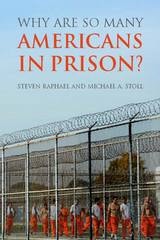
Why Are So Many Americans in Prison?
Steven Raphael
Russell Sage Foundation, 2013
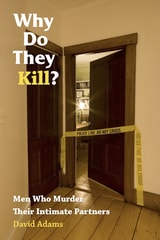
Why Do They Kill?
Men Who Murder Their Intimate PartnersDavid Adams
Vanderbilt University Press, 2007
Key turning points of these relationships include the first emergence of the man's violence, his blaming of the victim, her attempts to resist, his escalation, her attempts to end the relationship, and his punishment for her defiance. Critical perspective on the men's accounts comes from interviews with victims of attempted homicide (standing in for the murder victims) who survived shootings, stabbings, and strangulation. These women detail their partner's escalating patterns of child abuse, sexual violence, terroristic threats, and stalking. The section on help-seeking patterns of victims helps to dispel notions of learned helplessness among victims.
Why Our Drug Laws Have Failed
James Gray
Temple University Press, 2001
We have built large numbers of prisons, but they are overflowing with non-violent drug offenders. The huge profits made from drug sales are corrupting people and institutions here and abroad. And far from being protected by our drug prohibition policy, our children are being recruited by it to a lifestyle of drug use and drug selling.
Judge Gray's book drives a stake through the heart of the War on Drugs. After documenting the wide-ranging harms caused by this failed policy, Judge Gray also gives us hope. We have viable options. The author evaluates these options, ranging from education and drug treatment to different strategies for taking the profit out of drug-dealing.
Many officials will not say publicly what they acknowledge privately about the failure of the War on Drugs. Politicians especially are afraid of not appearing "tough on drugs." But Judge Gray's conclusions as a veteran trial judge and former federal prosecutor are reinforced by the testimonies of more than forty other judges nationwide.
Why Our Drug Laws Have Failed and What We Can Do About It
A Judicial Indictment of the War on DrugsJames Gray
Temple University Press, 2011
Our drug prohibition policy is hopeless, just as Prohibition, our alcohol prohibition policy, was before it. Today there are more drugs in our communities and at lower prices and higher strengths than ever before.
We have built large numbers of prisons, but they are overflowing with non-violent drug offenders. The huge profits made from drug sales are corrupting people and institutions here and abroad. And far from being protected by our drug prohibition policy, our children are being recruited by it to a lifestyle of drug use and drug selling.
Judge Gray’s book drives a stake through the heart of the War on Drugs. After documenting the wide-ranging harms caused by this failed policy, Judge Gray also gives us hope. We have viable options. The author evaluates these options, ranging from education and drug treatment to different strategies for taking the profit out of drug-dealing.
Many officials will not say publicly what they acknowledge privately about the failure of the War on Drugs. Politicians especially are afraid of not appearing "tough on drugs." But Judge Gray’s conclusions as a veteran trial judge and former federal prosecutor are reinforced by the testimonies of more than forty other judges nationwide.
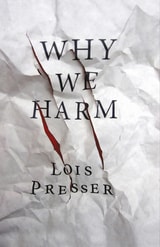
Why We Harm
Presser, Lois
Rutgers University Press, 2013
2014 Choice Outstanding Academic Title
Criminologists are primarily concerned with the analysis of actions that violate existing laws. But a growing number have begun analyzing crimes as actions that inflict harm, regardless of the applicability of legal sanctions. Even as they question standard definitions of crime as law-breaking, scholars of crime have few theoretical frameworks with which to understand the etiology of harmful action.
In Why We Harm, Lois Presser scrutinizes accounts of acts as diverse as genocide, environmental degradation, war, torture, terrorism, homicide, rape, and meat-eating in order to develop an original theoretical framework with which to consider harmful actions and their causes. In doing so, this timely book presents a general theory of harm, revealing the commonalities between actions that impose suffering and cause destruction.
Harm is built on stories in which the targets of harm are reduced to one-dimensional characters—sometimes a dangerous foe, sometimes much more benign, but still a projection of our own concerns and interests. In our stories of harm, we are licensed to do the harmful deed and, at the same time, are powerless to act differently. Chapter by chapter, Presser examines statements made by perpetrators of a wide variety of harmful actions. Appearing vastly different from one another at first glance, Presser identifies the logics they share that motivate, legitimize, and sustain them. From that point, she maps out strategies for reducing harm.
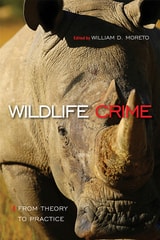
Wildlife Crime
From Theory to PracticeWilliam D.Moreto
Temple University Press, 2018
The editors and contributors to Wildlife Crime examine topical issues from extinction to trafficking in order to understand the ecological, economic, political, and social costs and consequences of these crimes. Drawing from diverse theoretical perspectives, empirical and methodological developments, and on-the-ground experiences of practitioners, this comprehensive volume looks at how conservationists and law enforcement grapple with and combat environmental crimes and the profitable market for illegal trade.
Chapters cover criminological perspectives on species poaching, unregulated fishing, the trading of ivory and rhino horns, the adoption of conservation technologies, and ranger workplaces and conditions. The book includes firsthand experiences and research from China, Indonesia, Kenya, Madagascar, Morocco, Peru, Russia, South Africa, Tanzania, and the United States. The result is a significant book about the causes of and response to wildlife crime.
Contributors include: Johan Bergenas, Avi Brisman, Craig Forsyth, Meredith Gore, Georg Jaster, Alex Killion, Kasey Kinnard, Antony C. Leberatto, Barney Long, Nerea Marteache, Gohar Petrossian, Jonah Ratsimbazafy, Gary Roloff, Viviane Seyranian, Louise Shelley, Rohit Singh, Nicole Sintov, Nigel South, Milind Tambe, Daan van Uhm, Greg Warchol, Rodger Watson, Rob White, Madelon Willemsen, and the editor.
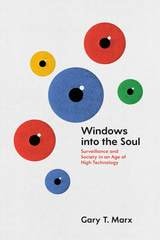
Windows into the Soul
Surveillance and Society in an Age of High TechnologyGary T. Marx
University of Chicago Press, 2016
In this landmark book, Marx sums up a lifetime of work on issues of surveillance and social control by disentangling and parsing the empirical richness of watching and being watched. Using fictional narratives as well as the findings of social science, Marx draws on decades of studies of covert policing, computer profiling, location and work monitoring, drug testing, caller identification, and much more, Marx gives us a conceptual language to understand the new realities and his work clearly emphasizes the paradoxes, trade-offs, and confusion enveloping the field. Windows into the Soul shows how surveillance can penetrate our social and personal lives in profound, and sometimes harrowing, ways. Ultimately, Marx argues, recognizing complexity and asking the right questions is essential to bringing light and accountability to the darker, more iniquitous corners of our emerging surveillance society.
For more information, please see www.garymarx.net.
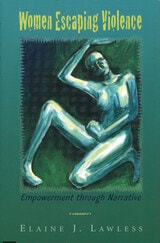
Women Escaping Violence
Empowerment through NarrativeElaine J. Lawless
University of Missouri Press, 2001
The statistics are alarming. Some say that once every nine minutes a woman in the United States is beaten by her spouse or partner. Others claim that once every four minutes a woman in the world is beaten by her spouse or partner. More women go to emergency rooms in the United States for injuries sustained at the hands of their spouses and partners than for all other injuries combined.
Shelters for battered women are filled beyond capacity every single day of the year. Despite the overwhelming evidence that violence in our homes is a daily reality, most of us are not willing to acknowledge this private violence or talk about it openly. Women Escaping Violence brings women's stories to the attention of the academy as well as the reading public. While we may be unwilling or unable to talk about the issue of battered women, many of us are ready to read what women have to say about their endangered lives.
Considerable scholarship is emerging in the area of domestic violence, including many self-help books about how to identify and escape abuse. Women Escaping Violence offers the unique view of battered women's stories told in their own words, as well as a feminist analysis of how these women use the power of narrative to transform their sense of self and regain a place within the larger society.
Lawless shares with the reader the heart-wrenching experiences of battered women who have escaped violence by fleeing to shelters with little more than a few items hastily shoved into a plastic bag, and often with small children in tow. The book includes women's stories as they are told and retold within the shelter, in the presence of other battered women and of caregivers. It analyzes the uses made of these narratives by those seeking to counsel battered women as well as by the women themselves.
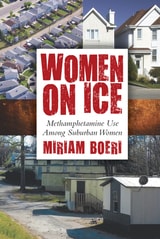
Women on Ice
Methamphetamine Use among Suburban WomenMiriam Boeri
Rutgers University Press, 2013
2013 Choice Outstanding Academic Title
Methamphetamine (ice, speed, crystal, shard) has been called epidemic in the United States. Yet few communities were ready for increased use of methamphetamine by suburban women. Women on Ice is the first book to study exclusively the lives of women who use the drug and its effects on their families.
In-depth interviews with women in the suburban counties of one of the largest metropolitan areas in the U.S. chronicle the details of their initiation into methamphetamine, the turning points into problematic drug use, and for a few, their escape from lives veering out of control. Their life course and drug careers are analyzed in relation to the intersecting influences of social roles, relationships, social/political structures, and political trends. Examining the effects of punitive drug policy, inadequate social services, and looming public health risks, including HIV/AIDS and hepatitis C, the book gives voice to women silenced by shame.
Boeri introduces new and developing concepts in the field of addiction studies and proposes policy changes to more broadly implement initiatives that address the problems these women face. She asserts that if we are concerned that the war on drugs is a war on drug users, this book will alert us that it is also a war on suburban families.
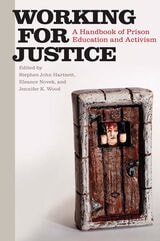
Working for Justice
A Handbook of Prison Education and ActivismEdited by Stephen John Hartnett, Eleanor Novek, and Jennifer K. Wood
University of Illinois Press, 2013
Writing as Punishment in Schools, Courts, and Everyday Life
Spencer Schaffner
University of Alabama Press, 2019
Writing tends to be characterized as a positive aspect of literacy that helps us to express our thoughts, to foster interpersonal communication, and to archive ideas. However, there is a vast array of evidence that emphasizes the counterbelief that writing has the power to punish, shame, humiliate, control, dehumanize, fetishize, and transform those who are subjected to it. In Writing as Punishment in Schools, Courts, and Everyday Life, Spencer Schaffner looks at many instances of writing as punishment, including forced tattooing, drunk shaming, court-ordered letters of apology, and social media shaming, with the aim of bringing understanding and recognition to the coupling of literacy and subjection.
Writing as Punishment in Schools, Courts, and Everyday Life is a fascinating inquiry into how sinister writing can truly be and directly questions the educational ideal that powerful writing is invariably a public good. While Schaffner does look at the darker side of writing, he neither vilifies nor supports the practice of writing as punishment. Rather, he investigates the question with humanistic inquiry and focuses on what can be learned from understanding the many strange ways that writing as punishment is used to accomplish fundamental objectives in everyday life.
Through five succinct case studies, we meet teachers, judges, parents, sex traffickers, and drunken partiers who have turned to writing because of its presumed power over writers and readers. Schaffner provides careful analysis of familiar punishments, such as schoolchildren copying lines, and more bizarre public rituals that result in ink-covered bodies and individuals forced to hold signs in public.
Schaffner argues that writing-based punishment should not be dismissed as benign or condemned as a misguided perversion of writing, but instead should be understood as an instrument capable of furthering both the aims of justice and degradation.
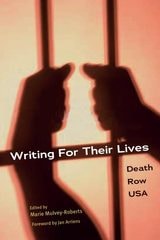
Writing for Their Lives
Death Row USAEdited by Marie Mulvey-Roberts. Foreword by Jan Arriens
University of Illinois Press, 2007
Exposing little-known facts about the five modes of execution practiced in the United States today, Writing for Their Lives documents the progress of life on death row from a capital trial to execution and beyond, through the testimony of the prisoners themselves as well as those who watch, listen, and write to them. What emerges are stories of the survival of the human spirit under even the most unimaginable circumstances, and the ways in which some prisoners find penitence and peace in the most unlikely surroundings. In spite of the uniformity of their prison life and its nearly inevitable conclusion, prisoners able to read and write letters are shown to retain and develop their individuality and humanity as their letters become poems and stories.
Writing for Their Lives serves ultimately as an affirmation of the value of life and provides bountiful evidence that when a state executes a prisoner, it takes a life that still had something to give.
This edition features an introduction by the editor as well as a foreword by Jan Arriens. Dr. Mulvey-Roberts will be donating her profits from the sale of this volume to the legal charity Amicus, which assists in capital defense in the United States."
Writing the World of Policing
The Difference Ethnography MakesEdited by Didier Fassin
University of Chicago Press, 2017
Wrongful Conviction
International Perspectives on Miscarriages of Justiceedited by C. Ronald Huff and Martin Killias
Temple University Press, 2009
Imperfections in the criminal justice system have long intrigued the general public and worried scholars and legal practitioners. In Wrongful Conviction, criminologists C. Ronald Huff and Martin Killias present an important collection of essays that analyzes cases of injustice across an array of legal systems, with contributors from North America, Europe and Israel. This collection includes a number of well-developed public-policy recommendations intended to reduce the instances of courts punishing innocents. It also offers suggestions for compensating more fairly those who are wrongfully convicted.
Wrongly Convicted
Perspectives on Failed JusticeWestervelt, Saundra D
Rutgers University Press, 2001
The American criminal justice system contains numerous safeguards to prevent the conviction of innocent persons. The Bill of Rights provides nineteen separate rights for the alleged criminal offender, including the right to effective legal representation and the right to be judged without regard to race or creed. Despite these safeguards, wrongful convictions persist, and the issue has reverberated in the national debate over capital punishment.
The essays in this volume are written from a cross-disciplinary perspective by some of the most eminent lawyers, criminologists, and social scientists in the field today. The articles are divided into four sections: the causes of wrongful convictions, the social characteristics of the wrongly convicted, case studies and personal histories, and suggestions for changes in the criminal justice system to prevent wrongful convictions. Contributors examine a broad range of issues, including the fallibility of eyewitness testimony, particularly in cross-racial identifications; the disadvantages faced by racial and ethnic minorities in the criminal justice system; and the impact of new technologies, especially DNA evidence, in freeing the innocent and bringing the guilty to justice. The book also asks such questions as: What legal characteristics do wrongful convictions share? What are the mechanisms that defendants and their attorneys use to overturn wrongful convictions? The book also provides case studies that offer specific examples of what can and does go wrong in the criminal justice system.