190 books match the query 'Critical theory' and 6 start with w
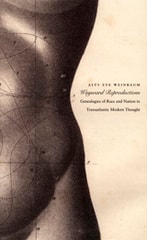
cover of Wayward Reproductions: Genealogies of Race and Nation in Transatlantic Modern Thought

Wayward Reproductions

Genealogies of Race and Nation in Transatlantic Modern Thought

Alys Eve Weinbaum

Duke University Press, 2004

Wayward Reproductions breaks apart and transfigures prevailing understandings of the interconnection among ideologies of racism, nationalism, and imperialism. Alys Eve Weinbaum demonstrates how these ideologies were founded in large part on what she calls “the race/reproduction bind”––the notion that race is something that is biologically reproduced. In revealing the centrality of ideas about women’s reproductive capacity to modernity’s intellectual foundations, Weinbaum highlights the role that these ideas have played in naturalizing oppression. She argues that attention to how the race/reproduction bind is perpetuated across national and disciplinary boundaries is a necessary part of efforts to combat racism.

Gracefully traversing a wide range of discourses––including literature, evolutionary theory, early anthropology, Marxism, feminism, and psychoanalysis––Weinbaum traces a genealogy of the race/reproduction bind within key intellectual formations of the late nineteenth and twentieth centuries. She examines two major theorists of genealogical thinking—Friedrich Nietzsche and Michel Foucault—and unearths the unacknowledged ways their formulations link race and reproduction. She explores notions of kinship and the replication of racial difference that run through Charlotte Perkins Gilman’s work; Marxist thinking based on Friedrich Engel’s The Origin of the Family; Charles Darwin’s theory of sexual selection; and Sigmund Freud’s early studies on hysteria. She also describes W. E. B. Du Bois’s efforts to transcend ideas about the reproduction of race that underwrite citizenship and belonging within the United States. In a coda, Weinbaum brings the foregoing analysis to bear on recent genomic and biotechnological innovations.
[more]
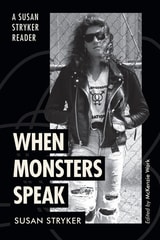
cover of When Monsters Speak: A Susan Stryker Reader

When Monsters Speak

A Susan Stryker Reader

Susan Stryker. Edited by McKenzie Wark

Duke University Press, 2024
Susan Stryker is a foundational figure in trans studies. When Monsters Speak showcases the development of Stryker’s writing from the 1990s to the present. It combines canonical pieces, such as “My Words to Victor Frankenstein,” with her hard to find earlier work published in zines and newsletters. Brought together, they ground Stryker’s thought in 1990s San Francisco and its innovative queer, trans, and S/M cultures. The volume includes an introduction by editor McKenzie Wark, who highlights Stryker’s connections to developments in queer theory, media studies, and autotheory while foregrounding Stryker’s innovative writing style and scholarly methods. When Monsters Speak is an authoritative and essential collection by one of the most important and influential intellectuals of our time.
[more]
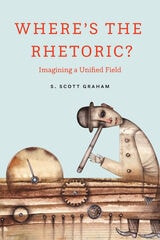
cover of Where's the Rhetoric?: Imagining a Unified Field

Where's the Rhetoric?

Imagining a Unified Field

S. Scott Graham

The Ohio State University Press, 2020

The emergence of rhetorical new materialisms and computational rhetorics has provoked something of an existential crisis within rhetorical studies. In Where’s the Rhetoric?, S. Scott Graham tackles this titular question by arguing first that scholarly efforts in rhetorical new materialisms and computational rhetoric be understood as coextensive with longstanding disciplinary commitments in rhetoric. In making this argument, Graham excavates the shared intellectual history of traditional rhetorical inquiry, rhetorical new materialisms, and computational rhetoric with particular emphasis on the works of Carolyn Miller, Kenneth Burke, and Henri Bergson.
 
Building on this foundation, Graham then argues for a more unified approach to contemporary rhetorical inquiry—one that eschews disciplinary demarcations between rhetoric’s various subareas. Specifically, Graham uses his unified field theory to explore 1) the rise of the “tweetorial” as a parascientific genre, 2) inventional practices in new media design, 3) statistical approaches to understanding biomedical discourse, and 4) American electioneering rhetorics. The book overall demonstrates how seemingly disparate intellectual approaches within rhetoric can be made to speak productively to one another in the pursuit of shared scholarly goals around questions of genre, media, and political discourse—thereby providing a foundation for imagining a more unified field.
 
[more]
cover of Wittgenstein & Critical Theory: Beyond Postmodern Criticism and Toward Descriptive Investigations

Wittgenstein & Critical Theory

Beyond Postmodern Criticism and Toward Descriptive Investigations

Susan B. Brill

Ohio University Press, 1994

The crucial point of Brill’s study is that of fit: which critical methods prove most useful towards opening up which texts? Close investigations into the parameters of the language games of texts, critics, and methods enable us to determine which paths to take towards more complete descriptive analyses and critique. Such an emphasis on the philosophical method of Ludwig Wittgenstein reorients literary criticism to involve a conjoint responsibility to both reader and text as the literary critic assumes the humbler role of a guide who assists a reader in/to diverse literary texts. Wittgenstein’s philosophical approach provides us with a strong means of developing such a method for literary criticism—a method that points the way forward beyond postmodern criticisms and to a categorically new approach to literary texts.

Brill’s work discusses at length the implications of Wittgenstein for literary criticism and theory. The volume specifically investigates the implications of Wittgenstein’s work for a number of contemporary critical orientations (notably poststructualism, feminism, and psychology). In addition, the research includes actual applications of Wittgenstein for literary criticism: diverse literary texts (including a number of poems and stories by Native American authors) are approached via a Wittgensteinian method as a means of discerning which critical approaches might be more or less efficacious. Not only does the book provide a solid introduction to Wittgensteinian philosophy for the critical scholars, but it also provides a clear methodology useful to critics seeking a means to navigate through the entanglement of contemporary criticism and theory.

Brill argues that a reliance upon the philosophy of Ludwig Wittgenstein can enable literary critics to escape the seemingly endless dialectic between modern and postmodern theory. Instead of debating which theory is theoretically best, we need to describe when theories work—and when they do not.

[more]
cover of Worlding: Finding a Way in Broken Times

Worlding

Finding a Way in Broken Times

Kathleen Stewart

Duke University Press, 2027
In Worlding, Kathleen Stewart traces the proliferation of everyday practices, fantasies, and scenes of damage in a new ordinary in the United States from the 1950s to the Trump years. Her poetic prose moves like a flip book across patterns, places, times, strays, troubles, and lines of power, laying down a creative-critical experiment in description, autoethnography, auto-theory, and a new materialism of elements. Writing in fragments overrun with ideas, she proposes a creative-critical practice that branches out rather than synthesizes. Worlding is a series of tryouts approaching the weight, generativity, and politics of the unthought, the cryptic, the visceral, the conventional, the artful, and the elemental. From birds and weather to a face or a harsh phrase, Stewart plays at the boundaries of worlding’s capacities, creatively mulling over the possibilities beyond the edge of experience and speculation.
[more]
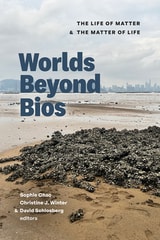
cover of Worlds Beyond Bios: The Life of Matter and the Matter of Life

Worlds Beyond Bios

The Life of Matter and the Matter of Life

Sophie Chao, Christine J. Winter, and David Schlosberg, editors

Duke University Press, 2026

Worlds Beyond Bios builds on recent theoretical and ethnographic approaches to the more-than-human, exploring how entities not traditionally recognized as “alive” play active roles in shaping multispecies worlds. Drawing from Indigenous and Global South epistemologies as well as anthropology, the environmental humanities, and political theory, the contributors develop philosophies and practices of engagement with matter that are agentive and affective. Taken together, they offer ways of theorizing relations, justice, and materiality in an age of planetary unmaking and colonial capitalist logics, grounded in an ethics of responsibility and repair. From the political agency of mountains and the liveliness of sand to the spectral futures of coal and the opaque aesthetics of dust, Worlds Beyond Bios reveals how assumed borders between bios and non-bios are not only porous but politically consequential.
[more]