Results by title
476 books match the query 'Criticism' and 13 start with w
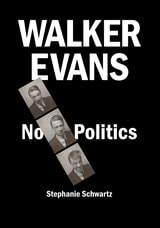
Walker Evans
No PoliticsBy Stephanie Schwartz
University of Texas Press, 2020
“NO POLITICS whatever.” Walker Evans made this emphatic declaration in 1935, the year he began work for FDR’s Resettlement Administration. Evans insisted that his photographs of tenant farmers and their homes, breadlines, and the unemployed should be treated as “pure record.” The American photographer’s statements have often been dismissed. In Walker Evans: No Politics, Stephanie Schwartz challenges us to engage with what it might mean, in the 1930s and at the height of the Great Depression, to refuse to work politically.
Offering close readings of Evans’s numerous commissions, including his contribution to Carleton Beals’s anti-imperialist tract, The Crime of Cuba (1933), this book is a major departure from the standard accounts of Evans’s work and American documentary. Documentary, Schwartz reveals, is not a means of being present—or being “political.” It is a practice of record making designed to distance its maker from the “scene of the crime.” That crime, Schwartz argues, is not just the Depression; it is the processes of Americanization reshaping both photography and politics in the 1930s. Historicizing documentary, this book reimagines Evans and his legacy—the complexities of claiming “no politics.”
Wallace Stevens and the Critical Schools
Melita C. Schaum
University of Alabama Press, 1988
Wallace Stevens and the Critical Schools reveals a field marked by conflict and contradiction, both within and among critical works in their attempts to explicate and appropriate this major American poet. Stevens’ changing reception among the critical schools reveals much about the shifting nature of American literature and criticism in this century and illuminates the often polemical process of literary canon formation. Each chapter of this book examines a particular aspect of the 20th-century critical involvement with Wallace Stevens’ poetry, introduced by a discussion of the poet’s work as an arena for the convergence of modern critical tendencies and concerns.
First, the author examines the avant-garde milieu of early 20th-century modernism, which implicated Stevens in its melee of affiliations and enmities and which influenced critics’ ambivalent responses to his early work. She traces the critical controversies of the poet’s emergence before and during the 1920s, specifically the clash between New Humanism and aestheticism, and demonstrates how the quality of irony in Stevens’ work became a part of the critics’ general repertoire in their assessment of this poet.
The 1930s, 1940s, and 1950s were decades during which Stevens criticism became dominated by the New Critical ideology. The turn toward deconstruction in Stevens criticism stands in part as a response to the New Critical dilemma, seen in the manner in which such critics as J. Hillis Miller and Joseph Riddel appropriated the concept of “decreation” to explain the sense of rupture in Stevens’ late poetry yet brought that concept to its logical end in a deconstructive paradigm.
Finally, Schaum identifies four major theoretical approaches to Stevens in the past two decades that continue to inform and direct the field of critical dissent and exploration in the 1980s. Such theories as Bloomian misprision, versions of hermeneutic criticism, redefinitions of the deconstructive enterprise, and the contemporary call for a new historicism continue the battle to appropriate Stevens as the “hard prize” of critical aims and investigations.
Warring Visions
Photography and VietnamThy Phu
Duke University Press, 2021
When Words Lose Their Meaning
Constitutions and Reconstitutions of Language, Character, and CommunityJames Boyd White
University of Chicago Press, 1984
"In this ambitious and demanding work of literary criticism, James Boyd White seeks to communicate 'a sense of reading in a new and different way.' . . . [White's] marriage of lawyerly acumen and classically trained literary sensibility—equally evident in his earlier work, The Legal Imagination—gives the best parts of When Words Lose Their Meaning a gravity and moral earnestness rare in the pages of contemporary literary criticism."—Roger Kimball, American Scholar
"James Boyd White makes a state-of-the-art attempt to enrich legal theory with the insights of modern literary theory. Of its kind, it is a singular and standout achievement. . . . [White's] selections span the whole range of legal, literary, and political offerings, and his writing evidences a sustained and intimate experience with these texts. Writing with natural elegance, White manages to be insightful and inciteful. Throughout, his timely book is energized by an urgent love of literature and law and their liberating potential. His passion and sincerity are palpable."—Allan C. Hutchinson, Yale Law Journal
"Undeniably a unique and significant work. . . . When Words Lose Their Meaning is a rewarding book by a distinguished legal scholar. It is a showcase for the most interesting sort of inter-disciplinary work: the kind that brings together from traditionally separate fields not so much information as ideas and approaches."—R. B. Kershner, Jr., Georgia Review
Where No Flag Flies
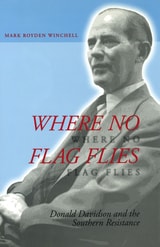
Donald Davidson and the Southern ResistanceMark Royden Winchell
University of Missouri Press, 2000
Donald Davidson (1893-1968) may well be the most unjustifiably neglected figure in twentieth-century southern literature. One of the most important poets of the Fugitive movement, he also produced a substantial body of literary criticism, the libretto for an American folk opera, a widely used composition textbook, and the recently discovered novel The Big Ballad Jamboree. As a social and political activist, Davidson had significant impact on conservative thought in this century, imfluencing important scholars from Cleanth Brooks to M. E. Bradford.
Despite these accomplishments, Donald Davidson has received little critical attention from either the literary or the southern scholarly community. Where No Flag Flies is Mark Royden Winchell's redress of this critical disservice. A comprehensive intellectual biography of Davidson, this seminal work offers a complete narrative of Davidson's life with all of its triumphs and losses, frustrations and fulfillments.
Winchell provides the reader with more than a simple study of a man and his achievements; he paints a complete portrait of the times in which Davidson published, from the 1930s to the early 1960s. Davidson was more directly involved in political and social activities than most writers of his generation, and Winchell provides the context, both literary and historical, in which Davidson's opinions and works developed. At the same time, Winchell offers detailed evaluations of Davidson's poetry, fiction, historical writings, and essays.
Drawing upon a wealth of previously unpublished archival material, including Davidson's letters and diary, Where No Flag Flies provides unique access to one of the most original minds of the twentieth-century South. Donald Davidson may not have achieved the recognition he deserved, but this remarkable biography finally makes it possible for a considerable literary audience to discover his true achievement.
Who Is the City For?
Architecture, Equity, and the Public Realm in ChicagoBlair Kamin
University of Chicago Press, 2022
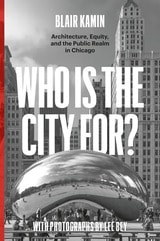
From his high-profile battles with Donald Trump to his insightful celebrations of Frank Lloyd Wright and front-page takedowns of Chicago mega-projects like Lincoln Yards, Pulitzer Prize–winning architecture critic Blair Kamin has long informed and delighted readers with his illuminating commentary. Kamin’s newest collection, Who Is the City For?, does more than gather fifty-five of his most notable Chicago Tribune columns from the past decade: it pairs his words with striking new images by photographer and architecture critic Lee Bey, Kamin’s former rival at the Chicago Sun-Times. Together, they paint a revealing portrait of Chicago that reaches beyond its glamorous downtown and dramatic buildings by renowned architects like Jeanne Gang to its culturally diverse neighborhoods, including modest structures associated with storied figures from the city’s Black history, such as Emmett Till.
At the book’s heart is its expansive approach to a central concept in contemporary political and architectural discourse: equity. Kamin argues for a broad understanding of the term, one that prioritizes both the shared spaces of the public realm and the urgent need to rebuild Black and brown neighborhoods devastated by decades of discrimination and disinvestment. “At best,” he writes in the book’s introduction, “the public realm can serve as an equalizing force, a democratizing force. It can spread life’s pleasures and confer dignity, irrespective of a person’s race, income, creed, or gender. In doing so, the public realm can promote the social contract — the notion that we are more than our individual selves, that our common humanity is made manifest in common ground.” Yet the reality in Chicago, as Who Is the City For? powerfully demonstrates, often falls painfully short of that ideal.
Who Killed American Poetry?
From National Obsession to Elite PossessionKaren L. Kilcup
University of Michigan Press, 2019
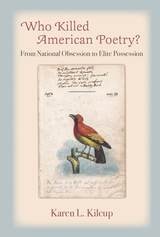
Conceptually and methodologically unique among studies of 19th-century American poetry, Who Killed American Poetry? not only charts changing attitudes toward American poetry, but also applies these ideas to the work of representative individual poets. Closely analyzing hundreds of reviews and critical essays, Karen L. Kilcup tracks the century’s developing aesthetic standards and highlights the different criteria reviewers used to assess poetry based on poets’ class, gender, ethnicity, and location. She shows that, as early as the 1820s, critics began to marginalize some kinds of emotional American poetry, a shift many scholars have attributed primarily to the late-century emergence of affectively restrained modernist ideals. Mapping this literary critical history enables us to more readily apprehend poetry’s status in American culture—both in the past and present—and encourages us to scrutinize the standards of academic criticism that underwrite contemporary aesthetics and continue to constrain poetry’s appeal.
Who American Killed Poetry? enlarges our understanding of American culture over the past two hundred years and will interest scholars in literary studies, historical poetics, American studies, gender studies, canon criticism, genre studies, the history of criticism, and affect studies. It will also appeal to poetry readers and those who enjoy reading about American cultural history.
Why Architecture Matters
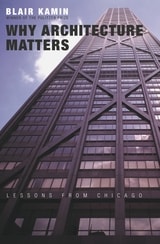
Lessons from ChicagoBlair Kamin
University of Chicago Press, 2001
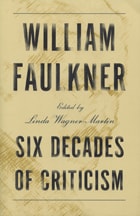
William Faulkner
Six Decades of CriticismLinda Wagner-Martin
Michigan State University Press, 2002
Few twentieth-century writers are as revered as William Faulkner. This collection brings together the best literary criticism on Faulkner from the last six decades, detailing the imaginative and passionate responses to his still-controversial novels. By focusing on the criticism rather than the works, Linda Wagner-Martin shows the primary directions in Faulkner’s influence on critics, writers, and students of American literature today. This invaluable volume reveals the patterns of change in literary criticism over time, while exploring the various critical streams—language theory, feminism, deconstruction, and psychoanalysis—that have elevated Faulkner’s work to the highest rank of the American literary pantheon.
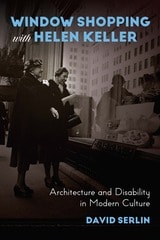
Window Shopping with Helen Keller
Architecture and Disability in Modern CultureDavid Serlin
University of Chicago Press, 2025
Window Shopping with Helen Keller recovers a series of influential moments when architects and designers engaged the embodied experiences of people with disabilities. David Serlin reveals how people with sensory and physical impairments navigated urban spaces and helped to shape modern culture. Through four case studies—the lives of Joseph Merrick (aka “The Elephant Man”) and Helen Keller, the projects of the Works Progress Administration, and the design of the Illinois Regional Library for the Blind and Physically Handicapped—Serlin offers a new history of modernity’s entanglements with disability.
Within the Circle
An Anthology of African American Literary Criticism from the Harlem Renaissance to the PresentAngelyn Mitchell
Duke University Press, 1994
The essays in this collection—many of which are not widely available today—either initiated or gave critical definition to specific periods or movements of African American literature. They address issues such as integration, separatism, political action, black nationalism, Afrocentricity, black feminism, as well as the role of art, the artist, the critic, and the audience. With selections from Langston Hughes, Sterling Brown, W. E. B. DuBois, Zora Neale Hurston, Richard Wright, James Baldwin, Toni Morrison, Barbara Smith, Alice Walker, Henry Louis Gates, Jr., and many others, this definitive collection provides a dynamic model of the cultural, ideological, historical, and aesthetic considerations in African American literature and literary criticism.
A major contribution to the study of African American literature, this volume will serve as a foundation for future work by students and scholars. Its importance will be recognized by all those interested in modern literary theory as well as general readers concerned with the African American experience.
Selections by (partial list): Houston A. Baker, Jr., James Baldwin, Sterling Brown, Barbara Christian, W. E. B. DuBois, Ralph Ellison, LeRoi Jones, Sarah Webster Fabio, Henry Louis Gates, Jr., W. Lawrence Hogue, Langston Hughes, Zora Neale Hurston, Alain Locke, Deborah E. McDowell, Toni Morrison, J. Saunders Redding, George Schuyler, Barbara Smith, Valerie Smith, Hortense J. Spillers, Robert B. Stepto, Alice Walker, Margaret Walker, Mary Helen Washington, Richard Wright

Wittgenstein & Critical Theory
Beyond Postmodern Criticism and Toward Descriptive InvestigationsSusan B. Brill
Ohio University Press, 1994
Brill’s work discusses at length the implications of Wittgenstein for literary criticism and theory. The volume specifically investigates the implications of Wittgenstein’s work for a number of contemporary critical orientations (notably poststructualism, feminism, and psychology). In addition, the research includes actual applications of Wittgenstein for literary criticism: diverse literary texts (including a number of poems and stories by Native American authors) are approached via a Wittgensteinian method as a means of discerning which critical approaches might be more or less efficacious. Not only does the book provide a solid introduction to Wittgensteinian philosophy for the critical scholars, but it also provides a clear methodology useful to critics seeking a means to navigate through the entanglement of contemporary criticism and theory.
Brill argues that a reliance upon the philosophy of Ludwig Wittgenstein can enable literary critics to escape the seemingly endless dialectic between modern and postmodern theory. Instead of debating which theory is theoretically best, we need to describe when theories work—and when they do not.
Wittgenstein's Ladder
Poetic Language and the Strangeness of the OrdinaryMarjorie Perloff
University of Chicago Press, 1996
"This book has the lucidity and the intelligence we have come to expect from Marjorie Perloff.—Linda Munk, American Literature
"[Perloff] has brilliantly adapted Wittgenstein's conception of meaning and use to an analysis of contemporary language poetry."—Linda Voris, Boston Review
"Wittgenstein's Ladder offers significant insights into the current state of poetry, literature, and literary study. Perloff emphasizes the vitality of reading and thinking about poetry, and the absolute necessity of pushing against the boundaries that define and limit our worlds."—David Clippinger, Chicago Review
"Majorie Perloff has done more to illuminate our understanding of twentieth century poetic language than perhaps any other critic. . . . Entertaining, witty, and above all highly original."—Willard Bohn, Sub-Stance