Results by title
434 books match the query 'Criticism & Theory' and 18 start with w
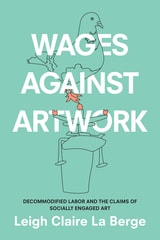
Wages Against Artwork
Decommodified Labor and the Claims of Socially Engaged ArtLeigh Claire La Berge
Duke University Press, 2019
Ways of Seeing After Dark
Kyle Parry
University of Minnesota Press, 2026
Rethinking darkness through the politics and possibilities of vision
Darkness is widely misunderstood, argues Kyle Parry. We take darkness as the enemy of sight, yet we can’t see without it. We call the worst parts of our lives dark, yet we wouldn’t be here without wombs, skulls, oceans, the moon, and other shadowed places. Ways of Seeing After Dark contends that darkness is not absence but presence, shaping how worlds are sensed, inhabited, and understood. Darkness brings peril, but it is also a fundamental, if increasingly threatened, condition of living together on this planet.
Tracing links between John Berger’s influential Ways of Seeing and his more poetic later writings, Parry recasts contemporary conditions defined by light pollution, digital mediation, and racialized regimes of seeing. In dialogue with artists, critics, and astronomers, Ways of Seeing After Dark examines how fear of darkness is built rather than universal and how such training intersects with broader social structures, including racism and capitalism. Showing how “felt darkness displaces physical darkness” and “brighter nights bring darker days,” Parry reveals the dark as a multifaceted phenomenon with political and perceptual significance, calling for new ways of seeing with and through the night.
Retail e-book files for this title are screen-reader friendly.
Westkunst, 1981
A Historiography of Modernism ExhibitedEdited by Mathilde Arnoux and Maria Bremer
Diaphanes, 2025
In 1981, the Cologne trade-fair center hosted a large exhibition titled Westkunst: Zeitgenössische Kunst seit 1939 (Western Art: Contemporary Art since 1939). Organized by art critic Laszlo Glozer and curator Kasper König, the Western-centric survey highlighted avant-garde art and politically charged themes of freedom and individual expression. By examining Westkunst’s historiographical stakes in light of the Iron Curtain division of Europe, the show is revealed as paradigmatic of the ways in which hegemonic concepts of Western art and the accompanying processes of othering were fashioned in the art world.
In this collective volume, Westkunst’s universalizing claims are scrutinized by focusing on the artistic tendencies exhibited; on exhibitionary discourses and practices of decontextualization, comparison, and appropriation; on the alleged realization of the values of progress, freedom, and autonomy; on the enacted conceptions of temporality and the architectural devices of narrativization; and on the exhibition’s blind spots and exclusions and the critical reactions it elicited. This analytic output makes fresh use of the archival materials, which are neither centralized nor systematized, with significant excerpts republished throughout the book.
Seen through the lens of exhibition history, this revisiting of Westkunst sheds light on a broader trend of cultural conservatism that was gaining strength in the 1980s, just before the end of the Cold War and the start of new forms of globalization.
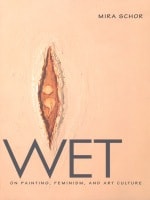
Wet
On Painting, Feminism, and Art CultureMira Schor
Duke University Press, 1997
Bridging the gap between art practice, artwork, and critical theory, Wet includes some of Schor’s most influential essays that have made a significant contribution to debates over essentialism. Articles range from discussions of contemporary women artists Ida Applebroog, Mary Kelly, and the Guerrilla Girls, to "Figure/Ground," an examination of utopian modernism’s fear of the "goo" of painting and femininity. From the provocative "Representations of the Penis," which suggests novel readings of familiar images of masculinity and introduces new ones, to "Appropriated Sexuality," a trenchant analysis of David Salle’s depiction of women, Wet is a fascinating and informative collection.
Complemented by over twenty illustrations, the essays in Wet reveal Schor’s remarkable ability to see and to make others see art in a radically new light.
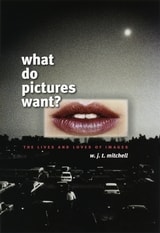
What Do Pictures Want?
The Lives and Loves of ImagesW. J. T. Mitchell
University of Chicago Press, 2005
According to W. J. T. Mitchell, we need to reckon with images not just as inert objects that convey meaning but as animated beings with desires, needs, appetites, demands, and drives of their own. What Do Pictures Want? explores this idea and highlights Mitchell's innovative and profoundly influential thinking on picture theory and the lives and loves of images. Ranging across the visual arts, literature, and mass media, Mitchell applies characteristically brilliant and wry analyses to Byzantine icons and cyberpunk films, racial stereotypes and public monuments, ancient idols and modern clones, offensive images and found objects, American photography and aboriginal painting. Opening new vistas in iconology and the emergent field of visual culture, he also considers the importance of Dolly the Sheep—who, as a clone, fulfills the ancient dream of creating a living image—and the destruction of the World Trade Center on 9/11, which, among other things, signifies a new and virulent form of iconoclasm.
What Do Pictures Want? offers an immensely rich and suggestive account of the interplay between the visible and the readable. A work by one of our leading theorists of visual representation, it will be a touchstone for art historians, literary critics, anthropologists, and philosophers alike.
What Happened to Art Criticism?
James Elkins
Prickly Paradigm Press, 2003
"In What Happened to Art Criticism?, art historian James Elkins sounds the alarm about the perilous state of that craft, which he believes is 'In worldwide crisis . . . dissolving into the background clutter of ephemeral cultural criticism' even as more and more people are doing it. 'It's dying, but it's everywhere . . . massively produced, and massively ignored.' Those who pay attention to other sorts of criticism may recognize the problems Elkins describes: 'Local judgments are preferred to wider ones, and recently judgments themselves have even come to seem inappropriate. In their place critics proffer informal opinions or transitory thoughts, and they shy from strong commitments.' What he'd like to see more of: ambitious judgment, reflection about judgment itself, and 'criticism important enough to count as history, and vice versa.' Amen to that."—Jennifer Howard, Washington Post Book World
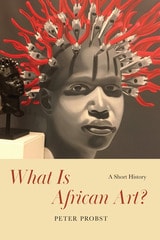
What Is African Art?
A Short HistoryPeter Probst
University of Chicago Press, 2022
This book examines the invention and development of African art as an art historical category. It starts with a simple question: What do we mean when we talk about African art? By confronting the historically shifting answers to this question, Peter Probst identifies “African art” as a conceptual vessel that manifests wider societal transformations.
What Is African Art? covers three key stages in the field’s history. Starting with the late nineteenth through the mid-twentieth centuries, the book first discusses the colonial formation of the field by focusing on the role of museums, collectors, and photography in disseminating visual cultures as relations of power. It then explores the remaking of the field at the dawn of African independence with the shift toward contemporary art and the rise of Black Atlantic studies in the 1970s and 1980s. Finally, it examines the post- and decolonial reconfiguration of the field driven by questions of representation, repair, and restitution.
What Is Art History?
Mark Roskill
University of Massachusetts Press, 1989
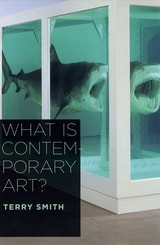
What Is Contemporary Art?
Terry Smith
University of Chicago Press, 2009
Who gets to say what counts as contemporary art? Artists, critics, curators, gallerists, auctioneers, collectors, or the public? Revealing how all of these groups have shaped today’s multifaceted definition, Terry Smith brilliantly shows that an historical approach offers the best answer to the question: What is Contemporary Art?
Smith argues that the most recognizable kind is characterized by a return to mainstream modernism in the work of such artists as Richard Serra and Gerhard Richter, as well as the retro-sensationalism of figures like Damien Hirst and Takashi Murakami. At the same time, Smith reveals, postcolonial artists are engaged in a different kind of practice: one that builds on local concerns and tackles questions of identity, history, and globalization. A younger generation embodies yet a third approach to contemporaneity by investigating time, place, mediation, and ethics through small-scale, closely connective art making. Inviting readers into these diverse yet overlapping art worlds, Smith offers a behind-the-scenes introduction to the institutions, the personalities, the biennials, and of course the works that together are defining the contemporary. The resulting map of where art is now illuminates not only where it has been but also where it is going.
What Philosophy Wants from Images
D. N. Rodowick
University of Chicago Press, 2017
Rodowick here explores work by artists such as Ken Jacobs, Ernie Gehr, Victor Burgin, Harun Farocki, and others—artists who are creating forms that express a new historical consciousness of images. These forms acknowledge a complex relationship to the disappearing past even as they point toward new media that will challenge viewers’ confidence in what the images they see are or are becoming. What philosophy wants from images, Rodowick shows, is to renew itself conceptually through deep engagement with new forms of aesthetic experience.
What We Made
Conversations on Art and Social CooperationTom Finkelpearl
Duke University Press, 2013
Interviewees. Naomi Beckwith, Claire Bishop, Tania Bruguera, Brett Cook, Teddy Cruz, Jay Dykeman, Wendy Ewald, Sondra Farganis, Harrell Fletcher, David Henry, Gregg Horowitz, Grant Kester, Mierle Laderman Ukeles, Pedro Lasch, Rick Lowe, Daniel Martinez, Lee Mingwei, Jonah Peretti, Ernesto Pujol, Evan Roth, Ethan Seltzer, and Mark Stern
What is Contemporary Art?
Alexander García Düttmann
Diaphanes, 2019

Where Is the Light Coming From
Essays on Art and Regular PeopleDan Kois
Duke University Press, 2027
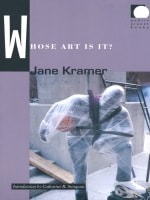
Whose Art Is It?
Jane Kramer
Duke University Press, 1994
This compelling narrative raises questions about community and public art policies, about stereotypes and multiculturalism. With wit, drama, sympathy, and circumspection, Kramer draws the reader into the multicultural debate, challenging our assumptions about art, image, and their relation to community. Her portrait of the South Bronx takes the argument to its grass roots—provocative, surprising in its contradictions and complexities and not at all easy to resolve.
Accompanied by an introduction by Catharine R. Stimpson exploring the issues of artistic freedom, "political correctness," and multiculturalism, Whose Art Is It? is a lively and accessible introduction to the ongoing debate on representation and private expression in the public sphere.
Without Model
Parva AestheticaTheodor W. Adorno
Seagull Books, 2023
Essays by Theodor W. Adorno on art and cinema.
In Without Model, Theodor W. Adorno strikingly demonstrates the intellectual range for which he is known. Taking the premise of the title as his guiding principle, that artistic and philosophical thought must eschew preconceptions and instead adapt itself to its time, circumstances, and object, Adorno presents a series of essays reflecting on culture at different levels, from the details of individual products to the social conditions of their production. He shows his more nostalgic side in the childhood reminiscences of ‘Amorbach’, but also his acute sociocultural analysis of the central topic of the culture industry. He criticizes attempts to maintain tradition in music and visual art, arguing against a restorative approach by stressing the modernity and individuality of historical works in the context of their time. In all of these essays, available for the first time in English, Adorno displays the remarkable thinking of one both steeped in tradition and dedicated to seeing beyond it.
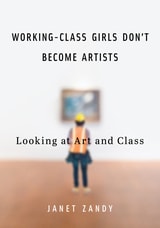
Working-Class Girls Don’t Become Artists
Looking at Art and ClassJanet Zandy
University of Illinois Press, 2026
Ambitious and original, Working-Class Girls Don’t Become Artists rewrites art history from a working-class perspective.
Worlds of Appearance
An Introduction to Aesthetics in PracticeWalead Beshty
University of Chicago Press, 2026
An accessible primer on aesthetics in art and everyday life, written by artist and scholar Walead Beshty.
In this general guide to the foundations of aesthetics, Walead Beshty introduces the complexities of aesthetics through succinct language and real-world examples, presenting an introductory theory of how the world becomes known to us through our senses and how that knowledge in turn builds our experience of everything around us.
Considering aesthetics on both a practical and a theoretical level, Worlds of Appearance asserts that art and aesthetics are inherently political, composing a fundamental form of communication and a means by which we can imagine the very nature of what can be experienced, sensed, and expressed. Aesthetics, argues Beshty, is a corporeal and material area of study, one that reveals how we perceive the world and how we develop technologies in response. With this book, he aims to fill a gap in existing writing about aesthetics, offering a clear explanation of how it acts as a dynamic force in our daily lives, how it functions on a concrete level, and how we can understand its possibilities.
Beginning with how we transform a flood of sensations into a coherent perception of the world, the book considers the basics of aesthetic production and reception, then moves on to look at specific examples of aesthetics in practice, with a focus on art, architecture, and performance. It concludes by laying out how aesthetic literacy is key to understanding the production of wide-ranging aspects of our lives, including digitization, mass media, systems of communications, and power relations.
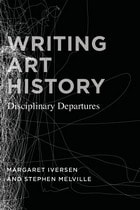
Writing Art History
Disciplinary DeparturesMargaret Iversen and Stephen Melville
University of Chicago Press, 2010
Faced with an increasingly media-saturated, globalized culture, art historians have begun to ask themselves challenging and provocative questions about the nature of their discipline. Why did the history of art come into being? Is it now in danger of slipping into obsolescence? And, if so, should we care?
In Writing Art History, Margaret Iversen and Stephen Melville address these questions by exploring some assumptions at the discipline’s foundation. Their project is to excavate the lost continuities between philosophical aesthetics, contemporary theory, and art history through close readings of figures as various as Michael Baxandall, Martin Heidegger, Jacques Lacan, and Alois Riegl. Ultimately, the authors propose that we might reframe the questions concerning art history by asking what kind of writing might help the discipline to better imagine its actual practices—and its potential futures.