Results by title
63 books match the query 'Detroit' and 3 start with w

Walter Reuther
THE MOST DANGEROUS MAN IN DETROITNelson Lichtenstein
University of Illinois Press, 1995
Supported by The Walter and May Reuther Memorial Fund
Previously published by Basic Books as The Most Dangerous Man in Detroit: Walter Reuther and the Fate of American Labor
Previously published by Basic Books as The Most Dangerous Man in Detroit: Walter Reuther and the Fate of American Labor
[more]

Waterfront Porch
Reclaiming Detroit's Industrial Waterfront as a Gathering Place for AllJohn H. Hartig
Michigan State University Press, 2019
Detroit was the epicenter of the fur trade era, an unparalleled leader of shipbuilding for one hundred years, the Silicon Valley of the industrial age, and the unquestioned leader of the arsenal of democracy. This unique history depicts Detroit as a city of innovation, resilience, and leadership in responding to change, and examines the current sustainability paradigm shift to which Detroit is responding, pivoting as the city has done in the past to redefine itself and lead the nation and world down a more sustainable path. This book details the building of a new waterfront porch alongside the Detroit River called the Detroit RiverWalk to help revitalize the city and region and promote sustainability practices. It is a story of one of the largest, by scale, urban waterfront redevelopment projects in the United States, and gives hope and proves that Detroit and its metropolitan region have a bright future.
[more]
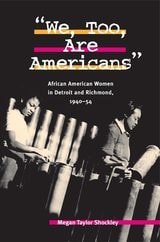
We, Too, Are Americans
African American Women in Detroit and Richmond, 1940-54Megan Taylor Shockley
University of Illinois Press, 2003
During World War II, factories across America retooled for wartime production, and unprecedented labor opportunities opened up for women and minorities. In We, Too, Are Americans, Megan Taylor Shockley examines the experiences of the African American women who worked in two capitols of industry--Detroit, Michigan, and Richmond, Virginia--during the war and the decade that followed it, making a compelling case for viewing World War II as the crucible of the civil rights movement.
As demands on them intensified, the women working to provide American troops with clothing, medical supplies, and other services became increasingly aware of their key role in the war effort. A considerable number of the African Americans among them began to use their indispensability to leverage demands for equal employment, welfare and citizenship benefits, fair treatment, good working conditions, and other considerations previously denied them.
Shockley shows that as these women strove to redefine citizenship, backing up their claims to equality with lawsuits, sit-ins, and other forms of activism, they were forging tools that civil rights activists would continue to use in the years to come.
[more]