429 books match the query 'Development' and 8 start with w
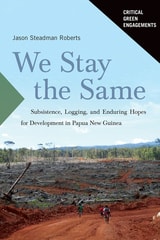
cover of We Stay the Same: Subsistence, Logging, and Enduring Hopes for Development in Papua New Guinea

We Stay the Same

Subsistence, Logging, and Enduring Hopes for Development in Papua New Guinea

Jason Steadman Roberts

University of Arizona Press, 2024

On a remote island in the South Pacific, the Lavongai have consistently struggled to obtain development through logging and commercial agriculture. Yet many Lavongai still long to move beyond the grind of subsistence work that has seemingly defined their lives on New Hanover, Papua New Guinea, for generations.

Following a long history of smaller-scale and largely unsuccessful resource development efforts, New Hanover became the site of three multinational-controlled special agricultural and business leases (SABLs) that combined to cover over 75 percent of the island for ninety-nine-year lease terms. These agroforestry projects were part of a national effort to encourage “sustainable” rural development by tapping into the growing global demand for agricultural lands and crops like oil palm and biofuels. They were supposed to succeed where the smaller-scale projects of the past had failed. Unfortunately, these SABLs resulted in significant forest loss and livelihood degradation, while doing little to promote the type of economic development that many Lavongai had been hoping for.

It is within this context that We Stay the Same grounds questions of hope for transformative economic change within Lavongai assessments of the inequitable relationships between global processes of resource development and the local lives that have become increasingly defined by the necessities and failures of these processes. Written in a clear and relatable style for students, We Stay the Same combines ethnographic and ecological research to show how the Lavongai continue to survive and make meaningful lives in a situation where their own hopes for a better future have often been used against them as a mechanism of a more distantly profitable dispossession.
 
[more]
cover of Wealth Accumulation and Communities of Color in the United States: Current Issues

Wealth Accumulation and Communities of Color in the United States

Current Issues

Jessica Gordon Nembhard and Ngina Chiteji, Editors

University of Michigan Press, 2010

"Congratulations to Drs. Nembhard and Chiteji and the authors included in this much needed volume of work! Their book offers the perspective and insight of scholars of color that are too often missing from information produced by the asset building field (people and organizations seeking to help low-income people develop assets). Communities served by the asset building field are disproportionately made up of people of color. This book captures work produced by scholars representing these communities and offers innovative and thought provoking analyses of wealth inequality. Decision-making on research, policy, and practice that fails to incorporate the knowledge of these and other asset accumulation experts of color runs the risk of being fatally flawed and irrelevant to the communities the asset building field intends to serve."
--Kilolo Kijakazi, Ph.D., The Ford Foundation

"An important contribution to the economics literature on wealth and to our understanding of racial and ethnic inequality. This book adds to our knowledge and understanding of the wealth positions of Latinos, Asian Americans, Hawaiians, and Native Americans and places this information in the context of black-white wealth inequality."
--Cecilia A. Conrad, Department of Economics, Pomona College
"This book does an outstanding job of introducing readers to a host of interesting questions related to racial and ethnic minority status and wealth composition and accumulation. The chapters on wealth accumulation among Native Americans, Latinos, and Asian Americans offer one of the few places where this information is readily available. The recent disaster in New Orleans has shown the nation that there is a strong interaction between wealth, race, and social outcomes. This book not only fills a void in understanding the black-white wealth inequality that was apparent after Hurricane Katrina, but it also provides great insight into the wealth status of other racial and ethnic minorities."
--Patrick L. Mason, Department of Economics, Florida State University

"This edited volume takes up an important, indeed, fundamental, topic, bringing together leading scholars to assess wealth accumulation among people of color. No other book or research report covers as many groups of color as appear in this volume, devoting chapters to African Americans, Latinos, Native Americans, Asian Americans, and Native Hawaiians. The result is a noteworthy achievement." --Michael Sherraden, Benjamin E. Youngdahl Professor of Social Development, Washington University in St. Louis

Jessica Gordon Nembhard is Assistant Professor and Economist, African American Studies Department, and co-founder of the Democracy Collaborative at the University of Maryland, College Park. Her work on the history of black cooperatives is well known in progressive circles.


Ngina Chiteji is Associate Professor of Economics, Skidmore College. She was a Visiting Assistant Research Scholar at The Democracy Collaborative, University of Maryland, College Park.
[more]
cover of Weaving a Fabric of Unity: Conversations on Education and Development

Weaving a Fabric of Unity

Conversations on Education and Development

Haleh Arbab

West Virginia University Press, 2024
Weaving a Fabric of Unity shares the story of FUNDAEC (the Foundation for the Application and Teaching of Science), a non-governmental organization found in Cali, Colombia in 1974, and highlights five decades of stories, learning, and insight from key individuals central to shaping its evolution. The book outlines FUNDAEC’s unique conceptual and methodological approach, which is focused on the releasing of human potentialities and the integration of theory and practice so that a population may carry out action and research related to its social, economic, and cultural life. Weaving a Fabric of Unity brings the reader on the journey of how the organization created one of Latin America’s most innovative curricula in rural development. It shares how FUNDAEC’s focus on raising up individuals and communities dedicated to the promotion of community wellbeing supported its efforts to organically scale over the last few decades. The program now reaches hundreds of thousands of students across Colombia, and is being adopted in over a dozen countries to support diverse populations working towards the collective realization of a dignified future.
[more]
cover of Wellbeing Economics: How and Why Economics Needs to Change

Wellbeing Economics

How and Why Economics Needs to Change

Nicky Pouw

Amsterdam University Press, 2020

Amidst rising global inequality, migration, climate change, health pandemics, and deepening poverty, it is time to redirect our economy towards more sustainable and socially just processes and outcomes.

In 'Wellbeing Economics' Nicky Pouw puts forward a new framework that places human wellbeing at the centre, instead of economic growth. She postulates ten reasons why economics should change to remain a relevant discipline and develops a Wellbeing Economic Matrix (WEM) to implement this approach. In doing so, it is one of the first economics books that 'rethinks the economy' from head to tail.
[more]
cover of When Women Have Wings: Feminism and Development in Medellin, Colombia

When Women Have Wings

Feminism and Development in Medellin, Colombia

Donna F. Murdock

University of Michigan Press, 2008
In When Women Have Wings, Donna F. Murdock provides an insightful and detailed look at the tensions, contradictions, and positive moments apparent in a women's development project in Medellín, Colombia. Based on sixteen months of ethnographic field research in a working-class women's community center run by a local feminist NGO, this in-depth account illuminates both working- and middle-class women's perspectives on the professionalization of feminist NGOs and provides an unusual ethnographic lens on the process as it unfolds. Using detailed descriptions of the encounters between working- and middle-class women to highlight how the women's center attempts to negotiate the pressures of feminism and professionalization, Murdock depicts the frailty and complexity of cross-class organizing and the ways that this process may be threatened by professionalized NGO styles. Poignant accounts of women's attempts to navigate these challenges amid poverty and civil war show how changing political and economic demands may ultimately compromise feminist NGOs' long-held commitments to sustainable development practice focused on grassroots empowerment. With its clear and vivid style, When Women Have Wings fills a gap for scholars of feminist development, professionalized feminist NGOs, grassroots democracy, and Latin American women's movements and will contribute much-needed insight into the everyday workings of the problems of professionalization and democratic development. "By offering a fine-grained, engaging and provocative account of the workings of feminist nongovernmental organizations and their working-class women constituencies, When Women Have Wings fills a gaping lacuna in the now expansive literature on women's movements in the Global South." -- Sonia E. Alvarez, Department of Political Sciences, University of Massachusetts-Amherst "Donna Murdock's in-depth ethnographic account will be an important contribution to the literature on women's movements, Latin American feminisms, and gender identity politics in the context of neoliberalism and political violence." -- Amy Lind, Department of Women's Studies, University of Cincinnati "This remarkable book, full of ethnographic detail and lucid analysis, tells a compelling story of feminist struggles with neoliberalism in Latin America. Murdock takes us into the lives and struggles of working-class women and their feminist allies, illustrating how class divides are painfully exacerbated by shrinking state budgets, rising requirements for citizenship, and the professionalization of social movements. She nonetheless leaves us with the 'fragile wings of hope,' grounded in women's ongoing efforts to confront violence and make their voices heard in the face of difficult odds. This is important reading for feminists, scholars of development, and those concerned with global justice." -- Millie Thayer, Department of Sociology, University of Massachusetts-Amherst
[more]
cover of Winged Defense: The Development and Possibilities of Modern Air Power--Economic and Military

Winged Defense

The Development and Possibilities of Modern Air Power--Economic and Military

William "Billy" Mitchell, with a new foreword by Robert S. Ehlers Jr.

University of Alabama Press, 2009

This book is the basis for airpower doctrine in the US, and demonstrates  how forward looking Gen Mitchell was even though the technology for conducting air operations was in its infancy  when it was written.  It is essential reading for anyone concerned with airpower history or aerospace doctrine.

William Lendrum "Billy" Mitchell (December 28, 1879 – February 19, 1936) was an American Army general who is regarded as the father of the U.S. Air Force, and is one of the most famous and most controversial figures in the history of American airpower.

Mitchell served in France during the First World War and, by the conflict's end, commanded all American air combat units in that country. After the war, he was appointed deputy director of the Air Service and began to advocate  increased investment in air power, claiming this would prove vital in future wars. He particularly stressed the ability of bombers to sink battleships and organized a series of dramatic bombing runs against stationary ships designed to test the idea that attracted wide notice from the public.

He antagonized many  in both the Army and Navy with his arguments and criticism and, in 1925, was demoted to Colonel. Later that year, he was court-martialed for insubordination after accusing military chiefs of an "almost treasonable administration of the national defense." He resigned from the service shortly thereafter.

Mitchell received many honors following his death, including a commission by the President as a Major General. He is also the only individual after whom a type of American military aircraft is named: the B-25 "Mitchell."

[more]
cover of Witnessing Slavery: The Development Of Ante-Bellum Slave Narratives

Witnessing Slavery

The Development Of Ante-Bellum Slave Narratives

Frances Smith Foster

University of Wisconsin Press, 1994
Frances Foster's classic study of pre-Civil War American slave autobiography is now issued in an accessible paperback edition. The first book to represent these slave narratives as literary in the complete sense of the word, and the first study to call attention to the significance of gender in the narratives, Witnessing Slavery will be welcomed by both general readers and students of the American south, slavery, the Civil War, and race issues.
[more]
cover of Women and Public Life in Early Meiji Japan: The Development of the Feminist Movement

Women and Public Life in Early Meiji Japan

The Development of the Feminist Movement

Mara Patessio

University of Michigan Press, 2011

Women and Public Life in Early Meiji Japan focuses on women’s activities in the new public spaces of Meiji Japan. With chapters on public, private, and missionary schools for girls, their students, and teachers, on social and political groups women created, on female employment, and on women’s participation in print media, this book offers a new perspective on nineteenth- and early twentieth-century Japanese history. Women’s founding of and participation in conflicting discourses over the value of women in Meiji public life demonstrate that during this period active and vocal women were everywhere, that they did not meekly submit to the dictates of the government and intellectuals over what women could or should do, and that they were fully integrated in the production of Meiji culture.
Mara Patessio shows that the study of women is fundamental not only in order to understand fully the transformations of the Meiji period, but also to understand how later generations of women could successfully move the battle forward. Women and Public Life in Early Meiji Japan is essential reading for all students and teachers of 19th- and early 20th-century Japanese history and is of interest to scholars of women’s history more generally.
[more]