Results by title
436 books match the query 'Disability' and 12 start with w

We Can't Wait
Disability Practices NowMichele Ilana Friedner
University of Minnesota Press, 2027
How disabled people and those around them create inhabitable worlds in an ableist present
In the rush to build a better tomorrow, disability rights advocates often focus their energies on planning for a more inclusive future while critiquing today’s inaccessible society. In We Can’t Wait, Michele Ilana Friedner instead offers a new lens on the current daily acts of worldmaking performed by disabled people, their kin, and nondisabled allies, attending to the joys and complexities that arise within these spaces.
Examining three educational sites in India—a foundation-run school for intellectually disabled children, the complex relationship between a college’s sign language interpreter and the students she works with, and abundant disabled student activism at a university—Friedner’s vivid ethnographic analysis bears witness to the physical, cognitive, and emotional labor with which disabled people and their social circles build inhabitable worlds as they are made to wait for an accessible feature that may never arrive. This practice of antiabandonment distributes agency throughout these communities and stretches social worlds in crucial ways.
Drawing from Alice Wong’s proclamation that disabled people are oracles of our collective futures, We Can’t Wait uplifts affirming approaches to today’s world in which no one is left behind and disabled ways of being can thrive—a care that is needed now, without delay.
Retail e-book files for this title are screen-reader friendly.
What Had Happened Was
Therí Alyce Pickens
Duke University Press, 2025

What We Have Done
An Oral History of the Disability Rights MovementFred Pelka
University of Massachusetts Press, 2012
“Nothing about us without us” has been a core principle of American disability rights activists for more than half a century. It represents a response by people with disabilities to being treated with scorn and abuse or as objects of pity, and to having the most fundamental decisions relating to their lives—where they would live; if and how they would be educated; if they would be allowed to marry or have families; indeed, if they would be permitted to live at all—made by those who were, in the parlance of the movement, “temporarily able-bodied.”
In What We Have Done: An Oral History of the Disability Rights Movement, Fred Pelka takes that slogan at face value. He presents the voices of disability rights activists who, in the period from 1950 to 1990, transformed how society views people with disabilities, and recounts how the various streams of the movement came together to push through the Americans with Disabilities Act of 1990, the most sweeping civil rights legislation since passage of the Civil Rights Act of 1964. Beginning with the stories of those who grew up with disabilities in the 1940s and '50s, the book traces how disability came to be seen as a political issue, and how people with disabilities—often isolated, institutionalized, and marginalized—forged a movement analogous to the civil rights, women's rights, and gay rights movements, and fought for full and equal participation in American society.
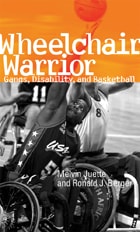
Wheelchair Warrior
Gangs, Disability, and BasketballMelvin Juette and Ronald J. Berger
Temple University Press, 2008
Melvin Juette has said that becoming paralyzed in a gang-related shooting was “both the worst and best thing that happened” to him. The incident, he believes, surely spared the then sixteen year-old African American from prison and/or an early death. It transformed him in other ways, too. He attended college and made wheelchair basketball his passion—ultimately becoming a star athlete and playing on the U.S. National Wheelchair Basketball Team.
In Wheelchair Warrior, Juette reconstructs the defining moments of his life with the assistance of sociologist Ronald Berger. His poignant memoir is bracketed by Berger’s thoughtful introduction and conclusion, which places this narrative of race, class, masculinity and identity into proper sociological context, showing how larger social structural forces defined his experiences. While Juette’s story never gives into despair, it does challenge the idea of the “supercrip.”

When I Am Dead
The Writings of George M. TeegardenRaymond Luczak
Gallaudet University Press, 2007
The Sixth Volume in the Gallaudet Classics in Deaf Studies Series
George M. Teegarden (1852-1936) taught at the Western Pennsylvania School for the Deaf for 48 years, established the printing department, and also served as the first editor of the school’s magazine. Despite these significant contributions, his greatest gift to deaf people was his skill as a writer and poet who was deaf, as readers will discover in When I Am Dead: The Writings of George M. Teegarden.
Editor Raymond Luczak selected Teegarden’s prose in When I Am Dead from several books, including Raindrop, and Stories, Old and New. Noting that these stories were never written for hearing readers, Luczak marvels at Teegarden’s ability to write English prose that the ASL-familiar reader would find incredibly easy to transliterate. By employing a rich blend of original stories and revisions of fables and myths, Teegarden taught his students the importance of improving their reading and writing skills to outfit them “for the battle of life.” He produced a body of work that Luczak characterizes as “a breath of fresh air: quick, painless, and usually told with a sense of wonder.”
Luczak’s choice of poems came from Teegarden’s self-published volume Vagrant Verses, a summation of his affection for Gallaudet College, the Deaf community, and all deaf people. The eponymous poem “When I Am Dead” articulates concisely the beliefs that directed Teegarden’s life of service:
“When I am dead, I hope to be
Remembered—this is true—
Not for my wit or vanities
But what I did for you.”

When the Phone Rings, My Bed Shakes
The Memoirs of a Deaf DoctorPhilip Zazove
Gallaudet University Press, 1993
Born almost totally deaf, Philip Zazove has spent his entire life beating the odds first by excelling in public schools during an era when most deaf children went to special schools, then by aspiring to become a medical doctor. When the Phone Rings, My Bed Shakes is the remarkable story of his determination and achievement in realizing his dreams.
Despite his stellar record at Northwestern University, Zazove was rejected by a host of medical schools. This only caused him to press harder, which won him acceptance at Rutgers University. He transferred to Washington University in St. Louis where, again against all advice, he decided to specialize in family practice. In vignettes of his patients, some amusing, others moving, he reveals the dedication and humanity that have made him a respected and well-loved doctor. His story will inspire all who read it.
Who Will Care For Us?
Long-Term Care and the Long-Term WorkforcePaul Osterman
Russell Sage Foundation, 2017
Using national surveys, administrative data, and nearly 120 original interviews with workers, employers, advocates, and policymakers, Osterman finds that direct care workers are marginalized and often invisible in the health care system. While doctors and families alike agree that good home care aides and CNAs are crucial to the well-being of their patients, the workers report poverty-level wages, erratic schedules, exclusion from care teams, and frequent incidences of physical injury on the job. Direct care workers are also highly constrained by policies that specify what they are allowed to do on the job, and in some states are even prevented from simple tasks such as administering eye drops.
Osterman concludes that broadening the scope of care workers’ duties will simultaneously boost the quality of care for patients and lead to better jobs and higher wages. He proposes integrating home care aides and CNAs into larger medical teams and training them as “health coaches” who educate patients on concerns such as managing chronic conditions and transitioning out of hospitals. Osterman shows that restructuring direct care workers’ jobs, and providing the appropriate training, could lower health spending in the long term by reducing unnecessary emergency room and hospital visits, limiting the use of nursing homes, and lowering the rate of turnover among care workers.
As the Baby Boom generation ages, Who Will Care for Us? demonstrates the importance of restructuring the long-term care industry and establishing a new relationship between direct care workers, patients, and the medical system.
Why I Burned My Book
Paul Longmore
Temple University Press, 2003

Window Shopping with Helen Keller
Architecture and Disability in Modern CultureDavid Serlin
University of Chicago Press, 2025
Window Shopping with Helen Keller recovers a series of influential moments when architects and designers engaged the embodied experiences of people with disabilities. David Serlin reveals how people with sensory and physical impairments navigated urban spaces and helped to shape modern culture. Through four case studies—the lives of Joseph Merrick (aka “The Elephant Man”) and Helen Keller, the projects of the Works Progress Administration, and the design of the Illinois Regional Library for the Blind and Physically Handicapped—Serlin offers a new history of modernity’s entanglements with disability.
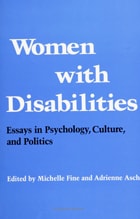
Women with Disabilities
Essays in Psychology, Culture, and Politicsedited by Michelle Fine and Adrienne Asch
Temple University Press, 1989
Women with disabilities are women first, sharing the dreams and disappointments common to women in a male-dominated society. But because society persists in viewing disability as an emblem of passivity and incompetence, disabled women occupy a devalued status in the social hierarchy. This book represents the intersection of the feminist and disability rights perspectives; it analyzes the forces that push disabled women towards the margins of social life, and it considers the resources that enable these women to resist the stereotype.
Drawing on law, social science, folklore, literature, psychoanalytic theory, and political activism, this book describes the experience of women with disabilities. The essays consider the impact of social class, race, the age at which disability occurs, and sexual orientation on the disabled woman's self esteem as well as on her life options. The contributors focus their inquiry on the self perceptions of disabled women and ask: From what sources do these women draw positive self images? How do they resist the culture's power to label them as deviant? The essays describe the ways in which disabled women face discrimination in the workplace and the failure of the mainstream women's movement to address their concerns.
In the series Health, Society, and Policy, edited by Sheryl Ruzek and Irving Kenneth Zola.
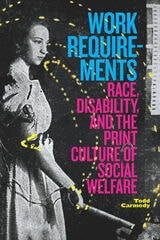
Work Requirements
Race, Disability, and the Print Culture of Social WelfareTodd Carmody
Duke University Press, 2022
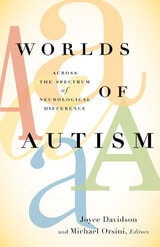
Worlds of Autism
Across the Spectrum of Neurological DifferenceJoyce Davidson
University of Minnesota Press, 2013
Since first being identified as a distinct psychiatric disorder in 1943, autism has been steeped in contestation and controversy. Present-day skirmishes over the potential causes of autism, how or even if it should be treated, and the place of Asperger’s syndrome on the autism spectrum are the subjects of intense debate in the research community, in the media, and among those with autism and their families. Bringing together innovative work on autism by international scholars in the social sciences and humanities, Worlds of Autism boldly challenges the deficit narrative prevalent in both popular and scientific accounts of autism spectrum disorders, instead situating autism within an abilities framework that respects the complex personhood of individuals with autism.
A major contribution to the emerging, interdisciplinary field of critical autism studies, this book is methodologically and conceptually broad. Its authors explore the philosophical questions raised by autism, such as how it complicates neurotypical understandings of personhood; grapple with the politics that inform autism research, treatment, and care; investigate the diagnosis of autism and the recognition of difference; and assess representations of autism and stories told by and about those with autism.
From empathy, social circles, and Internet communities to biopolitics, genetics, and diagnoses, Worlds of Autism features a range of perspectives on autistic subjectivities and the politics of cognitive difference, confronting society’s assumptions about those with autism and the characterization of autism as a disability.
Contributors: Dana Lee Baker, Washington State U; Beatrice Bonniau, Paris Descartes U; Charlotte Brownlow, U of Southern Queensland, Australia; Kristin Bumiller, Amherst College; Brigitte Chamak, Paris Descartes U; Kristina Chew, Saint Peter’s U, New Jersey; Patrick McDonagh, Concordia U, Montreal; Stuart Murray, U of Leeds; Majia Holmer Nadesan, Arizona State U; Christina Nicolaidis, Portland State U; Lindsay O'Dell, Open U, London; Francisco Ortega, State U of Rio de Janeiro; Mark Osteen, Loyola U, Maryland; Dawn Eddings Prince; Dora Raymaker; Sara Ryan, U of Oxford; Lila Walsh.