Results by title
679 books match the query 'Ecology' and 23 start with w
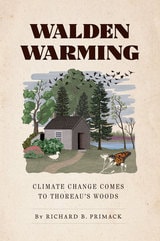
Walden Warming
Climate Change Comes to Thoreau's WoodsRichard B. Primack
University of Chicago Press, 2014
In Walden Warming, Richard B. Primack uses Thoreau and Walden, icons of the conservation movement, to track the effects of a warming climate on Concord’s plants and animals. Under the attentive eyes of Primack, the notes that Thoreau made years ago are transformed from charming observations into scientific data sets. Primack finds that many wildflower species that Thoreau observed—including familiar groups such as irises, asters, and lilies—have declined in abundance or have disappeared from Concord. Primack also describes how warming temperatures have altered other aspects of Thoreau’s Concord, from the dates when ice departs from Walden Pond in late winter, to the arrival of birds in the spring, to the populations of fish, salamanders, and butterflies that live in the woodlands, river meadows, and ponds.
Primack demonstrates that climate change is already here, and it is affecting not just Walden Pond but many other places in Concord and the surrounding region. Although we need to continue pressuring our political leaders to take action, Primack urges us each to heed the advice Thoreau offers in Walden: to “live simply and wisely.” In the process, we can each minimize our own contributions to our warming climate.
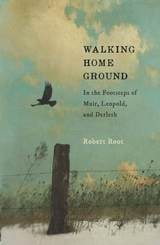
Walking Home Ground
In the Footsteps of Muir, Leopold, and DerlethRobert Root
Wisconsin Historical Society Press, 2017
When longtime author Robert Root moves to a small town in southeast Wisconsin, he gets to know his new home by walking the same terrain traveled by three Wisconsin luminaries who were deeply rooted in place—John Muir, Aldo Leopold, and August Derleth. Root walks with Muir at John Muir State Natural Area, with Leopold at the Shack, and with Derleth in Sac Prairie; closer to home, he traverses the Ice Age Trail, often guided by such figures as pioneering scientist Increase Lapham. Along the way, Root investigates the changes to the natural landscape over nearly two centuries, and he chronicles his own transition from someone on unfamiliar terrain to someone secure on his home ground.In prose that is at turns introspective and haunting, Walking Home Ground inspires us to see history’s echo all around us: the parking lot that once was forest; the city that once was glacier. "Perhaps this book is an invitation to walk home ground," Root tells us. "Perhaps, too, it’s a time capsule, a message in a bottle from someone given to looking over his shoulder even as he tries to examine the ground beneath his feet."
Wasted World
How Our Consumption Challenges the PlanetRob Hengeveld
University of Chicago Press, 2012
Water Wisdom
Preparing the Groundwork for Cooperative and Sustainable Water Management in the Middle EastAbed Rabbo, Alfred
Rutgers University Press, 2010
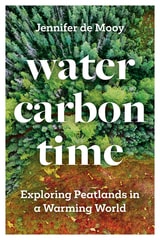
Water, Carbon, Time
Exploring Peatlands in a Warming WorldJennifer de Mooy
University of Minnesota Press, 2026
Revealing the hidden worlds of peatlands and their potential to fight climate change
Bogs, fens, mires, moors, muskegs, and pocosins—they are found in nearly all the world’s climatic zones but are easily overlooked in our landscapes. Yet these murky ecosystems formed of decay are both full of life and crucial to our planetary wellbeing: covering only about three percent of the earth’s surface, peatlands store more carbon than all the world’s forests combined. In Water, Carbon, Time, Jennifer de Mooy shares her personal discovery of these natural wonders in all their variety and understated beauty, bringing much-needed attention to the restorative possibilities of their spongy depths.
De Mooy first encountered peatlands on a trip to Ireland with her father, but her later work on climate change policy in the United States motivated her to investigate options for reducing greenhouse gases in the atmosphere. Her interest was practical: could peatlands combat global warming? To deepen her understanding of these unique wetlands, she embarked on a quest from bogs and fens in Minnesota and Maine to bofedales in Peru and muskegs in Canada and Alaska. A vivid account of her journey, Water, Carbon, Time describes these peatlands in all their richness and mystery: what they are and how to find them, the diversity of ecological life they support, and how their hidden systems promote climate resilience.
As she learns more about the importance of peatlands, de Mooy emphasizes all we lose when they are damaged by drainage, fire, and the broader sweep of climate change. When peatlands are threatened, we risk releasing stored carbon from their soil, where it has accumulated over millennia, into the atmosphere. In parts a travelogue, an ecological history, and a call to action, Water, Carbon, Time demonstrates there is still hope for these precious ecosystems—and their potential as a natural climate solution right beneath our feet.
Retail e-book files for this title are screen-reader friendly with images accompanied by short alt text and/or extended descriptions.
What Kind of Ancestor Do You Want to Be?
Edited by John Hausdoerffer, Brooke Parry Hecht, Melissa K. Nelson, and Katherine Kassouf Cummings
University of Chicago Press, 2021
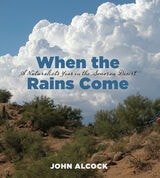
When the Rains Come
A Naturalist’s Year in the Sonoran DesertJohn Alcock
University of Arizona Press, 2009
John Alcock knows the Sonoran Desert better than just about anyone else, and in this book he tracks the changes he observes in plant and animal life over the course of a drought year. Combining scientific knowledge with years of exploring the desert, he describes the variety of ways in which the wait for rain takes place—and what happens when it finally comes.
The desert is a land of five seasons, featuring two summers—hot, dry months followed by monsoon—and Alcock looks at the changes that take place in an entire desert community over the course of all five. He describes what he finds on hikes in the Usery Mountains near Phoenix, where he has studied desert life over three decades and where frequent visits have enabled him to notice effects of seasonal variation that might escape a casual glance.
Blending a personal perspective with field observation, Alcock shows how desert ecology depends entirely on rainfall. He touches on a wide range of topics concerning the desert’s natural history, noting the response of saguaro flowers to heat and the habits of predators, whether soaring red-tailed hawk or tiny horned lizard. He also describes unusual aspects of insects that few desert hikers will have noticed, such as the disruptive color pattern of certain grasshoppers that is more effective than most camouflage.
When the Rains Come is brimming with new insights into the desert, from the mating behaviors of insects to urban sprawl, and features photographs that document changes in the landscape as drought years come and go. It brings us the desert in the harshest of times—and shows that it is still teeming with life.
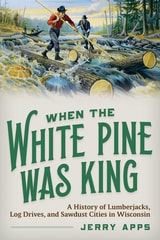
When the White Pine Was King
A History of Lumberjacks, Log Drives, and Sawdust Cities in WisconsinJerry Apps
Wisconsin Historical Society Press, 2020
For more than half a century, logging, lumber production, and affiliated enterprises in Wisconsin’s Northwoods provided jobs for tens of thousands of Wisconsinites and wealth for many individuals. The industry cut through the lives of nearly every Wisconsin citizen, from an immigrant lumberjack or camp cook in the Chippewa Valley to a Suamico sawmill operator, an Oshkosh factory worker to a Milwaukee banker.
When the White Pine Was King tells the stories of the heyday of logging: of lumberjacks and camp cooks, of river drives and deadly log jams, of sawmills and lumber towns and the echo of the ax ringing through the Northwoods as yet another white pine crashed to the ground. He explores the aftermath of the logging era, including efforts to farm the cutover (most of them doomed to fail), successful reforestation work, and the legacy of the lumber and wood products industries, which continue to fuel the state’s economy.
Enhanced with dozens of historic photos, When the White Pine Was King transports readers to the lumber boom era and reveals how the lessons learned in the vast northern forestlands continue to shape the region today.
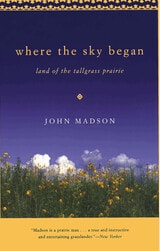
Where The Sky Began
Land of the Tallgrass PrairieJohn Madson
University of Iowa Press, 2004
Originally published in 1982, Where the Sky Began, John Madson’s landmark publication, introduced readers across the nation to the wonders of the tallgrass prairie, sparking the current interest in prairie restoration. Now back in print, this classic tome will serve as inspiration to those just learning about the heartland’s native landscape and rekindle the passion of long-time prairie enthusiasts.
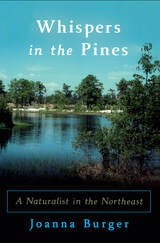
Whispers in the Pines
A Naturalist in the NortheastBurger, Joanna
Rutgers University Press, 2006
In this book, naturalist Joanna Burger takes us on a series of delightful trips through the Pine Barrens. From the Albany Pine Bush, the Long Island Barrens, and the New Jersey Pine Barrens in the Northeast, to the pinelands of South Carolina and Florida, Burger describes in lively detail how these habitats have come to harbor such a unique assemblage of species.
She introduces us to amphibians and reptiles, neotropical migrants and other birds, and a range of common and unusual mammals. Burger also traces the regions’ historic and geologic backgrounds, and the impact of human occupation from the time of the paleo-Indians to the present. She revisits the tension between development and preservation, reminding us that a healthy pine barren region requires uninterrupted land and rejuvenating fires, both of which are increasingly jeopardized.
Whispers in the Pines is essential reading for everyone concerned with the history and preservation of these unique landscapes and their wildlife.
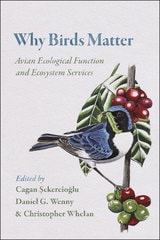
Why Birds Matter
Avian Ecological Function and Ecosystem ServicesEdited by Çagan H. Sekercioglu, Daniel G. Wenny, and Christopher J. Whelan
University of Chicago Press, 2016
The first book to approach ecosystem services from an ornithological perspective, Why Birds Matter asks what economic value we can ascribe to those services, if any, and how this value should inform conservation. Chapters explore the role of birds in such important ecological dynamics as scavenging, nutrient cycling, food chains, and plant-animal interactions—all seen through the lens of human well-being—to show that quantifying avian ecosystem services is crucial when formulating contemporary conservation strategies. Both elucidating challenges and providing examples of specific ecosystem valuations and guidance for calculation, the contributors propose that in order to advance avian conservation, we need to appeal not only to hearts and minds, but also to wallets.
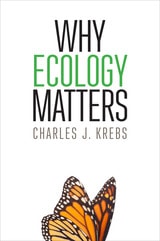
Why Ecology Matters
Charles J. Krebs
University of Chicago Press, 2016
Highlighting key principles in ecology—from species extinction to the sun’s role in powering ecosystems—each chapter introduces a general question, illustrates that question with real-world examples, and links it to pressing ecological issues in which humans play a central role, such as the spread of invasive species, climate change, overfishing, and biodiversity conservation. While other introductions to ecology are rooted in complex theory, math, or practice and relegate discussions of human environmental impacts and their societal implications to sidebars and appendices, Why Ecology Matters interweaves these important discussions throughout. It is a book rooted in our contemporary world, delving into ecological issues that are perennial, timeless, but could not be more timely.
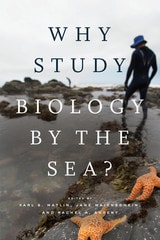
Why Study Biology by the Sea?
Edited by Karl S. Matlin, Jane Maienschein, and Rachel A. Ankeny
University of Chicago Press, 2020
From the Stazione Zoologica in Naples to the Marine Biological Laboratory in Woods Hole, the Amoy Station in China, or the Misaki Station in Japan, students and researchers at seaside research stations have long visited the ocean to investigate life at all stages of development and to convene discussions of biological discoveries. Exploring the history and current reasons for study by the sea, this book examines key people, institutions, research projects, organisms selected for study, and competing theories and interpretations of discoveries, and it considers different ways of understanding research, such as through research repertoires. A celebration of coastal marine research, Why Study Biology by the Sea? reveals why scientists have moved from the beach to the lab bench and back.
Wild Ideas
David Rothenberg
University of Minnesota Press, 1995
A new view of what’s “wild,” and a new path for environmentalism.
At the very heart of American respect for nature, historically and philosophically, is the notion of the wild. This notion comes under scrutiny in Wild Ideas, a collection of essays that bring a fresh and refreshing perspective to the wilderness paradoxically at the center of our civilization.
Blending well-known and new voices, the volume surveys classical and romantic concepts of wilderness, from the scary to the sublime, and shows why neither serves us anymore. Instead, the authors argue for a “wild culture,” in which nature is not opposed to humanity, a mere matter of resources and consumers. A cogent reassessment of the ideas that drive the conservation movement, Wild Ideas points out a new direction for future environmentalism.Among the topics discussed are the confluence of wilderness, empire, and race in the United States; the way the ecology movement uses language; gendered views of the wilderness; maps and topology, and how they affect our view of the wild; healing by the wilderness experience; and the idea of an urban wilderness. Contributors: David Abram; Douglas Buege, U of Wisconsin; Denis Cosgrove, U of London; Robert Greenway, Sonoma State U; Ed Grumbine, Sierra Institute; Marvin Henberg, Linfield College; Irene Klaver, Montana State U; Andrew Light, U of Alberta; Lois Lorentzen, U of San Francisco; Max Oelschlaeger, U of North Texas; R. Murray Schafer; Tom Wolf.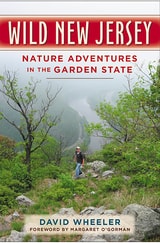
Wild New Jersey
Nature Adventures in the Garden StateDavid Wheeler
Rutgers University Press, 2011
Wild New Jersey invites readers along Wheeler’s whirlwind year-long tour of the most ecologically diverse state for its size in America. Along with the expert guidance of charismatic wildlife biologists and local conservationists, he explores mountains, valleys, beaches, pine barrens, caves, rivers, marshlands, and more—breathtaking landscapes and the state’s Noah’s Ark of fascinating creatures.
This isn’t your ordinary ride on the Jersey Turnpike. Fasten your seatbelts and join Wheeler as he . . .
- Kayaks through the Meadowlands under the watchful eye of the Empire State Building,
- Pans for cretaceous fossils in a hidden brook once home to mastodons and giant sloths,
- Rides a fishing boat in the frigid snows of winter on a high-seas quest for Atlantic puffins,
- Trudges through the eerie darkness of a bog on a mysterious night hike,
- Dogsleds across the windswept alpine slopes in the haunts of the porcupine and bobcat.
With Wheeler’s compelling narrative, in-depth background details, and eye for revealing the offbeat, you can count this as the first nature book to paint the extraordinary picture of New Jersey’s unlikely wilderness in all its glory. Come along for all the adventure and insight in Wild New Jersey!
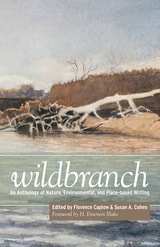
Wildbranch
An Anthology of Nature, Environmental, and Place-based WritingEdited by Florence Caplow and Susan A. Cohen. Foreword by H. Emerson Blake
University of Utah Press, 2010
Wildbranch: An Anthology of Nature, Environmental, and Place-based Writing is a powerful collection of mostly unpublished essays and poetry by both prominent American environmental writers and exciting new voices. The poetry and essays by more than fifty contributors offer the reader glimpses into places as diverse as a forest in West Africa, the moors of Ireland, the canyons of the Sonoran desert mountains, and the fields of New England, and they reflect the varied perspectives of field biologists, hunters, farmers, environmental educators, wilderness guides, academics, writers, and artists.
The collection is an intimate portrait of the natural world drawn through the wisdom, ecological consciousness, and open hearts of these exceptional contributors. The Wildbranch Writing Workshop, cosponsored by Orion magazine and Sterling College, has encouraged thoughtful natural history, outdoor, and environmental writing for more than twenty years. The Wildbranch faculty has included its founder E. Anne Proulx, the essayists Edward Hoagland, Janisse Ray, and Scott Russell Sanders, the poet Alison Hawthorne Deming, and many other notable authors. Many have work included in the anthology.
Winner of the New Mexico Book Association's Southwest Book Design & Production Awards for Excellence in the category Trade Books: Non-illustrated.
Wilderness Tapestry
An Eclectic Approach To PreservationVause Zeveloff
University of Nevada Press, 1992
To further understanding of the meanings and values of wilderness, this volume explores wilderness and its significance to humans from myriad viewpoints, based on a meeting of the North American Interdisciplinary Wilderness Conference.
Wildlife in the Anthropocene
Conservation after NatureJamie Lorimer
University of Minnesota Press, 2015
Elephants rarely breed in captivity and are not considered domesticated, yet they interact with people regularly and adapt to various environments. Too social and sagacious to be objects, too strange to be human, too captive to truly be wild, but too wild to be domesticated—where do elephants fall in our understanding of nature?
In Wildlife in the Anthropocene, Jamie Lorimer argues that the idea of nature as a pure and timeless place characterized by the absence of humans has come to an end. But life goes on. Wildlife inhabits everywhere and is on the move; Lorimer proposes the concept of wildlife as a replacement for nature. Offering a thorough appraisal of the Anthropocene—an era in which human actions affect and influence all life and all systems on our planet— Lorimer unpacks its implications for changing definitions of nature and the politics of wildlife conservation. Wildlife in the Anthropocene examines rewilding, the impacts of wildlife films, human relationships with charismatic species, and urban wildlife. Analyzing scientific papers, policy documents, and popular media, as well as a decade of fieldwork, Lorimer explores the new interconnections between science, politics, and neoliberal capitalism that the Anthropocene demands of wildlife conservation.
Imagining conservation in a world where humans are geological actors entangled within and responsible for powerful, unstable, and unpredictable planetary forces, this work nurtures a future environmentalism that is more hopeful and democratic.
Wildly Successful Farming
Sustainability and the New Agricultural Land EthicBrian DeVore
University of Wisconsin Press, 2020
Written by agricultural journalist Brian DeVore, the book is based on interviews he has conducted at farms, wildlife refuges, laboratories, test plots, and gardens over the past twenty-five years. He documents innovations in cover cropping, managed rotational grazing, perennial polyculture, and integrated pest management. His accounts provide insight into the impacts regenerative farming methods can have on wildlife, water, landscape, soils, and rural communities and suggest ways all of us can support wildly successful farmers.
Wisconsin's Natural Communities
How to Recognize Them, Where to Find ThemRandy Hoffman
University of Wisconsin Press, 2002
Cattails grow in a marsh, pitcher plants grow in a bog, jewelweed grows in a swamp, right? Do sandhill cranes live among sandy hills? Frogs live near lakes and ponds, but can they live on prairies, too? What is a pine barrens, an oak opening, a calcareous fen?
Wisconsin’s Natural Communities is an invitation to discover, explore, and understand Wisconsin’s richly varied natural environment, from your backyard or neighborhood park to stunning public preserves.Part 1 of the book explains thirty-three distinct types of natural communities in Wisconsin—their characteristic trees, beetles, fish, lichens, butterflies, reptiles, mammals, wildflowers—and the effects of geology, climate, and historical events on these habitats. Part 2 describes and maps fifty natural areas on public lands that are outstanding examples of these many different natural communities: Crex Meadows, Horicon Marsh, Black River Forest, Maribel Caves, Whitefish Dunes, the Blue Hills, Avoca Prairie, the Moquah Barrens and Chequamegon Bay, the Ridges Sanctuary, Cadiz Springs, Devil’s Lake, and many others.
Intended for anyone who has a love for the natural world, this book is also an excellent introduction for students. And, it provides landowners, public officials, and other stewards of our environment with the knowledge to recognize natural communities and manage them for future generations.
Wolf
The Ecology and Behavior of an Endangered SpeciesDavid Mech
University of Minnesota Press, 1981
Wolves
Behavior, Ecology, and ConservationEdited by L. David Mech and Luigi Boitani
University of Chicago Press, 2003
As wolf populations have rebounded, scientific studies of them have also flourished. But there hasn't been a systematic, comprehensive overview of wolf biology since 1970. In Wolves, many of the world's leading wolf experts provide state-of-the-art coverage of just about everything you could want to know about these fascinating creatures. Individual chapters cover wolf social ecology, behavior, communication, feeding habits and hunting techniques, population dynamics, physiology and pathology, molecular genetics, evolution and taxonomy, interactions with nonhuman animals such as bears and coyotes, reintroduction, interactions with humans, and conservation and recovery efforts. The book discusses both gray and red wolves in detail and includes information about wolves around the world, from the United States and Canada to Italy, Romania, Saudi Arabia, Israel, India, and Mongolia. Wolves is also extensively illustrated with black and white photos, line drawings, maps, and fifty color plates.
Unrivalled in scope and comprehensiveness, Wolves will become the definitive resource on these extraordinary animals for scientists and amateurs alike.
Working with Your Woodland
A Landowner’s GuideMollie Beattie, Charles Thompson, and Lynn Levine
University Press of New England, 1993