Results by title
300 books match the query 'Economic Development' and 4 start with w

Wealth Accumulation and Communities of Color in the United States
Current IssuesJessica Gordon Nembhard and Ngina Chiteji, Editors
University of Michigan Press, 2010
--Kilolo Kijakazi, Ph.D., The Ford Foundation
"An important contribution to the economics literature on wealth and to our understanding of racial and ethnic inequality. This book adds to our knowledge and understanding of the wealth positions of Latinos, Asian Americans, Hawaiians, and Native Americans and places this information in the context of black-white wealth inequality."
--Cecilia A. Conrad, Department of Economics, Pomona College
--Patrick L. Mason, Department of Economics, Florida State University
"This edited volume takes up an important, indeed, fundamental, topic, bringing together leading scholars to assess wealth accumulation among people of color. No other book or research report covers as many groups of color as appear in this volume, devoting chapters to African Americans, Latinos, Native Americans, Asian Americans, and Native Hawaiians. The result is a noteworthy achievement." --Michael Sherraden, Benjamin E. Youngdahl Professor of Social Development, Washington University in St. Louis
Jessica Gordon Nembhard is Assistant Professor and Economist, African American Studies Department, and co-founder of the Democracy Collaborative at the University of Maryland, College Park. Her work on the history of black cooperatives is well known in progressive circles.
Ngina Chiteji is Associate Professor of Economics, Skidmore College. She was a Visiting Assistant Research Scholar at The Democracy Collaborative, University of Maryland, College Park.
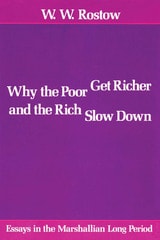
Why the Poor Get Richer and the Rich Slow Down
Essays in the Marshallian Long PeriodBy W. W. Rostow
University of Texas Press, 1980
Bearing on fundamental issues of economic theory, history, and public policy, this volume elaborates and goes beyond themes enunciated in W. W. Rostow's previous works. The eight essays presented here are unified by the author's insistence that neo-Keynesian and neoclassical theory are an inadequate basis for economic analysis and policy prescription. Changes in technology and in the supply of energy, food, and raw materials, he contends, must be taken into account. The scale and character of the investments required to respond to these changes link his analysis back to conventional income analysis. Rostow outlines in several contexts the framework for a general, disaggregated theory of production and prices that meets this criterion.
The theoretical and historical essays include a review and unification of various long-cycle theories; a formal mathematical model of the Kondratieff cycle; a review of theories relating technology and the price system, including Rostow's own formulation of the appropriate linkage; a lengthy analysis of the pre-1914 relation between money and prices, including a detailed critique of modern monetarist interpretations; and an analysis of the proposition that economic growth assumes an S-shaped path of acceleration and deceleration.
The policy essays include an examination of the links between energy-related investment, full employment, and patterns of regional development in the United States; the discussion of an appropriate framework and procedure for North-South international economic negotiations; and the text of a 1965 talk on inflation that touches on the relations among economics, economists, and the performance of societies as a whole.
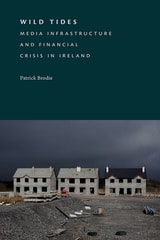
Wild Tides
Media Infrastructure and Financial Crisis in IrelandPatrick Brodie
Duke University Press, 2026

World Development
An IntroductionProdromos Panayiotopoulos
Pluto Press, 2001
World Development offers answers to these questions. A comprehensive introductory guide for students, teachers, volunteers and NGO workers in development, World Development examines the substantive issues surrounding development, industrialisation and globalization and places them within a historic context. It outlines the historical development of the world economy and assesses the current prospects for developing countries. The book contains in-depth analyses of how particular industries operate at local and global levels, drawing from case studies on textiles, tourism and copper. There are also case studies of specific countries, including South Korea, Cyprus, Mexico, China and Spain.