Results by title
218 books match the query 'Education, Higher' and 14 start with w
WPAing in a Pandemic and Beyond
Revision, Innovation, and AdvocacyTodd Ruecker
Utah State University Press, 2025
The chapters in this collection include a variety of voices who have been involved in writing program administration in recent years to reflect on the work done in this moment of crisis. Through both short vignettes and longer chapters, this book explores the complicated interactions between WPA work and navigating times of crisis to provide insights for moving forward. Authors explore a variety of topics including professional development, curricular change, advocating in the face of intransigent administrations and others, caring for students, and taking time for self-care. Pointing to specific actions for continued advocacy, WPAing in a Pandemic and Beyond will be of great interest to WPAs and writing studies scholars.
Weathering the Storm
Independent Writing Programs in the Age of Fiscal AusterityRichard N. Matzen Jr.
Utah State University Press, 2019
Leading writing specialists at the University of Texas at Austin, Syracuse University, the University of Minnesota, and many other institutions document and think carefully about the on-the-ground obstacles that have made the creation of IWPs unique. From institutional naysayers in English departments to skeptical administrators, IWPs and the faculty within them have surmounted not only negative economics but also negative rhetorics. This collection charts the story of this journey as writing faculty continually make the case for the importance of writing in the university curriculum.
Independence has, for the most part, allowed IWPs to better respond to the Great Recession, but to do so they have had to define writing studies in relation to other disciplines and departments. Weathering the Storm will be of great interest to faculty and graduate students in rhetoric and composition, writing program administrators, and writing studies and English department faculty.
Contributors: Linda Adler-Kassner, Lois Agnew, Alice Batt, David Beard, Davida Charney, Amy Clements, Diane Davis, Frank Gaughan, Heidi Skurat Harris, George H. Jensen, Rodger LeGrand, Drew M. Loewe, Mark Garrett Longaker, Cindy Moore, Peggy O’Neill, Chongwon Park, Louise Wetherbee Phelps, Mary Rist, Valerie Ross, John J Ruszkiewicz, Eileen E. Schell, Madeleine Sorapure, Chris Thaiss, Patrick Wehner, Jamie White-Farnham, Carl Whithaus, Traci A. Zimmerman
What Do You Think, Mr. Ramirez?
The American Revolution in EducationGeoffrey Galt Harpham
University of Chicago Press, 2017
That, says Harpham, was the midcentury promise of American education, the deep current of commitment and aspiration that undergirded the educational system that was built in the postwar years, and is under extended assault today. The United States was founded, he argues, on the idea that interpreting its foundational documents was the highest calling of opinion, and for a brief moment at midcentury, the country turned to English teachers as the people best positioned to train students to thrive as interpreters—which is to say as citizens of a democracy. Tracing the roots of that belief in the humanities through American history, Harpham builds a strong case that, even in very different contemporary circumstances, the emphasis on social and cultural knowledge that animated the midcentury university is a resource that we can, and should, draw on today.
What's the Use?
On the Uses of UseSara Ahmed
Duke University Press, 2019
Where You Stand Is Where You Sit
An Academic Administrator's HandbookRobert V. Smith
University of Arkansas Press, 2006
This handbook addresses the three key responsibilities of academic officers: inspiration, evaluation, and representation. “Getting a Good Start” deals with the promise of a new position, communicating with supervisors, and “getting around.” “Offering Inspiration and Direction” looks at the integrated scholar and “academic intrapreneurs”; diversity; the joys, challenges, and failure of professional life; and dealing with tragedies. “Guidance to Various Academic Administrators and Support Staff” examines the development, roles, and responsibilities of academic officers and institutional planning and budgeting. Reviewing the state of the institution and its personnel is covered in “Assessments and Evaluations,” and “Policies and Partnerships” deals with ethics-based policies, academic consortia and partnerships, and international outreach.
Throughout this valuable handbook, Smith offers background, advice, and examples that will interest both the novice and seasoned administrator as he takes us on a tour of success stories, challenges, and foibles.
White Scholars/African American Texts
Edited by Lisa A. Long
Rutgers University Press, 2005
What makes someone an authority? What makes one person's knowledge more credible than another's? In the ongoing debates over racial authenticity, some attest that we can know each other's experiences simply because we are all "human," while others assume a more skeptical stance, insisting that racial differences create unbridgeable gaps in knowledge.
Bringing new perspectives to these perennial debates, the essays in this collection explore the many difficulties created by the fact that white scholars greatly outnumber black scholars in the study and teaching of African American literature. Contributors, including some of the most prominent theorists in the field as well as younger scholars, examine who is speaking, what is being spoken and what is not, and why framing African American literature in terms of an exclusive black/white racial divide is problematic and limiting.
In highlighting the "whiteness" of some African Americanists, the collection does not imply that the teaching or understanding of black literature by white scholars is definitively impossible. Indeed such work is not only possible, but imperative. Instead, the essays aim to open a much needed public conversation about the real and pressing challenges that white scholars face in this type of work, as well as the implications of how these challenges are met.
Who Should Pay?
Higher Education, Responsibility, and the PublicNatasha Quadlin
Russell Sage Foundation, 2022
Who Should Pay? draws on a decade’s worth of public opinion surveys analyzing public attitudes about whether parents, students, or the government should be primarily responsible for funding higher education. Quadlin and Powell find that between 2010 and 2019, public opinion has shifted dramatically in favor of more government funding. In 2010, Americans overwhelming believed that parents and students were responsible for the costs of higher education. Less than a decade later, the percentage of Americans who believed that federal or state/local government should be the primary financial contributor has more than doubled. The authors contend that the rapidity of this change may be due to the effects of the 2008 financial crisis and the growing awareness of the social and economic costs of high levels of student debt. Quadlin and Powell also find increased public endorsement of shared responsibility between individuals and the government in paying for higher education. The authors additionally examine attitudes on the accessibility of college for all, whether higher education at public universities should be free, and whether college is worth the costs.
Quadlin and Powell also explore why Americans hold these beliefs. They identify individualistic and collectivist world views that shape public perspectives on the questions of funding, accessibility, and worthiness of college. Those with more individualistic orientations believed parents and students should pay for college, and that if students want to attend college, then they should work hard and find ways to achieve their goals. Those with collectivist orientations believed in a model of shared responsibility – one in which the government takes a greater level of responsibility for funding education while acknowledging the social and economic barriers to obtaining a college degree for many students. The authors find that these belief systems differ among socio-demographic groups and that bias – sometimes unconscious and sometimes deliberate – regarding race and class affects responses from both individualistic and collectivist-oriented participants.
Public opinion is typically very slow to change. Yet Who Should Pay? provides an illuminating account of just how quickly public opinion has shifted regarding the responsibility of paying for a college education and its implications for future generations of students.

Why Afterschool Matters
Nelson, Ingrid A.
Rutgers University Press, 2017
Why Afterschool Matters takes a different approach, closely following ten Mexican American students who attended the same extracurricular program in California, then chronicling its long-term effects on their lives, from eighth grade to early adulthood. Discovering that participation in the program was life-changing for some students, yet had only a minimal impact on others, sociologist Ingrid A. Nelson investigates the factors behind these very different outcomes. Her research reveals that while afterschool initiatives are important, they are only one component in a complex network of school, family, community, and peer interactions that influence the educational achievement of disadvantaged students.
Through its detailed case studies of individual students, this book brings to life the challenges marginalized youth en route to college face when navigating the intersections of various home, school, and community spheres. Why Afterschool Matters may focus on a single program, but its findings have major implications for education policy nationwide.
Working with Faculty Writers
Anne Ellen Geller and Michele Eodice
Utah State University Press, 2013
Contributors from a variety of institution types and perspectives consider who faculty writers are and who they may be in the future, reveal the range of locations and models of support for faculty writers, explore the ways these might be delivered and assessed, and consider the theoretical, philosophical, political, and pedagogical approaches to faculty writing support, as well as its relationship to student writing support.
With the pressure on faculty to be productive researchers and writers greater than ever, this is a must-read volume for administrators, faculty, and others involved in developing and assessing models of faculty writing support.
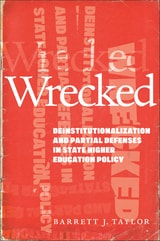
Wrecked
Deinstitutionalization and Partial Defenses in State Higher Education PolicyBarrett J. Taylor
Rutgers University Press, 2022
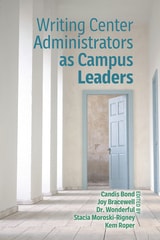
Writing Center Administrators as Campus Leaders
Candis Bond
Utah State University Press, 2026
Writing Center Administrators as Campus Leaders challenges the current erasure of the WCA role within discourse on campus leadership by highlighting the various ways these leaders have had transformative impacts on their institutions, emphasizing the wide range of knowledge, skills, and added value that WCAs bring to the university ecosystem.
Contributors from diverse institutions, institutional contexts, identity formations, and career paths theorize different forms of leadership from within and beyond writing centers. The first section brings together perspectives on leadership theory and practice, focusing on the practical gains offered and challenges afforded via writing center professional pathways. The second section emphasizes partnerships and networks forged through intentional and creative leadership models. In the final section, contributors consider the emotional and affective dimensions of WCA labor, offering multiple roadmaps for WCAs to transition their experiences into more recognition, resources, and broader administrative roles while underscoring the potential of inclusive, community-focused leadership for current and aspiring WCAs.
Providing key insights and practical examples, Writing Center Administrators as Campus Leaders validates and inspires current and future WCAs and informs university administrators on the ways that WCAs can and do impact higher education as true campus leaders.
Writing Instruction in Nineteenth-Century American Colleges
James A. Berlin. Foreword by Donald C. Stuart
Southern Illinois University Press, 1984
Defining a rhetoric as a social invention arising out of a particular time, place, and set of circumstances, Berlin notes that “no rhetoric—not Plato’s or Aristotle’s or Quintilian’s or Perelman’s—is permanent.” At any given time several rhetorics vie for supremacy, with each attracting adherents representing various views of reality expressed through a rhetoric.
Traditionally rhetoric has been seen as based on four interacting elements: “reality, writer or speaker, audience, and language.” As emphasis shifts from one element to another, or as the interaction between elements changes, or as the definitions of the elements change, rhetoric changes. This alters prevailing views on such important questions as what is appearance, what is reality.
In this interpretive study Berlin classifies the three 19th-century rhetorics as classical, psychological-epistemological, and romantic, a uniquely American development growing out of the transcendental movement. In each case studying the rhetoric provides insight into society and the beliefs of the people.
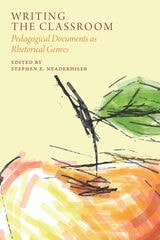
Writing the Classroom
Pedagogical Documents as Rhetorical Genresedited by Stephen E. Neaderhiser
Utah State University Press, 2022
The contributors to this unique collection employ a wide range of methodological frameworks to demonstrate how pedagogical genres—even ones as seemingly straightforward as the class syllabus—have lives extending well beyond the classroom as they become part of how college teachers represent their own academic identities, advocate for pedagogical values, and negotiate the many external forces that influence the act of teaching. Writing the Classroom shines a light on genres that are often treated as two-dimensional, with purely functional purposes, arguing instead that genres like assignment prompts, course proposals, teaching statements, and policy documents play a fundamental role in constructing the classroom and the broader pedagogical enterprise within academia.
Writing the Classroom calls on experienced teachers and faculty administrators to critically consider their own engagement with pedagogical genres and offers graduate students and newer faculty insight into the genres that they may only now be learning to inhabit as they seek to establish their personal teacherly identities. It showcases the rhetorical complexity of the genres written in the service of pedagogy not only for students but also for the many other audiences within academia that have a role in shaping the experience of teaching.
Contributors: Michael Albright, Lora Arduser, Lesley Erin Bartlett, Logan Bearden, Lindsay Clark, Dana Comi, Zack K. De Piero, Matt Dowell, Amy Ferdinandt Stolley, Mark A. Hannah, Megan Knight, Laura R. Micciche, Cindy Mooty, Dustin Morris, Kate Navickas, Kate Nesbit, Jim Nugent, Lori A. Ostergaard, Cynthia Pengilly, Jessica Rivera-Mueller, Christina Saidy, Megan Schoen, Virginia Schwarz, Christopher Toth
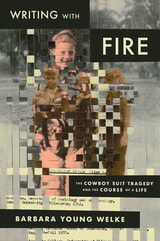
Writing with Fire
The Cowboy Suit Tragedy and the Course of a LifeBarbara Young Welke
University of Chicago Press, 2026
A cultural and legal history intertwined with a deeply emotional meditation on the course of life, memory, and the documents that define us.
During the 1940s and 1950s, an untold number of American children suffered devastating injuries when the fur-like fabric on the chaps of their Gene Autry–branded cowboy playsuits exploded into flame. Barbara Young Welke was researching this history when her teenage daughter unexpectedly died.
The shock of Welke’s loss transformed her understanding of the children and their families. Her experience also led her to question the norms of scholarship and of writing. Historians are trained to separate the personal from the intellectual, to be suspicious of emotion. These and other norms are embedded in and reinforced by the calling card of academics, the curriculum vitae. Welke wondered how that cold document—with its literal meaning, “the course of life”—had become a form that excludes so much of what gives life meaning. What impact did that have on what we know, how we know it, and how we understand ourselves? Similarly, Welke wondered, what might we see if we looked at the history of the cowboy suit tragedy as more than a matter of lawsuits brought by grieving families? Here, Welke traces the making, marketing, and selling of the cowboy suits; the lengths the defendants went to avoid and limit liability; and the meaning of the injuries, deaths, and legal settlements in the course of these children’s and families’ lives.
Writing with Fire interweaves the histories of the cowboy suit tragedy and the curriculum vitae. Grounded in archival and legal research, oral histories, and letters Welke wrote her daughter following her death, Welke offers an inimitable examination of trauma, law, autobiography, and identity. The result is revelatory and unforgettable: a provocative historical reflection on life and death, depression and war, markets and families, law, power, and precarity in modern America.