Results by title
81 books match the query 'Educational equalization' and 4 start with w
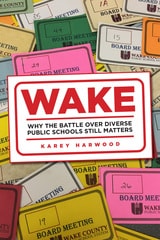
Wake
Why the Battle over Diverse Public Schools Still MattersKarey Alison Harwood
Rutgers University Press, 2024
The Wake County Public School System was once described as a beacon of hope for American school districts. It was both academically successful and successfully integrated. It accomplished these goals through the hard work of teachers and administrators, and through a student assignment policy that made sure no school in the countywide district became a high poverty school. Although most students attended their closest school, the “diversity policy” modified where some students were assigned to make sure no school had more than 40% of its students qualifying for free or reduced-price lunch or more than 25% performing below grade level. When the school board election of 2009 swept into office a majority who favored “neighborhood schools,” the diversity policy that had governed student assignment for years was eliminated. Wake: Why the Battle Over Diverse Public Schools Still Matters tells the story of the aftermath of that election, including the fierce public debate that ensued during school board meetings and in the pages of the local newspaper, and the groundswell of community support that voted in a pro-diversity school board in 2011. What was at stake in those years was the fundamental direction of the largest school district in North Carolina and the 14th largest in the U.S. Would it maintain a commitment to diverse schools, and if so, how would it balance that commitment with various competing interests and demands? Through hundreds of published opinion articles and several in depth interviews with community leaders, Wake examines the substance of that debate and explores the community’s vision for public education. Wake also explores the importance of knowing the history of a place, including the history of school segregation. Wake County’s example still resonates, and the battle over diverse public schools still matters, because owning responsibility for the problem of segregated schools (or not) will shape the direction of America’s future.
[more]
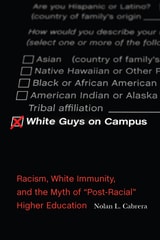
White Guys on Campus
Racism, White Immunity, and the Myth of "Post-Racial" Higher EducationCabrera, Nolan L
Rutgers University Press, 2019
Winner of the 2019 AERA Division J Outstanding Publication Award and the 2019 ASHE Outstanding Book Award
On April 22, 2015, Boston University professor Saida Grundy set off a Twitter storm with her provocative question: “Why is white America so reluctant to identify white college males as a problem population?” White Guys on Campus is a critical examination of race in higher education, centering Whiteness, in an effort to unveil the frequently unconscious habits of racism among White male undergraduates. Nolan L. Cabrera moves beyond the “few bad apples” frame of contemporary racism, and explores the structures, policies, ideologies, and experiences that allow racism to flourish. This book details many of the contours of contemporary, systemic racism, while engaging the possibility of White students to participate in anti-racism. Ultimately, White Guys on Campus calls upon institutions of higher education to be sites of social transformation instead of reinforcing systemic racism, while creating a platform to engage and challenge the public discourse of “post- racialism.”
On April 22, 2015, Boston University professor Saida Grundy set off a Twitter storm with her provocative question: “Why is white America so reluctant to identify white college males as a problem population?” White Guys on Campus is a critical examination of race in higher education, centering Whiteness, in an effort to unveil the frequently unconscious habits of racism among White male undergraduates. Nolan L. Cabrera moves beyond the “few bad apples” frame of contemporary racism, and explores the structures, policies, ideologies, and experiences that allow racism to flourish. This book details many of the contours of contemporary, systemic racism, while engaging the possibility of White students to participate in anti-racism. Ultimately, White Guys on Campus calls upon institutions of higher education to be sites of social transformation instead of reinforcing systemic racism, while creating a platform to engage and challenge the public discourse of “post- racialism.”
[more]
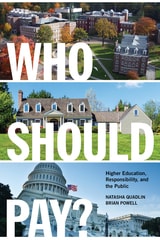
Who Should Pay?
Higher Education, Responsibility, and the PublicNatasha Quadlin
Russell Sage Foundation, 2022
Americans now obtain college degrees at a higher rate than at any time in recent decades in the hopes of improving their career prospects. At the same time, the rising costs of an undergraduate education have increased dramatically, forcing students and families to take out often unmanageable levels of student debt. The cumulative amount of student debt reached nearly $1.5 trillion in 2017, and calls for student loan forgiveness have gained momentum. Yet public policy to address college affordability has been mixed. While some policymakers support more public funding to broaden educational access, others oppose this expansion. Noting that public opinion often shapes public policy, sociologists Natasha Quadlin and Brian Powell examine public opinion on who should shoulder the increasing costs of higher education and why.
Who Should Pay? draws on a decade’s worth of public opinion surveys analyzing public attitudes about whether parents, students, or the government should be primarily responsible for funding higher education. Quadlin and Powell find that between 2010 and 2019, public opinion has shifted dramatically in favor of more government funding. In 2010, Americans overwhelming believed that parents and students were responsible for the costs of higher education. Less than a decade later, the percentage of Americans who believed that federal or state/local government should be the primary financial contributor has more than doubled. The authors contend that the rapidity of this change may be due to the effects of the 2008 financial crisis and the growing awareness of the social and economic costs of high levels of student debt. Quadlin and Powell also find increased public endorsement of shared responsibility between individuals and the government in paying for higher education. The authors additionally examine attitudes on the accessibility of college for all, whether higher education at public universities should be free, and whether college is worth the costs.
Quadlin and Powell also explore why Americans hold these beliefs. They identify individualistic and collectivist world views that shape public perspectives on the questions of funding, accessibility, and worthiness of college. Those with more individualistic orientations believed parents and students should pay for college, and that if students want to attend college, then they should work hard and find ways to achieve their goals. Those with collectivist orientations believed in a model of shared responsibility – one in which the government takes a greater level of responsibility for funding education while acknowledging the social and economic barriers to obtaining a college degree for many students. The authors find that these belief systems differ among socio-demographic groups and that bias – sometimes unconscious and sometimes deliberate – regarding race and class affects responses from both individualistic and collectivist-oriented participants.
Public opinion is typically very slow to change. Yet Who Should Pay? provides an illuminating account of just how quickly public opinion has shifted regarding the responsibility of paying for a college education and its implications for future generations of students.
[more]
Writing Placement in Two-Year Colleges
The Pursuit of Equity in Postsecondary EducationJessica Nastal
University Press of Colorado, 2023
Writing Placement in Two-Year Colleges brings together two-year college teacher-scholar-activists from across the U.S. to share stories, strategies, and data about local efforts at reforming writing placement assessment to advance educational access and equity. The chapters in this edited collection help faculty and writing program administrators navigate the shifting landscape of placement in the 2020s. Contributors demonstrate how two-year colleges have addressed local and state-level pressures for reform, especially at a time when the nation has been rocked by the COVID-19 pandemic with its inequitable economic, social, and physical toll.
[more]