Results by title
153 books match the query 'Egypt' and 9 start with w
When Egypt Ruled the East
George Steindorff and Keith C. Steele
University of Chicago Press, 1963
When Lincoln Came to Egypt
George W. Smith, with a Foreword by Daniel W. Stowell
Southern Illinois University Press, 2017
Why War?
The Cultural Logic of Iraq, the Gulf War, and SuezPhilip Smith
University of Chicago Press, 2005
Comprised of case studies of the War in Iraq, the Gulf War, and the Suez Crisis, Why War? decodes the cultural logic of the narratives that justify military action. Each nation, Smith argues, makes use of binary codes—good and evil, sacred and profane, rational and irrational, to name a few. These codes, in the hands of political leaders, activists, and the media, are deployed within four different types of narratives—mundane, tragic, romantic, or apocalyptic. With this cultural system, Smith is able to radically recast our "war stories" and show how nations can have vastly different understandings of crises as each identifies the relevant protagonists and antagonists, objects of struggle, and threats and dangers.
The large-scale sacrifice of human lives necessary in modern war, according to Smith, requires an apocalyptic vision of world events. In the case of the War in Iraq, for example, he argues that the United States and Britain replicated a narrative of impending global doom from the Gulf War. But in their apocalyptic account they mistakenly made the now seemingly toothless Saddam Hussein once again a symbol of evil by writing him into the story alongside al Qaeda, resulting in the war's contestation in the United States, Britain, and abroad.
Offering an innovative approach to understanding how major wars are packaged, sold, and understood, Why War? will be applauded by anyone with an interest in military history, political science, cultural studies, and communication.
Wine, Wealth, and the State in Late Antique Egypt
The House of Apion at OxyrhynchusT. M. Hickey
University of Michigan Press, 2012
The "glorious house" of the senatorial family of the Flavii Apiones is the best documented economic entity of the Roman Empire during the fifth through seventh centuries, that critical period of transition between the classical world and the Middle Ages. For decades, the rich but fragmentary manuscript evidence that this large agricultural estate left behind, preserved for 1,400 years by the desiccating sands of Egypt, has been central to arguments concerning the agrarian and fiscal history of Late Antiquity, including the rise of feudalism.
Wine, Wealth, and the State in Late Antique Egypt is the most authoritative synthesis concerning the economy of the Apion estate to appear to date. T. M. Hickey examines the records of the family's wine production in the sixth century in order to shed light on ancient economic practices and economic theory, as well as on the wine industry and on estate management. Based on careful study of the original manuscripts, including unpublished documents from the estate archive, he presents controversial conclusions, much at odds with the "top down" models currently dominating the scholarship.
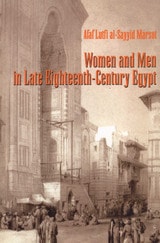
Women and Men in Late Eighteenth-Century Egypt
By Afaf Lutfi al-Sayyid Marsot
University of Texas Press, 1995
In the late eighteenth century, decentralized and chaotic government in Egypt allowed women a freedom of action that has not been equaled until recent times. Delving extensively into archival sources, Afaf Marsot presents the first comprehensive picture of women's status and opportunities in this period.
Marsot makes important connections between forms of government, economic possibilities, and gender relations, showing how political instability allowed women to acquire property, independent of males, as a hedge against political uncertainty. She traces the linkages that women formed among themselves and with the ulama (non-Ottoman native elites) who aided and supported them. The book concludes with a comparison of women's status in the nineteenth century, when the introduction of European institutions that did not recognize their legal existence marginalized women, causing them to have to rely on men as major breadwinners. These important findings about the relationship between forms of government and the status of women will be of interest to a wide audience.
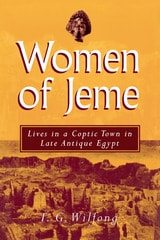
Women of Jeme
Lives in a Coptic Town in Late Antique EgyptT.G. Wilfong
University of Michigan Press, 2002
Contrary to the submissive, demure ideals for women proposed by the religious writers of Christian Egypt, the evidence from Jeme points to a more complex, dynamic situation. Women were active in the home, but some also played important and visible parts in the religious and economic life of their community. A bishop's attempts to monitor the behavior of the women in his district, the intricate inheritance dispute between an aunt and her niece, one woman's pious donations of murals to a church, three women's agonized decisions to give up their children to the local monastery, and the transactions of a family of women moneylenders--all these episodes paint a vivid picture of life in a Coptic town.
Although the remains of Jeme have long been known to scholars, little synthetic work has been done on this rich source for social history in Egypt before and after the Muslim conquests. The Women of Jeme is the first book-length study of the evidence. It will be of interest to Egyptologists and papyrologists, as well as to scholars of Coptic studies, early Christianity, social history and women's studies. The book assumes no prior knowledge of the subject, and the author has taken care to make it accessible to anyone with an interest in the ancient world.
T. G. Wilfong is Assistant Professor of Egyptology and Assistant Curator for Greco-Roman Egypt, University of Michigan.
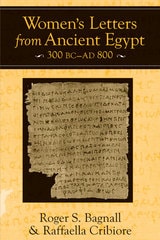
Women's Letters from Ancient Egypt, 300 BC-AD 800
Roger S. Bagnall and Raffaella Cribiore
University of Michigan Press, 2015
More than three hundred letters written in Greek and Egyptian by women in Egypt in the millennium from Alexander the Great to the Arab conquest survive on papyrus and pottery. These letters were written by women from various walks of life and shed light on critical social aspects of life in Egypt after the pharaohs. Roger S. Bagnall and Raffaella Cribiore collect the best preserved of these letters in translation and set them in their paleographic, linguistic, social, and economic contexts. As a result, Women's Letters from Ancient Egypt, 300 BC-AD 800, provides a sense that these women's habits, interests, and means of expression were a product more of their social and economic standing than of specifically gender-related concerns or behavior.
Women's Letters from Ancient Egypt, 300 BC-AD 800, takes the reader through theoretical discussions about the handwriting and language of the letters, the education and culture of the writers, and the writers' everyday concerns and occupations, as well as comparing these letters to similar letters from later historical periods. For each letter, discussion focuses on handwriting, language, and content; in addition, numerous illustrations help the reader to see the variety of handwritings. Most of this material has never been available in English translation before, and the letters have never previously been considered as a single body of material.
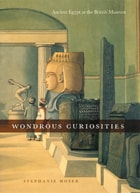
Wondrous Curiosities
Ancient Egypt at the British MuseumStephanie Moser
University of Chicago Press, 2006
When the British Museum opened its doors more than two centuries ago, scores of visitors waited eagerly outside for a first glimpse of ancient relics from Egypt, Greece, and Rome. Even today, in this age of satellite television and high-speed Internet access, museums maintain their unique allure, continuing to play a vital role in connecting us with little-known terrains and the deep mysteries of our historical past. That’s because, as Stephanie Moser argues in Wondrous Curiosities, museum displays don’t just transmit knowledge—they actually create it.
Based on her exploration of the British Museum’s world-famous collection of Egyptian antiquities, this pioneering study reveals the powerful role of museums in shaping our understanding of science, culture, and history. Drawing on guidebooks and archival documents, Moser demonstrates that this British exhibition of ancient Egyptian artifacts was central to the way we came to define the remarkable society that produced them. And she also reveals the specific strategies—such as using pattern and symmetry, juxtaposing different types of objects, and singling out particular items—that the British Museum and others used, and still use, in representing the past. With a wealth of illustrations and a detailed account of how the museum acquired and displayed its Egyptian collections, Wondrous Curiosities will fascinate curators and scholars of British history, Egyptology, art history, archaeology, and the history of science.
Working Out Egypt
Effendi Masculinity and Subject Formation in Colonial Modernity, 1870–1940Wilson Chacko Jacob
Duke University Press, 2011