Results by title
79 books match the query 'Election' and 6 start with w
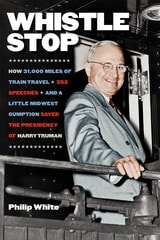
Whistle Stop
How 31,000 Miles of Train Travel, 352 Speeches, and a Little Midwest Gumption Saved the Presidency of Harry TrumanPhilip White
University Press of New England, 2015
Why Americans Split Their Tickets
Campaigns, Competition, and Divided GovernmentBarry C. Burden and David C. Kimball
University of Michigan Press, 2004
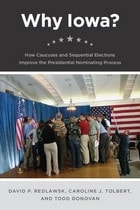
Why Iowa?
How Caucuses and Sequential Elections Improve the Presidential Nominating ProcessDavid P. Redlawsk, Caroline J. Tolbert, and Todd Donovan
University of Chicago Press, 2010
If Barack Obama had not won in Iowa, most commentators believe that he would not have been able to go on to capture the Democratic nomination for president. Why Iowa? offers the definitive account of those early weeks of the campaign season: from how the Iowa caucuses work and what motivates the candidates’ campaigns, to participation and turnout, as well as the lingering effects that the campaigning had on Iowa voters. Demonstrating how “what happens in Iowa” truly reverberates throughout the country, five-time Iowa precinct caucus chair David P. Redlawsk and his coauthors take us on an inside tour of one of the most media-saturated and speculated-about campaign events in American politics.
Considering whether a sequential primary system, in which early, smaller states such as Iowa and New Hampshire have such a tremendous impact is fair or beneficial to the country as a whole, the authors here demonstrate that not only is the impact warranted, but it also reveals a great deal about informational elements of the campaigns. Contrary to conventional wisdom, this sequential system does confer huge benefits on the nominating process while Iowa’s particularly well-designed caucus system—extensively explored here for the first time—brings candidates’ arguments, strengths, and weaknesses into the open and under the media’s lens.
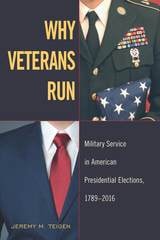
Why Veterans Run
Military Service in American Presidential Elections, 1789-2016Jeremy M. Teigen
Temple University Press, 2017
The assumptions that military service helps candidates attract votes—while lacking it harms a candidate’s chances—has been an article of faith since the electoral coronation of George Washington in 1789. Perhaps the most compelling fact driving the perception that military service helps win votes is the large number of veterans who have held public office. Some candidates even exaggerate their military service to persuade voters. However, sufficient counter-examples undermine the idea that military veterans enjoy an advantage when seeking political office.
In Why Veterans Run, Jeremy Teigenexplains the tendency of parties to elevate those with armed forces experience to run for high office. He describes the veteran candidate phenomenon by examining the related factors and patterns, showing why different eras have more former generals running and why the number of veterans in election cycles varies. With both quantitative and qualitative analysis, Why Veterans Run investigates each postwar era in U.S. electoral history and elaborates why so many veterans run for office. Teigen also reveals how election outcomes with veteran candidates illuminate the relationship between the military and civilian spheres as well as the preferences of the American electorate.
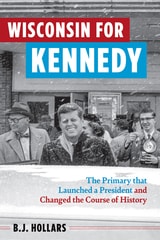
Wisconsin for Kennedy
The Primary That Launched a President and Changed the Course of HistoryB. J. Hollars
Wisconsin Historical Society Press, 2024
When John F. Kennedy ran for president in 1960, he did something no candidate had done before: he leveraged the power of state primaries to win his party’s nomination. Kennedy’s first battleground state? Wisconsin—a state that would prove more arduous, more exhausting, and more crucial to winning the presidency than any other.
Wisconsin for Kennedy brings to life the stories behind JFK’s history-making 1960 Wisconsin primary campaign, and how Kennedy’s team managed to outmaneuver his politically seasoned opponent, Hubert Humphrey. From Jackie Kennedy commandeering a supermarket loudspeaker in Kenosha, to the Wisconsin forklift driver who planned President Kennedy’s final trip to Dallas, this captivating book places readers at the heart of the action.
Author B.J. Hollars chronicles JFK’s nail-biting Wisconsin win by drawing on rarely cited oral histories from the eclectic team of people who worked together to make it happen: a cranberry farmer, a union leader, a mayor, an architect, and others. Wisconsin for Kennedy explores how Wisconsin helped propel JFK all the way to the White House in a riveting historical account that reads like a work of rollicking, page-turning fiction.
“In the spirit of Theodore H. White’s The Making of The President: 1960, B.J. Hollars offers a vivid account of the Wisconsin primary that launched JFK’s successful presidential campaign, inspiring voters to pass the torch to a new generation of leadership for our country. Anyone mesmerized by JFK’s legacy will enjoy this great read.”
—Former US Representative Ron Kind
“For generations, my family has had the great privilege of serving the people of Wisconsin. In Wisconsin for Kennedy, B.J. Hollars performs his own act of service, recounting the riveting and untold story of Wisconsin’s politically perilous 1960 primary. A poignant contribution to political history that reads like a page-turner.”
—Former Wisconsin Governor James Doyle Jr.
"A hopeful quality . . . pervades Wisconsin for Kennedy, written about a time and place when politics was conducted in a less severe and divisive way than it is now. Hollars further succeeds in showing how political history is made by a wide range of citizens. Wisconsinites, Midwesterners, and indeed Americans of all political persuasions can be grateful to B.J. Hollars for these important reminders."
— Middle West Review
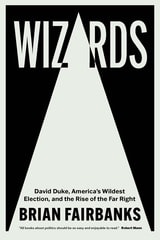
Wizards
David Duke, America's Wildest Election, and the Rise of the Far RightBrian Fairbanks
Vanderbilt University Press, 2022
A surging Republican populist.
The Democrat, hounded by corruption allegations; the Republican, dogged by business failures and ties to white supremacists.
The Republican turned out thousands of screaming supporters for speeches blaming illegal immigrants and crime on the Democrats, and the Democrat plummeted in the polls.
Sound familiar?
The '91 Louisiana Governor's race was supposed to be forgettable. But when former KKK Grand Wizard David Duke shocked the nation by ousting incumbent Republican Governor Buddy Roemer in the primary, the world took notice. Democrat Edwin Edwards, a former three-term governor and two-time corruption defendant, was left alone to face Duke in the general election—and he was going to lose.
Then a little-known state committeewoman stepped in with evidence of Duke's nefarious past. Could her evidence be enough to sway the minds of fired-up voters, or would Louisiana welcome a far-right radical into the highest office in the state?
Journalist Brian Fairbanks explores how the final showdown between Duke and Edwards in November 1991 led to a major shift in our national politics, as well as the rise of the radical right and white supremacist groups, and how history repeated itself in the 2016 presidential election. The story of these political "wizards," almost forgotten by history, remains eerily prescient and disturbingly relevant, and a compulsive page-turner.