Results by title
158 books match the query 'End' and 3 start with w

Waiting For The Revolution To End
Syrian Displacement, Time and SubjectivityCharlotte Al-Khalili
University College London, 2023
Based on more than three years of embedded fieldwork with Syrians displaced in the border city of Gaziantep (southern Turkey), this book places the Syrian revolution and its tragic aftermath under ethnographic scrutiny. It charts the evolution from peaceful uprising (2011) to armed confrontation (2012), descent into fully fledged conflict (2013) and finally to proxy war (2015), to propose an understanding of revolution beyond success and failure.
While the Assad regime remains in place, the Syrian revolution (al-thawra) still holds a transformational power that can be located on intimate and world-making scales. Charlotte Al-Khalili traces the unintended consequences of revolution to reveal the reshaping of Syrian life-worlds and exiles’ evolving theorizations, experiences, and imaginations of al-thawra. She describes the in-between spatio-temporal realm inhabited by Syrians displaced to Turkey as they await the revolution’s outcomes and maps the revolution’s multidimensional and multi-scalar effects on their everyday life. By following the chronology of events inside Syria and Syrians’ geography of displacement, Waiting for the Revolution to End makes the relation between revolution and displacement its centerpiece, both as an ethnographic object and an analytical device.
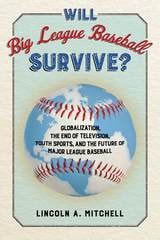
Will Big League Baseball Survive?
Globalization, the End of Television, Youth Sports, and the Future of Major League BaseballLincoln A. Mitchell
Temple University Press, 2016
Major League Baseball is a beloved American institution that has been a product of the economic, social, and media structures that have evolved in the United States over the last century. In his shrewd analysis, Will Big League Baseball Survive?, Lincoln Mitchell asks whether the sport will continue in its current form as a huge, lucrative global business that offers a monopoly in North America—and whether those structures are sustainable.
Mitchell places baseball in the context of the larger, evolving American and global entertainment sector. He examines how both changes directly related to baseball—including youth sports and the increased globalization of the game—as well as broader societal trends such as developments in media consumption and celebrity culture will impact big league baseball over the next few decades.
His book ultimately proposes several possible scenarios for what big league baseball might look like. Will it become more global, smaller, or remain the same, or will it transform into some kind of hybrid of the three?
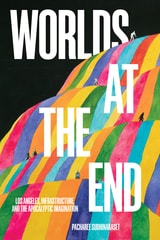
Worlds at the End
Los Angeles, Infrastructure, and the Apocalyptic ImaginationPacharee Sudhinaraset
Temple University Press, 2024
Worlds at the End analyzes destruction, rupture, and continuance through texts ranging from Karen Tei Yamashita’s Tropic of Orange, which considers racial colonial infrastructure, to the work of Diné poet Esther Belin, which illuminates how the separation between the Indian reservation and LA is part of a broader infrastructural network of termination. And she unpacks Octavia Butler’s post-apocalyptic novel, Parable of the Sower, where LA’s freeways and roadways are routes of forced migration, colonization, and flight.
Tearing down existing institutions that marginalize people of color and moving past them, Worlds at the End highlights the imaginaries of those subjugated, racialized, and made other, for whom modernity, freedom, and progress meant violence, brutality, and relegation to the status of devalued surplus populations. As Sudhinaraset deftly shows, the apocalypse marks moments of historical and spatial transition, offering stories of doomsdays that will give rise to resurgence and regeneration.