Results by title
240 books match the query 'English as a Second Language' and 19 start with w
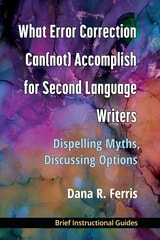
What Error Correction Can(not) Accomplish for Second Language Writers
Dispelling Myths, Discussing OptionsDana R. Ferris
University of Michigan Press, 2018
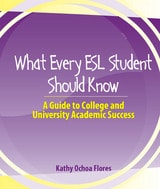
What Every ESL Student Should Know
A Guide to College and University Academic SuccessKathy Ochoa Flores
University of Michigan Press, 2008
This book teaches English language learners about language learning and classroom expectations. It is a compilation of advice, experiences, suggestions, strategies, and learning theories collected over many years of teaching this population.
What Every ESL Student Should Know was written to help English language learners be successful in community college and college classrooms—specifically, how to prepare students for expectations and behavior within the classroom and how to help them to be good students, how to participate in class, what to expect from the class, and what to do to learn English. Learning strategies and language theories are presented in brief.
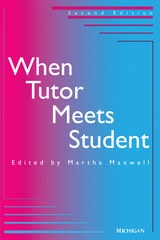
When Tutor Meets Student
Martha Maxwell, Editor
University of Michigan Press, 1994
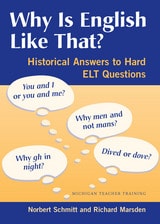
Why Is English Like That?
Historical Answers to Hard ELT QuestionsNorbert Schmitt and Richard Marsden
University of Michigan Press, 2006
The book outlines the historical events that shaped English; describes how its grammar, vocabulary, spelling, and pronunciation developed over time; and highlights the "quirks" and "exceptions" in English that can be explained on a historical basis. By understanding how the English of today evolved from the English of past times, both teachers and students will be more comfortable with the many conventions of the English language.
Why Is English Like That? also contains reproducible grammar and vocabulary exercises that will help teachers incorporate some of this historical knowledge into classroom activities. This book was written with English language teachers in mind, and the exercises are designed for ESL/EFL students, but it may also be used by teachers in training (L1 and L2).

Words around Us . . . and Effective Ways to Use Them
W. D. Sheeler and R. W. Markley
University of Michigan Press, 2000
Words for Students of English, Vol. 1
A Vocabulary Series for ESLHolly Deemer Rogerson, Betsy Davis, Suzanne T. Hershelman, and Carol Jasnow
University of Michigan Press, 1992
Words for Students of English, Vol. 2
A Vocabulary Series for ESLHolly Deemer Rogerson, Gary Esarey, Linda M. Schmandt, and Dorolyn A. Smith
University of Michigan Press, 1992
Words for Students of English, Vol. 3
A Vocabulary Series for ESLHolly Deemer Rogerson, Suzanne T. Hershelman, Carol Jasnow, and Carol Moltz
University of Michigan Press, 1992
Words for Students of English, Vol. 4
A Vocabulary Series for ESLHolly Deemer Rogerson, Gary Esarey, Suzanne T. Hershelman, Carol Jasnow, Carol Moltz, Linda M. Schmandt, and Dorolyn A. Smith
University of Michigan Press, 1992
Words for Students of English, Vol. 5
A Vocabulary Series for ESLHolly Deemer Rogerson, Suzanne T. Hershelman, and Carol Jasnow
University of Michigan Press, 1992
Volume 5 consists of 25 units that present basewords with definitions, usage examples, and exercises. Each unit focuses on a specific topic, carefully selected for its relevance to students' lives, so that students can practice new words in meaningful contexts. The exercises are flexible and easy to use, taking students from simple, fairly controlled practice to a final phase of communicative exercise. A list of words covered in previous volumes in included.
SKILL LEVEL: High-Intermediate
Words for Students of English, Vol. 6
A Vocabulary Series for ESLHolly Deemer Rogerson, Gary Esarey, Suzanne T. Hershelman, Carol Jasnow, Linda M. Schmandt, Dorolyn A. Smith, and Courtenay Meade Snellings
University of Michigan Press, 1992
Words for Students of English, Vol. 7
A Vocabulary Series for ESLHolly Deemer Rogerson
University of Michigan Press, 1992
Words for Students of English, Volume 8
A Vocabulary Series for ESLDawn E. McCormick, Lionel Menasche, Marilyn Smith Slaathaug, and Judith L. Yogman
University of Michigan Press, 2004
Workbook for Keys to Teaching Grammar to English Language Learners, Second Ed.
Keith S. Folse and Ekaterina V. Goussakova
University of Michigan Press, 2017
The Workbook has been updated to reflect new content in the Second Edition of the Handbook and once again features exercises that carefully follow the sequence of material in the Handbook. To facilitate use of the Workbook with the Handbook, each exercise is coded with the corresponding pages for the material in the Handbook. Reflecting the different learning styles in any given class, the exercises practice identifying grammatical features in a variety of different ways, including many charts, matching activities, and short answer questions. In addition, the Workbook has a variety of exercises consisting of sentences typical of English language learners so that teachers can become familiar with specific types of errors that ESL students make with certain grammar points.
The Workbook also features some action research projects to guide teachers in collecting small samples of data from their target student populations.
Workbook for The ESL Writer's Handbook, 2nd Edition
Janine Carlock, Maeve Eberhardt, Jaime Horst, and Lionel Menasche
University of Michigan Press, 2018
The new edition of the Workbook includes 85 exercises to facilitate students’ understanding of some of the most complex or troublesome writing areas discussed in the Handbook. Exercises have been revised, and new exercises have been added to Sections 4 (Research Paper) and 5 (Grammar and Style).
Workbook for The ESL Writer's Handbook, 3rd Edition
Janine Carlock, Maeve Eberhardt, Jaime Horst
University of Michigan Press, 2025
CEFR Levels: B1–C2
Writing Myths
Applying Second Language Research to Classroom TeachingJoy Reid with Keith S. Folse, Cynthia M. Schuemann, Pat Byrd and John Bunting, Ken Hyland, Dana Ferris, Susan Conrad, Sharon Cavusgil, Paul Kei Matsuda
University of Michigan Press, 2008
This volume was conceived as a "best practices" resource for writing teachers in the way that Vocabulary Myths by Keith S. Folse is one for reading and vocabulary teachers. It was written to help ensure that writing teachers are not perpetuating the myths of teaching writing.
Each author is a practicing teacher who selected his or her "myth" based on classroom experience and expertise. Both the research and pedagogy in this book are based on the newest research in, for example, teacher preparation, EAP and ESP, and corpus linguistics. The myths discussed in this book are:
§ Teaching vocabulary is not the writing teacher's job. (Keith S. Folse)
§ Teaching citation is someone else's job. (Cynthia M. Schuemann)
§ Where grammar is concerned, one size fits all. (Pat Byrd and John Bunting)
§ Academic writing should be assertive and certain. (Ken Hyland)
§ Students must learn to correct all their writing errors. (Dana Ferris)
§ Corpus-based research is too complicated to be useful for writing teachers. (Susan Conrad)
§ Academic writing courses should focus on paragraph and essay development. (Sharon Cavausgil)
§ International and U.S. resident ESL writers cannot be taught in the same class. (Paul Kei Matsuda)
The book concludes with a discussion of students' myths about academic writing and teaching written by Joy Reid.
Writing Together
Building Social Writing Opportunities for Graduate StudentsRachael Cayley, Fiona Coll, and Daniel Aureliano Newman
University of Michigan Press, 2025
Writing Together gathers accounts from graduate writing professionals about how social writing programs are imagined and delivered. It surveys the motivations, rationales, evaluation strategies, and structures that underpin these initiatives in order to create a practical resource for writing professionals who wish to establish or refine their own offerings. Rather than presenting “how to” approaches, the book presents “how we” accounts that enable readers to learn from the creative practices and experiences of others. By capturing a range of experiences, institutional models, and forms of social writing support, Writing Together explains the thinking behind social writing initiatives and the processes through which those initiatives have been assessed. It demonstrates that social writing practices are not just a means to an end, but an end in themselves—that writing together is a great way to write and a promising basis for graduate writing pedagogy and professional development.
Writing on the Wall
Writing Education and Resistance to Isolationismedited by David S. Martins, Brooke R. Schreiber & Xiaoye You
Utah State University Press, 2022
The collection extends existing scholarship and research about the ways racist and colonial rhetorics impact writing education; the impact of translingual, transnational, and cosmopolitan ideologies on student learning and student writing; and the role international educational partnerships play in pushing back against isolationist ideologies. Established and early-career scholars who work in a broad range of institutional contexts highlight the historical connections among monolingualism, racism, and white nationalism and introduce community- and classroom-based practices that writing teachers use to resist isolationist beliefs and tendencies.
“Writing on the wall” serves as a metaphor for the creative, direct action writing education can provide and invokes border spaces as sites of identity expression, belonging, and resistance. The book connects transnational writing education with the fight for racial justice in the US and around the world and will be of significance to secondary and postsecondary writing teachers and graduate students in English, linguistics, composition, and literacy studies.
Contributors: Olga Aksakalova, Sara P. Alvarez, Brody Bluemel, Tuli Chatterji, Keith Gilyard, Joleen Hanson, Florianne Jimenez Perzan, Rebecca Lorimer Leonard, Layli Maria Miron, Tony D. Scott, Kate Vieira, Amy J. Wan